Anurag Thakur Hails Anti-Paper-Leak Bill Passed by Both Houses
Synopsis
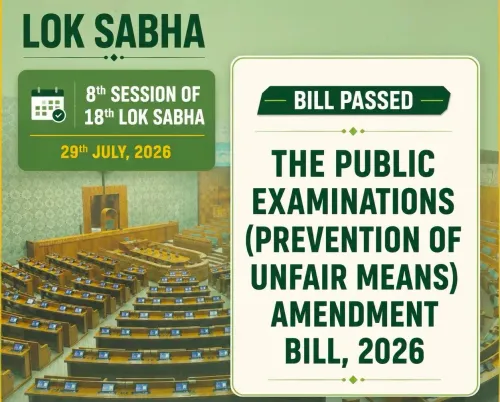
The Public Examinations (Prevention of Unfair Means) Amendment Bill, 2026 cleared both Lok Sabha and Rajya Sabha after two days of debate. BJP MP Anurag Thakur hailed it as a historic step to protect crores of competitive exam aspirants and restore credibility to India's examination system.
Key Takeaways
The Public Examinations (Prevention of Unfair Means) Amendment Bill, 2026 was passed by both Lok Sabha and Rajya Sabha following two days of detailed parliamentary debate.
BJP MP Anurag Thakur called the passage 'a historic and decisive step' to secure the future of crores of hardworking youth.
The bill amends the Public Examinations (Prevention of Unfair Means) Act, 2024 , which was itself enacted in response to repeated paper leak scandals.
High-profile exam integrity crises involving NEET and UGC-NET , conducted by the NTA , were key drivers behind successive legislative action.
The notification of rules under the amended Act will be the critical next step determining real-world enforcement.
Crores of young Indians who grind through years of preparation for competitive exams got a legislative shield this week — and BJP MP Anurag Thakur is calling it historic. On Friday, July 31, 2026, Thakur took to X to welcome the passage of the Lok Pariksha (Uchit Sadhan Nivaran) Sanshodhan Vidheyak, 2026 — the Public Examinations (Prevention of Unfair Means) Amendment Bill, 2026 — through both houses of Parliament, declaring that the gang exploiting the futures of India's children will not be spared under any circumstances.
Thakur wrote: 'देश के बच्चों के भविष्य से खिलवाड़ करने वाली गैंग को किसी भी हालत में बख्शा नहीं जाएगा' — 'The gang that plays with the future of the country's children will not be spared under any circumstances.' He described the bill's passage through Lok Sabha and Rajya Sabha following two days of detailed debate as 'a historic and decisive step' toward securing the future of the country's hardworking youth and making the examination system more credible.
From NEET Shock to Parliamentary Action
The amendment builds on the Public Examinations (Prevention of Unfair Means) Act, 2024 — itself a direct legislative response to a cascade of paper leak scandals that shook public confidence in India's high-stakes testing infrastructure. Examinations conducted by bodies including UPSC, SSC, and the National Testing Agency (NTA) were repeatedly compromised, with the NEET and UGC-NET controversies becoming flashpoints for student protests across the country.
The 2024 Act introduced stringent penalties and centralised oversight, but the scale and persistence of malpractice networks evidently demanded a sharper legislative instrument. The 2026 amendment, after extended floor debate in both chambers, now moves toward the notification of rules that will determine how — and how fast — the law bites.
What Parliament Debated Over Two Days
Both houses gave the bill extensive floor time — unusual for legislation of this nature — signalling cross-party acknowledgement that exam integrity has become a national crisis, not a partisan talking point. Thakur, who previously held the Information & Broadcasting and Youth Affairs & Sports portfolios, has consistently positioned youth welfare as a core legislative priority. His post frames the bill not as a government achievement but as a victory for 'crores of hardworking young people' of the country.
The next test is implementation: the notification of rules under the amended Act and the robustness of enforcement mechanisms will determine whether this legislation remains a statement of intent or becomes a genuine deterrent. India's paper-leak networks have proven adaptable. The law now has to be faster.
Point of View
Championing this bill allows the party to reclaim a youth-welfare narrative that took a significant hit during the NEET controversy. The real political and policy test, however, lies entirely ahead: if enforcement under the amended law fails to produce visible prosecutions, the legislation risks becoming another symbolic gesture rather than a structural fix for India's compromised examination ecosystem.
NationPress
15 Sept 2026
Frequently Asked Questions
What is the Public Examinations Amendment Bill 2026?
The Public Examinations (Prevention of Unfair Means) Amendment Bill, 2026 is a parliamentary legislation that amends the 2024 Act to further strengthen measures against paper leaks and malpractice in government-conducted competitive examinations in India.
Has the anti-paper-leak bill been passed by Parliament?
Yes. The bill was passed by both Lok Sabha and Rajya Sabha following two days of debate, as confirmed by BJP MP Anurag Thakur on July 31, 2026.
What exams does the paper leak law cover in India?
The law targets public examinations conducted by central bodies such as UPSC, SSC, and the National Testing Agency (NTA), which administers tests including NEET and UGC-NET.
What was the original Public Examinations Act 2024?
The Public Examinations (Prevention of Unfair Means) Act, 2024 was enacted by Parliament to prohibit unfair practices and paper leaks in public examinations, introducing stricter penalties and centralised oversight after a series of high-profile exam scandals.
What happens after the anti-paper-leak bill is passed?
The government must notify rules under the amended Act to operationalise its provisions. Parliamentary and judicial review of implementation will follow as the law moves from legislation to enforcement.