Anurag Thakur accuses Rahul Gandhi of foreign backing to destabilise India
Synopsis
BJP MP Anurag Thakur, posting from Hamirpur on 4 November 2026, accused Rahul Gandhi of acting on the advice of foreign patrons to defame Indian democracy and spread anarchy in pursuit of political power — the latest flare-up in a long-running BJP-Congress war of words over foreign influence.
Key Takeaways
Anurag Thakur , BJP Lok Sabha MP from Hamirpur , accused Rahul Gandhi of acting on 'foreign masters and friends' advice on 4 November 2026 .
Thakur alleged Gandhi seeks to defame Indian democracy and spread anarchy to gain political power.
The post was geo-tagged to Hamirpur , Thakur's constituency which he has held since 2008 .
The allegation follows a well-established BJP pattern of charging Congress leaders with seeking foreign support against the Indian government.
No specific event or evidence was cited in the post; Congress had not publicly responded at the time of publication.
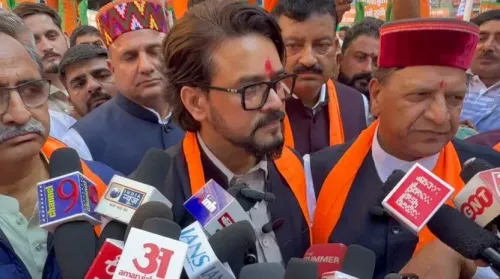
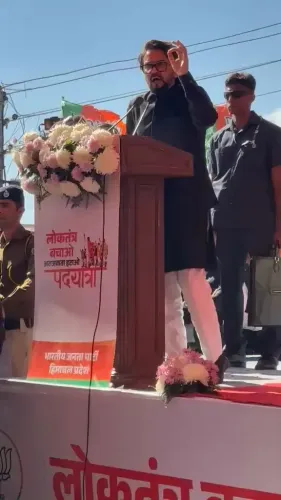
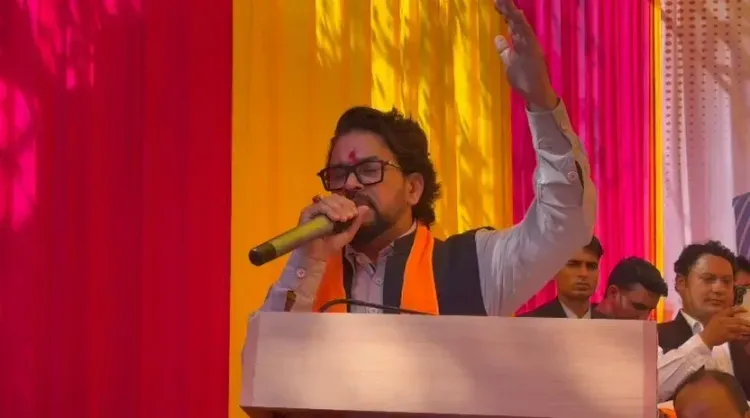
Speaking from Hamirpur on Wednesday, 4 November 2026, BJP MP Anurag Thakur launched a sharp broadside at Congress leader Rahul Gandhi, alleging that Gandhi is acting on the advice of foreign patrons to defame Indian democracy and seize power through chaos.
Thakur's post, shared in Hindi, states: 'Apne videshi aakaon aur mitron ki salah par Rahul Gandhi Bharat ke loktantra ko badnaam karna aur anarajkata failaa kar satta haasil karna chahte hain' — 'On the advice of his foreign masters and friends, Rahul Gandhi wants to defame India's democracy and gain power by spreading anarchy.' The statement was geo-tagged to Hamirpur, Thakur's Lok Sabha constituency, which he has represented continuously since 2008.
A familiar front in BJP-Congress political warfare
The allegation sits squarely within a long-running pattern of accusation and counter-accusation between BJP and Indian National Congress. BJP leaders have periodically charged that Congress figures court external criticism of the Indian government to build political pressure at home. For Congress, such attacks are routinely dismissed as attempts to suppress legitimate dissent and label opposition as anti-national.
Thakur himself — a former Union Minister for Information and Broadcasting as well as Youth Affairs and Sports — has been among the BJP's most combative voices in Parliament and on the campaign trail. His use of the phrase 'foreign masters' (videshi aaka) echoes the sharper end of that rhetorical tradition.
Why 'foreign influence' stays a live political charge
The question of foreign funding and foreign commentary on Indian democracy has repeatedly surfaced in Indian political discourse. Concerns about overseas donations to political-linked civil society groups, foreign media coverage of domestic protests, and Indian-origin diaspora voices have all, at various points, been cited by ruling-party leaders as evidence of external interference. The opposition, in turn, argues that international scrutiny of democratic institutions is a normal feature of open societies.
Rahul Gandhi's international engagements — including addresses at foreign universities and meetings with overseas lawmakers — have previously drawn BJP criticism. No specific event has been cited by Thakur in this post, but the geo-tag placing it in Hamirpur suggests the remarks may be part of local political outreach in his home constituency ahead of or during a period of heightened political activity.
Congress has not yet publicly responded to this particular post. If past exchanges are any guide, a rebuttal calling the charge 'desperate and baseless' is likely to follow. The cycle of claim and counter-claim over foreign influence remains one of the defining fault lines of contemporary Indian electoral politics — and neither side shows any sign of stepping back from it.
Point of View
The persistent challenge is to rebut such charges without appearing defensive, while keeping economic and governance issues at the centre of public discourse. The exchange illustrates how foreign-influence allegations have become a durable instrument of Indian electoral combat — deployed most intensely whenever political competition sharpens.
NationPress
4 Nov 2026
Frequently Asked Questions
What exactly did Anurag Thakur say about Rahul Gandhi?
Thakur posted in Hindi on 4 November 2026 that Rahul Gandhi, acting on the advice of his foreign masters and friends, wants to defame India's democracy and seize power by spreading anarchy.
Why does BJP accuse Rahul Gandhi of having foreign links?
BJP leaders have cited Rahul Gandhi's speeches at foreign universities, meetings with overseas parliamentarians, and international media interactions as evidence of foreign backing. These charges are part of a broader BJP-Congress dispute over foreign influence in Indian politics.
What is Anurag Thakur's political background?
Anurag Thakur is a BJP Lok Sabha MP from Hamirpur, Himachal Pradesh, who has held the seat since 2008. He previously served as Union Minister for Information and Broadcasting and for Youth Affairs and Sports.
How has Congress responded to BJP's foreign influence allegations?
Congress has consistently dismissed such charges as baseless attempts to label legitimate political opposition as anti-national and to deflect attention from governance failures.
Is this the first time BJP has used 'videshi aaka' language against Rahul Gandhi?
No. The 'videshi aaka' (foreign masters) phrase has appeared in BJP rhetoric against Rahul Gandhi on multiple earlier occasions, particularly after his overseas speeches or meetings with foreign officials drew criticism from the ruling party.