Anurag Thakur hails HP scientists in Stanford-Elsevier Top 2% list
Synopsis
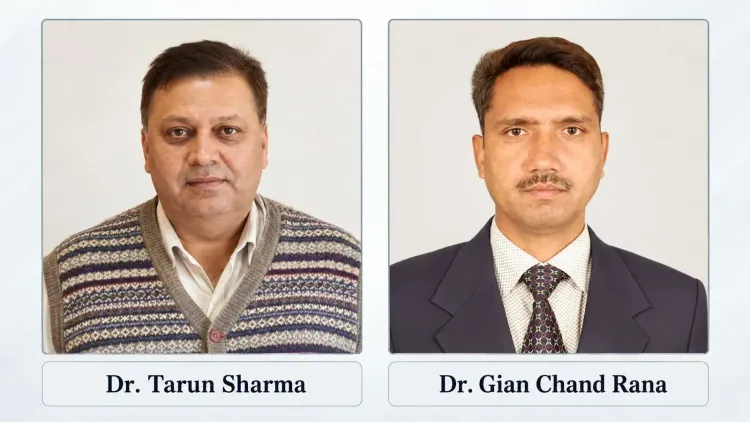
BJP MP Anurag Thakur has congratulated Dr. Tarun Sharma of Himachal Pradesh University and Dr. Gian Chand Rana of Government Degree College, Dhaneta, for featuring in the 2026 Stanford-Elsevier World's Top 2% Scientists list, highlighting their work in photonics and fluid dynamics respectively.
Key Takeaways
Tarun Sharma of Himachal Pradesh University and Dr.
Gian Chand Rana of Government Degree College, Dhaneta have been named in the 2026 Stanford–Elsevier World's Top 2% Scientists ranking.
The ranking is compiled using Scopus citation data and metrics developed by Stanford University researchers, measuring cumulative scientific impact.
Sharma specialises in silicon photonics, nanophotonics , and AI-driven photonics ; Dr.
Rana works in fluid dynamics and mechanical engineering .
Rana hails from Nadaun , in the Hamirpur constituency of Himachal Pradesh — the same seat represented by Anurag Thakur.
The achievement highlights a broader trend of scientists from non-metropolitan Indian institutions gaining global citation-based recognition.
Two scientists from Himachal Pradesh have broken into one of the most closely watched global benchmarks in academic research — and a BJP MP is making sure the country notices. BJP MP Anurag Thakur on Saturday, 17 October 2026, congratulated Dr. Tarun Sharma of Himachal Pradesh University and Dr. Gian Chand Rana, Principal of Government Degree College, Dhaneta, for being recognised among the World's Top 2% Scientists in the 2026 Stanford–Elsevier ranking.
Silicon photonics to fluid dynamics — what the two scientists do
The ranking, compiled annually using Scopus citation data and metrics developed by Stanford University researchers, measures a scientist's cumulative impact on their field through research output and citation influence. It is widely regarded as one of the most objective global measures of individual scientific contribution.
Dr. Sharma's research spans silicon photonics, nanophotonics, and the emerging frontier of AI-driven photonics — areas with direct implications for next-generation computing and communications. Dr. Rana works in fluid dynamics and mechanical engineering, disciplines that underpin everything from aerospace design to industrial machinery.
A personal note from Nadaun, Hamirpur
Thakur, who represents the Hamirpur constituency in Himachal Pradesh, noted with particular pride that Dr. Rana hails from Nadaun — a sub-district within his own constituency. 'It is a matter of immense pride that Dr. Gian Chand Rana hails from my constituency, Nadaun, in Hamirpur, Himachal Pradesh,' he wrote. 'His achievement is an inspiration for aspiring researchers and students across the region.'
That detail matters beyond the personal. Nadaun is a small town, not a metropolitan research hub. A scientist from there earning a place among the world's top-cited researchers is precisely the kind of story that reframes what 'centres of excellence' can look like in India.
Non-metro India climbing global science rankings
Indian MPs increasingly spotlight local academic achievements on social media to draw attention to scientific output beyond the IITs and AIIMS campuses that dominate headlines. The broader pattern is real: state universities and smaller colleges in Tier-2 and Tier-3 cities have registered a gradual but measurable rise in global citation-based rankings over the past decade, driven partly by increased access to international journals and collaborative research networks.
For Himachal Pradesh — a state whose research infrastructure is modest compared to larger states — having two scientists recognised on the same Stanford–Elsevier list in the same year is a signal worth watching. If the state government follows up with targeted research grants or faculty development programmes, this moment could mark an inflection point rather than an isolated achievement.
Two researchers from the hills of Himachal Pradesh have just placed their work on a global citation map — the question now is whether institutions and policymakers will build on that momentum.
Point of View
Thakur adds a constituency-level dimension that resonates with voters and students in smaller towns, reinforcing the message that world-class science is not the exclusive preserve of metro institutions. The Stanford–Elsevier ranking's citation-based methodology gives these recognitions credibility that government awards alone cannot confer, making them useful pegs for both politicians and science policy advocates. Whether Himachal Pradesh's government follows this moment with concrete research funding will determine if this recognition becomes part of a durable academic ecosystem or remains a feel-good milestone.
NationPress
17 Oct 2026
Frequently Asked Questions
What is the Stanford–Elsevier World's Top 2% Scientists ranking?
It is an annual global list of the most-cited scientists, compiled using Scopus citation data and metrics developed by researchers at Stanford University . It ranks scientists based on their cumulative research output and citation impact across their careers.
Who are the two Himachal Pradesh scientists in the 2026 Stanford–Elsevier list?
Dr. Tarun Sharma of Himachal Pradesh University , who works in silicon photonics, nanophotonics and AI-driven photonics, and Dr. Gian Chand Rana , Principal of Government Degree College, Dhaneta , who specialises in fluid dynamics and mechanical engineering.
What is Dr. Gian Chand Rana's connection to Anurag Thakur's constituency?
Dr. Rana hails from Nadaun , a sub-district within the Hamirpur Lok Sabha constituency represented by BJP MP Anurag Thakur in Himachal Pradesh.
What does Dr. Tarun Sharma research?
Dr. Tarun Sharma works in silicon photonics, nanophotonics , and AI-driven photonics — fields relevant to next-generation computing and high-speed communications technology.
Why does the Stanford–Elsevier ranking matter for Indian science?
The ranking uses an objective, citation-based methodology that places Indian scientists on a globally comparable scale. Recognition of researchers from smaller state institutions like Government Degree College, Dhaneta, signals that scientific excellence in India is growing beyond elite metropolitan campuses.