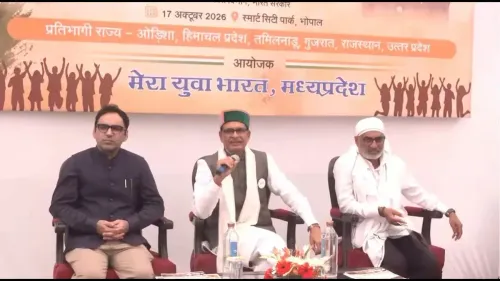
Shivraj Singh Chouhan Invokes Vedic Antiquity
Synopsis
Union Agriculture Minister Shivraj Singh Chouhan invoked India's Vedic antiquity on X, asserting that the hymns of the Vedas were composed here long before civilisation emerged in today's developed nations — a recurring motif in BJP's cultural messaging.
Key Takeaways
Shivraj Singh Chouhan posted on X on October 17, 2026 invoking India's Vedic civilisational heritage.
The post states that Vedic hymns were composed in India before 'the sun of civilisation' rose in today's developed nations.
Assertions of Vedic antiquity are a recurring element in BJP leaders' cultural communication.
Mainstream scholarship dates the earliest Vedic texts to approximately 1500–1200 BCE .
The framing inverts the usual developed-versus-developing binary by positioning India as the original knowledge civilisation.
Before the first cities rose in the ancient world, the hymns of the Vedas were already echoing across the Indian subcontinent. Union Agriculture Minister Shivraj Singh Chouhan posted on X on Saturday, October 17, 2026, invoking that civilisational depth in a single, sharp line.
The post, written in Hindi, states: 'Jab duniya ke viksit deshon mein sabhyata ke surya ka uday nahin hua tha, tab hamare yahan Vedon ki richaen rach di gayi thin' — 'When the sun of civilisation had not yet risen in the developed nations of the world, the hymns of the Vedas had already been composed here.'
A One-Line Assertion with a Long Political History
The sentiment is not new to Indian public life. Assertions about Vedic antiquity — positioning India as a fountainhead of knowledge long before Mediterranean or Mesopotamian cultures reached their peaks — have been a recurring thread in BJP leaders' public communication. Chouhan, a four-term Chief Minister of Madhya Pradesh before joining the Union Cabinet, has consistently woven cultural pride into his political identity.
The framing places India's intellectual heritage in direct contrast with 'developed nations' (viksit desh), a pointed inversion of the contemporary development discourse, where India is usually the aspirant and the West the benchmark.
The Vedic Heritage Argument in Modern Politics
Scholars date the earliest Vedic compositions to roughly 1500–1200 BCE, though some Indian nationalist traditions argue for considerably older origins. The political use of this antiquity is straightforward: it repositions India not as a developing economy catching up, but as an ancient civilisation whose wisdom predates modernity itself.
For a minister whose portfolio spans agriculture and rural development — sectors deeply tied to land, community, and tradition — the invocation carries a quiet coherence. It is cultural confidence dressed in a single sentence.
Point of View
Such statements serve dual purpose: they reinforce a Hindu-cultural identity among the base while projecting a confident, pre-colonial historical narrative to a broader audience. The inversion of 'developed nations' as the reference point is particularly deliberate — it reframes the entire development conversation by suggesting India's real benchmark is its own deep past, not the contemporary West. As India approaches its centenary of independence in 2047, this civilisational register is only likely to grow louder in ministerial messaging.
NationPress
17 Oct 2026
Frequently Asked Questions
What did Shivraj Singh Chouhan post about the Vedas?
He posted on X that when civilisation had not yet dawned in today's developed nations, the hymns of the Vedas had already been composed in India — asserting the deep antiquity of Indian knowledge traditions.
When are the Vedas believed to have been composed?
Mainstream scholarship dates the earliest Vedic compositions to roughly 1500–1200 BCE , though some traditions argue for older origins. They are among the oldest known bodies of religious and philosophical literature in the world.
Why do BJP leaders frequently reference Vedic heritage?
Invoking Vedic antiquity is part of a broader civilisational nationalism that positions India as an ancient knowledge civilisation, reinforcing cultural pride and a Hindu-cultural political identity that forms a core part of the BJP's ideological appeal.
What is Shivraj Singh Chouhan's current role?
Shivraj Singh Chouhan is the Union Minister of Agriculture and Farmers Welfare and Rural Development in the Government of India, and a senior BJP leader who served four terms as Chief Minister of Madhya Pradesh .
Is this a new argument in Indian politics?
No. Assertions about Vedic antiquity relative to other world civilisations have been a recurring motif in Indian political rhetoric for decades, particularly prominent among BJP and affiliated organisations.