Giriraj Singh Slams Opposition's Parliamentary Conduct
Synopsis
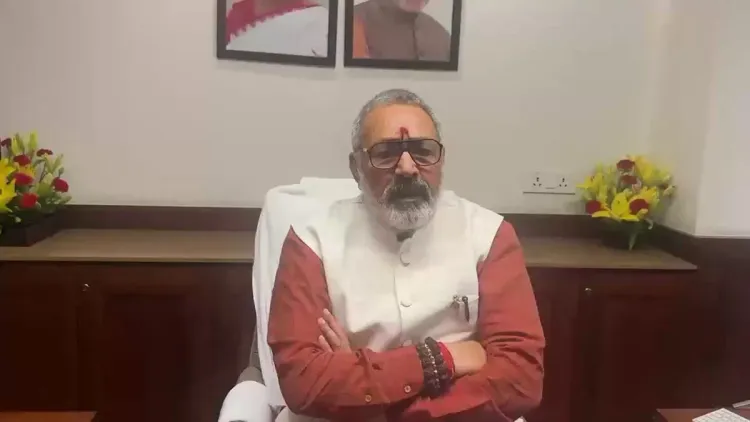
Union Textiles Minister Giriraj Singh on 29 July 2026 accused the opposition of wrecking Parliament's atmosphere with uncivil language and zero evidence, calling the House a forum for responsible debate, not empty rhetoric.
Key Takeaways
Giriraj Singh , Union Textiles Minister and senior BJP leader, posted a sharp attack on opposition parliamentary conduct on 29 July 2026 .
He accused the opposition of using 'uncivil vocabulary' and spreading confusion with 'no facts, no proof.' He opened with a Hindi couplet arguing that when facts are demanded, the opposition falls silent.
He declared Parliament 'a platform for responsible speech, not an arena for empty rhetoric.' The charge fits a recurring pattern of ruling-party leaders accusing the opposition of disrupting sessions rather than engaging on substance.
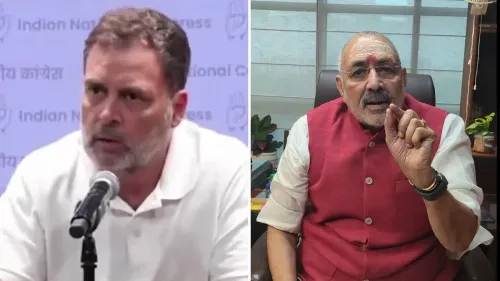
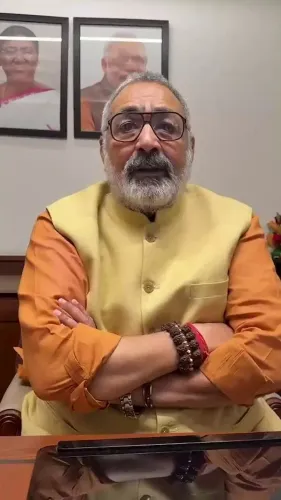
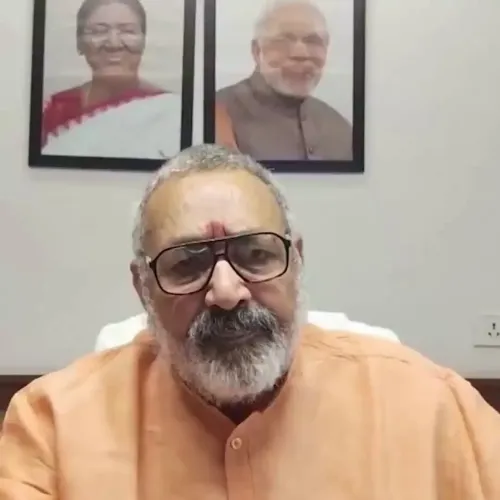
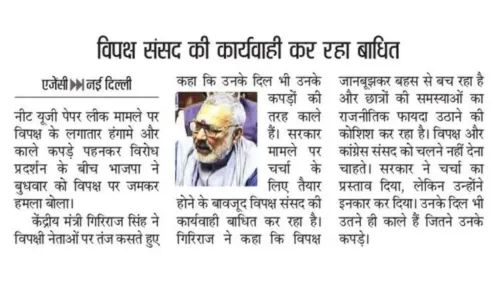
Parliament is a stage for accountability — and Union Textiles Minister Giriraj Singh is drawing the line. On Wednesday, 29 July 2026, the senior BJP leader fired a sharp broadside at the opposition, accusing it of poisoning the atmosphere of India's Parliament with crude language and baseless noise instead of reasoned debate.
Posting in Hindi, Giriraj Singh opened with a pointed couplet: 'Baaton ke mahal khade kiye, neenv magar benaam, tathya poochiye saamne, chha jaata hai viraam' — 'Palaces of words are built, yet the foundation has no name; ask for facts and silence descends.' The verse set the tone for what followed: a direct charge that the opposition relies on 'uncivil vocabulary' and deliberate confusion rather than evidence.
The Charge: Noise Without Evidence
'No facts, no proof — only disrupting Parliament's atmosphere with abusive language,' Singh wrote, adding that the opposition harbours the 'misconception' that groundless uproar and manufactured confusion can rescue its political fortunes. The language was combative, but the underlying argument was structural: that the opposition mistakes spectacle for strategy.
He closed with a firm declaration — 'Sansad zimmedari se baat karne ka manch hai, kori bayanbazi ka akhada nahin' — 'Parliament is a platform for responsible speech, not an arena for empty rhetoric.'
A Recurring Fault Line in Indian Parliamentary Politics
This is not an isolated flash of frustration. Ruling-party leaders have repeatedly accused opposition members of drowning out legislative business with slogans, walkouts, and well-footprint protests rather than engaging on substance. The opposition, for its part, has long argued that the government curtails debate time on consequential legislation, leaving disruption as the only lever of visibility.
The cycle has played out across multiple sessions of both Lok Sabha and Rajya Sabha — each side casting the other as the wrecker of democratic deliberation. Singh's post, timed mid-session, lands squarely in that tradition, but the couplet format signals something more calculated: a bid to frame the opposition's conduct not just as disruptive, but as intellectually hollow.
When a senior cabinet minister reaches for poetry to make a political point, the message is as much about optics as substance — Parliament, he implies, deserves better than what it is getting.
Point of View
Not a spontaneous outburst — the choice of a Hindi couplet signals an appeal to a Hindi-belt audience beyond the parliamentary gallery. It fits the BJP's broader strategic framing: positioning the opposition as obstructionist and fact-free, a narrative that has proved electorally useful in the past. The absence of any specific incident or bill in the post is telling; this is about setting a tone and shaping perception of the session as a whole, not litigating a single vote. Watch whether opposition leaders respond in kind or choose to rebut with specific examples of curtailed debate time.
NationPress
13 Sept 2026
Frequently Asked Questions
What did Giriraj Singh say about the opposition in Parliament?
Giriraj Singh accused the opposition of disrupting Parliament's atmosphere with uncivil language and no factual basis, and declared that Parliament is a platform for responsible speech, not empty rhetoric.
Why did Giriraj Singh post a Hindi couplet about Parliament?
He used the couplet to argue that the opposition builds 'palaces of words' but goes silent when asked for facts — framing his criticism in a culturally resonant, shareable format aimed at a Hindi-speaking audience.
Is parliamentary disruption a new issue in India?
No. Ruling-party figures and opposition benches have traded accusations over parliamentary conduct across multiple sessions of both Lok Sabha and Rajya Sabha , making it a recurring fault line in Indian legislative politics.
What is Giriraj Singh's role in the government?
Giriraj Singh is the Union Minister of Textiles , a senior BJP leader, and a Lok Sabha MP from Begusarai, Bihar .
How has the opposition responded to such charges?
Opposition parties have historically countered that the government restricts debate time on key legislation, arguing that disruption becomes necessary when substantive engagement is blocked — though no specific response to this post has been verified.