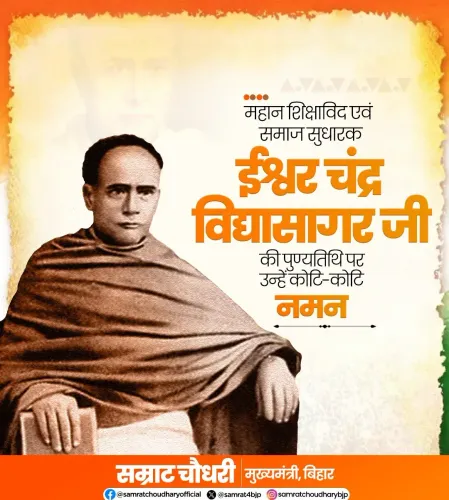
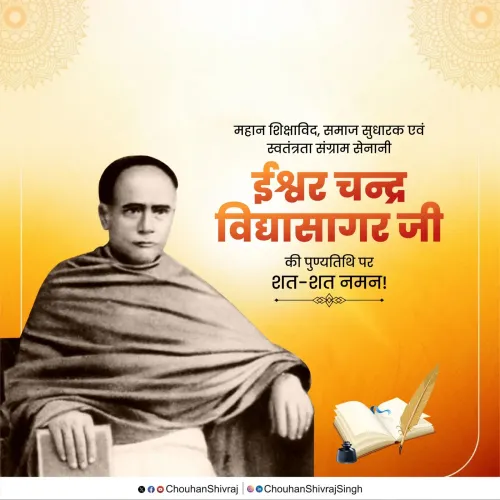
Shivraj Singh Chouhan pays tribute to Ishwar Chandra Vidyasagar on birth anniversary

Synopsis
Union Agriculture Minister Shivraj Singh Chouhan marked the birth anniversary of 19th-century Bengali polymath and social reformer Ishwar Chandra Vidyasagar on 26 September 2026, saluting his fight against social evils and his pioneering work for women's rights and girls' education.
Key Takeaways
Shivraj Singh Chouhan paid tribute to Ishwar Chandra Vidyasagar on his birth anniversary, 26 September 2026 .
Vidyasagar is celebrated for spearheading the Hindu Widows' Remarriage Act of 1856 , a landmark legislative win for women's rights in colonial India.
He founded and supported multiple girls' schools across Bengal and campaigned against child marriage and polygamy.
Chouhan praised Vidyasagar's struggle against social evils and his efforts toward the upliftment of marginalised communities and women's empowerment.
BJP leaders regularly mark anniversaries of 19th-century reformers as part of a broader narrative linking the party's welfare agenda to India's social reform heritage.
A towering 19th-century reformer who rewrote the rules for Indian women and girls gets his due this Saturday — Union Agriculture Minister Shivraj Singh Chouhan offered a heartfelt tribute to Ishwar Chandra Vidyasagar on his birth anniversary, Saturday, 26 September 2026, saluting a life spent dismantling social injustice.
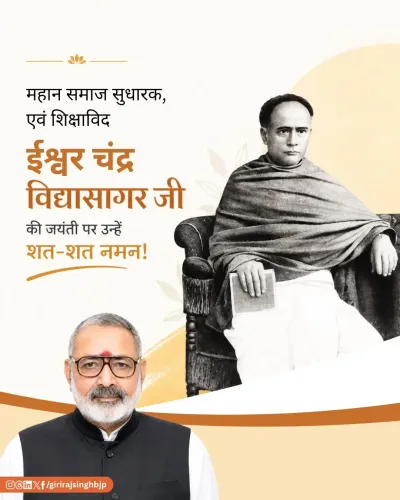
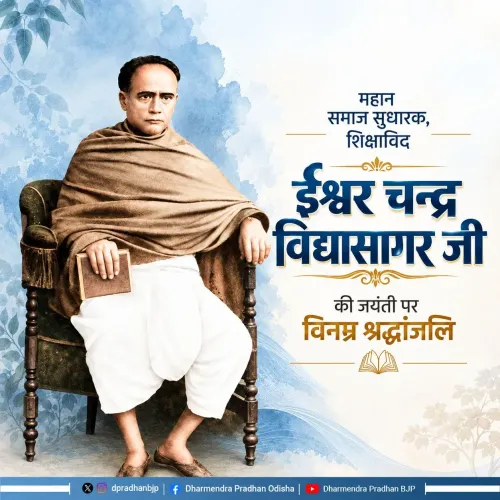
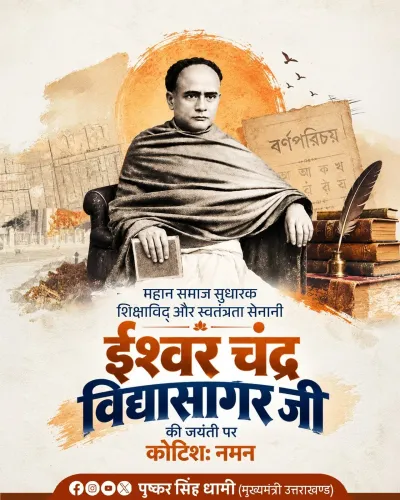
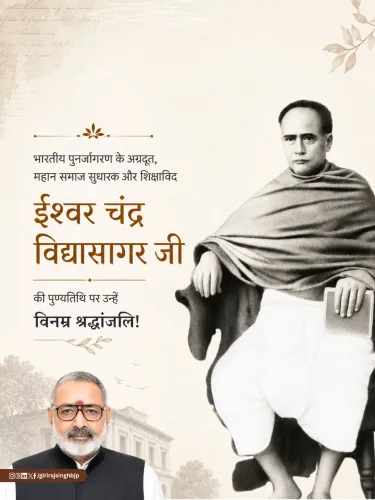
Posting on X in Hindi, Chouhan wrote: 'महान समाज सुधारक, शिक्षाविद एवं स्वतंत्रता संग्राम सेनानी ईश्वर चंद्र विद्यासागर जी की जयंती पर कोटि-कोटि नमन करता हूँ!' — 'I bow in reverence, countless times, on the birth anniversary of the great social reformer, educationist and freedom fighter Ishwar Chandra Vidyasagar!' He added that Vidyasagar's fight against social evils and his efforts toward the upliftment of the marginalised and women's empowerment 'will always remain a source of inspiration.'
The man who moved a parliament — and a society
Ishwar Chandra Vidyasagar was a 19th-century Bengali polymath whose influence cut far deeper than any single campaign. A Sanskrit scholar turned social activist, he is most celebrated for spearheading the movement that produced the Hindu Widows' Remarriage Act of 1856 — one of colonial India's first legislative victories for women's rights. He lobbied colonial authorities relentlessly, collecting thousands of signatures from across Bengal in support of the bill.
He did not stop there. Vidyasagar founded and supported dozens of girls' schools across Bengal, fought publicly against child marriage and polygamy, and used his own earnings and influence to keep the reform movement alive. His personal moral courage — including his willingness to be ostracised by orthodox society — gave Indian progressivism some of its earliest and most durable vocabulary.
BJP's reform-heritage frame and what it signals
Tributes like this one are far from accidental. BJP leaders and Union ministers have made a consistent practice of marking the birth anniversaries of pre-independence social reformers — invoking figures such as Vidyasagar to connect the party's current governance narrative on women's welfare and education to a longer arc of Indian social progress. The pattern frames contemporary schemes for girls' education and rural women's empowerment as heirs to a tradition that began long before independence.
For Chouhan specifically, whose ministerial brief spans agriculture and rural development, themes of uplifting the marginalised and empowering women in rural India carry particular resonance. The tribute, while ceremonial in form, lands against a backdrop of ongoing government programmes targeting women's welfare in India's villages.
Point of View
Given the competitive political terrain in West Bengal. The tribute signals that reform heritage is not merely commemorative but actively deployed as governance vocabulary. Over time, the consistency of such messaging shapes how the party frames its own identity as an heir to India's social progress movement.
NationPress
26 Sept 2026
Frequently Asked Questions
Who was Ishwar Chandra Vidyasagar?
Ishwar Chandra Vidyasagar was a 19th-century Bengali scholar, social reformer and educationist who championed the Hindu Widows' Remarriage Act of 1856, founded girls' schools across Bengal, and fought against child marriage and polygamy.
Why is Ishwar Chandra Vidyasagar famous?
He is most famous for leading the campaign that resulted in the Hindu Widows' Remarriage Act of 1856, one of colonial India's first legislative victories for women's rights, and for his wide-ranging work in girls' education.
When is Ishwar Chandra Vidyasagar's birth anniversary?
Ishwar Chandra Vidyasagar's birth anniversary falls on 26 September , and it is marked each year with tributes from political leaders, educationists and social activists across India.
Why did Shivraj Singh Chouhan pay tribute to Vidyasagar?
Shivraj Singh Chouhan paid tribute on Vidyasagar's birth anniversary to honour his contributions as a social reformer, educationist and freedom fighter, particularly his work for women's empowerment and the upliftment of marginalised communities.
What is the Hindu Widows' Remarriage Act 1856?
The Hindu Widows' Remarriage Act of 1856 was a colonial-era law passed under British India that legalised the remarriage of Hindu widows, overturning centuries of social and religious prohibition. Vidyasagar's persistent lobbying was instrumental in getting it enacted.