Shivraj Singh Chouhan warns forces of anarchy: '140 crore Indians will foil your plans'
Synopsis
Union Agriculture Minister Shivraj Singh Chouhan issued a combative warning on X, invoking 140 crore Indians against unnamed forces he accused of spreading anarchy — a sharp law-and-order message characteristic of the BJP's political communication.
Key Takeaways
Union Agriculture Minister Shivraj Singh Chouhan posted a combative warning on X on 16 October 2026 .
He declared that 140 crore Indians would never allow 'vile designs' aimed at spreading anarchy to succeed.
No specific group, incident, or location was named in the post, leaving the adversary deliberately undefined.
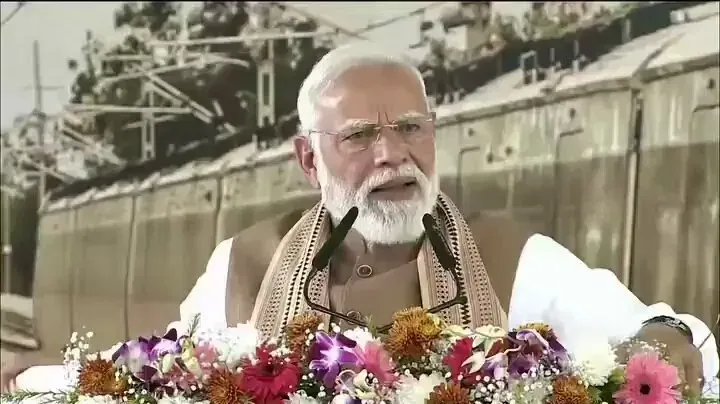
The post included a video , suggesting it was crafted as a complete audio-visual political message.
The rhetoric aligns with the BJP's established law-and-order and national unity messaging framework used by senior leaders.
Follow-up statements from other ministers and potential parliamentary references to public order are expected as the winter session approaches.
A stark warning to those seeking to destabilise India — that is what Union Agriculture Minister Shivraj Singh Chouhan delivered on Friday, 16 October 2026, in a combative post on X that invoked the collective will of 140 crore Indians against what he called 'unholy designs' aimed at spreading chaos.
The minister's post, written in sharp Hindi, reads: 'Arajkata failane walon, kaan kholkar sun lo… 140 crore Bharatiya tumhare napak mansoobe kabhi kamyab nahi hone denge!' — 'Those spreading anarchy, listen carefully… 140 crore Indians will never let your vile designs succeed!'
The language of 140 crore — a BJP rhetorical signature
The invocation of India's population as a unified, resolute force is a deliberate rhetorical move with deep roots in the ruling party's political playbook. BJP leaders have repeatedly framed challenges to public order — whether protests, civil unrest, or political opposition — as attempts at 'anarchy' that a unified citizenry will ultimately defeat. The framing positions the state not as one side in a political contest, but as the embodiment of popular will.
Chouhan, as a four-term former Chief Minister of Madhya Pradesh and one of the BJP's most experienced mass communicators, is particularly adept at this register. The message is pitched directly at a mass audience, bypassing institutional language in favour of the direct, urgent cadence of a public rally. The explicit phrase 'napak mansoobe' — 'vile' or 'unholy designs' — carries a moral charge that frames the unnamed adversary not merely as politically wrong, but as fundamentally illegitimate.
No specific trigger named — but the framing speaks volumes
What the post pointedly does not do is name a specific incident, group, or grievance. That ambiguity is itself a choice. By leaving the adversary undefined, the message functions as a broad-spectrum assertion of national resolve, applicable to any threat the audience perceives as real at the moment. It is a political communication technique as old as populism itself — the unnamed enemy, the united people, the certain victory.
The post also accompanied a video, the contents of which were not independently verifiable, suggesting the statement was designed as a complete audio-visual package rather than a standalone text — a further signal of deliberate messaging intent.
Whether this is a response to a specific flash-point on the ground or a pre-emptive assertion of stability will become clearer as fellow ministers and party spokespersons weigh in — and as the winter session of Parliament approaches, where public order is perennially a flashpoint.
Point of View
This carries more weight than a standard ministerial statement; it is a mobilisation signal dressed as a warning. The approach also pre-empts the opposition's ability to define the narrative around any specific incident, since no incident is named. As the winter session looms, such messaging typically precedes coordinated legislative and rhetorical pushback on public-order themes.
NationPress
16 Oct 2026
Frequently Asked Questions
What did Shivraj Singh Chouhan post on X on 16 October 2026?
He issued a sharp warning in Hindi, stating that 140 crore Indians would never allow the 'vile designs' of those spreading anarchy to succeed.
Who is Shivraj Singh Chouhan?
Shivraj Singh Chouhan is the Union Minister of Agriculture and Farmers Welfare and Rural Development, a senior BJP leader, and a former four-term Chief Minister of Madhya Pradesh.
What does 'napak mansoobe' mean in Chouhan's post?
The Hindi phrase 'napak mansoobe' translates to 'vile' or 'unholy designs,' and Chouhan used it to describe the alleged intentions of those he accused of spreading anarchy.
Who was Shivraj Singh Chouhan's warning directed at?
The post did not name any specific group, individual, or incident; the adversary was left deliberately undefined, making it a broad-spectrum assertion of national resolve.
Is this a common BJP communication strategy?
Yes. BJP leaders have periodically framed opposition or protest activity as attempts at anarchy, invoking India's population scale to assert national unity — a well-established pattern in the party's law-and-order messaging.