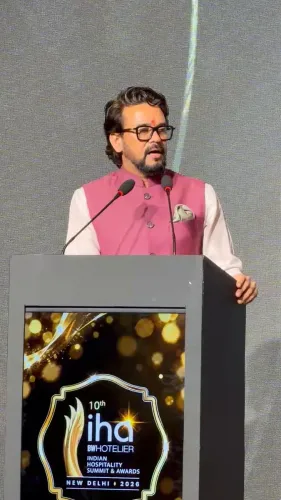
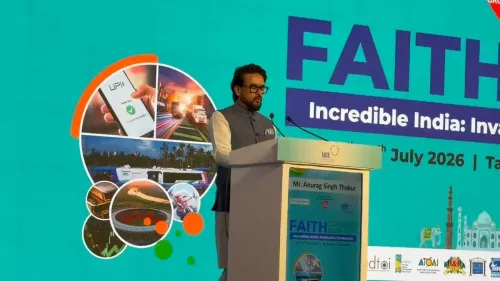
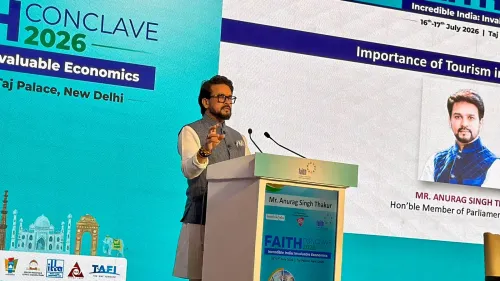
Anurag Thakur on India's Hospitality as Sacred Duty
Synopsis
At a Business World forum in Delhi, BJP MP Anurag Thakur declared hospitality a 'religion' and 'sacred duty' intrinsic to Indian civilisation, echoing the Atithi Devo Bhava ethos to frame India's cultural identity as a global tourism and soft-power asset.
Key Takeaways
BJP MP Anurag Thakur spoke at a Business World event in Delhi on 25 September 2026 .
He described hospitality as 'a religion', 'a sacred duty', and part of India's 'DNA'.
The remarks echo the Atithi Devo Bhava ('the guest is god') campaign, launched by India's Ministry of Tourism in 2002 .
The cultural framing is a long-standing pillar of India's Incredible India international tourism branding.
Addressing a business audience positions the argument as a competitive differentiator for India's hospitality and tourism sector.
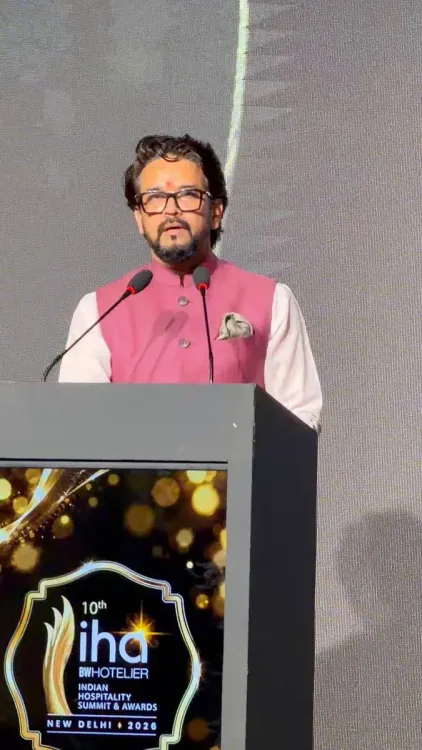
Hospitality is not a policy line for India — it is, as BJP MP Anurag Thakur put it at a Business World event in Delhi on Friday, 25 September 2026, a religion. Speaking at the forum, Thakur invoked one of Indian civilisation's oldest self-definitions to make a pointed case for the country's place in global tourism and soft power.
Thakur's words were crisp and threefold: 'Hospitality is a religion for us. Hospitality is among our sacred duties. Hospitality is in our DNA.' The deliberate repetition was rhetorical by design — a drumbeat meant to anchor Indian cultural identity to a very modern economic conversation.
Atithi Devo Bhava: an old idea doing new work
The sentiment Thakur articulated has deep institutional roots. The Atithi Devo Bhava campaign — 'the guest is god' — was first launched by India's Ministry of Tourism in 2002 as a formal effort to codify and promote this ethos among tourism-sector workers and communities. More than two decades later, the phrase has moved well beyond a government slogan; it now anchors India's 'Incredible India' branding in international markets and is regularly deployed as a soft-power argument in diplomatic and trade contexts.
Indian political figures across the spectrum have leaned on this framing, but the context here matters: a Business World forum signals an audience of industry leaders and policy shapers, not a campaign rally. The message, then, is directed squarely at the hospitality and tourism sector — an industry that contributes significantly to employment and foreign-exchange earnings.
Why the framing lands beyond sentiment
Invoking cultural DNA at a business forum is a deliberate strategic move. It positions Indian hospitality not as a learned service standard but as an inherited competitive advantage — something no training manual can replicate. For a sector that competes with Southeast Asian destinations, the Gulf's luxury infrastructure, and Europe's heritage draw, that is a differentiation argument with real commercial weight.
The post's tag of Business World and its Delhi location marker suggest this was part of a structured industry conversation, though the precise event details remain unconfirmed. What is clear is the register Thakur chose: not statistics or scheme announcements, but civilisational confidence.
India's oldest value proposition, it turns out, is still being pitched — and the audience is global.
Point of View
He sidesteps sector-specific vulnerabilities — infrastructure gaps, service-quality inconsistencies — and reframes the conversation on India's strongest ground. The Atithi Devo Bhava lineage shows this is not improvisation but a durable soft-power strategy. The question is whether sentiment, however sincere, is being matched by structural investment in the tourism and hospitality sector.
NationPress
25 Sept 2026
Frequently Asked Questions
What is Atithi Devo Bhava and who launched it?
Atithi Devo Bhava, meaning 'the guest is god', is a campaign launched by India's Ministry of Tourism in 2002 to promote a culture of warm hospitality among tourism-sector workers and communities across the country.
What did Anurag Thakur say about Indian hospitality?
At a Business World event in Delhi on 25 September 2026, Anurag Thakur said 'Hospitality is a religion for us. Hospitality is among our sacred duties. Hospitality is in our DNA,' linking Indian cultural values to the country's identity as a tourism destination.
Why is Indian hospitality considered a soft-power tool?
Indian political and cultural leaders regularly cite the tradition of welcoming guests as evidence of a deep-rooted civilisational value, which is used to differentiate India as a travel destination and to project a warm national image in international diplomacy and tourism marketing.
What is Incredible India and how does it relate to this?
Incredible India is India's flagship international tourism branding campaign. Cultural values like Atithi Devo Bhava and the hospitality ethos Thakur described form a core part of this branding, positioning India's heritage and warmth as central draws for global travellers.
Who is Anurag Thakur?
Anurag Thakur is a BJP Lok Sabha MP from Hamirpur, Himachal Pradesh, and a former Union Minister of Information and Broadcasting as well as Youth Affairs and Sports.