Arunachal CMO: 6 Tawang Athletes Get Free Training
Synopsis
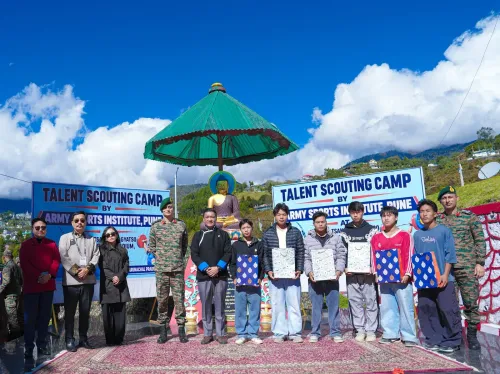
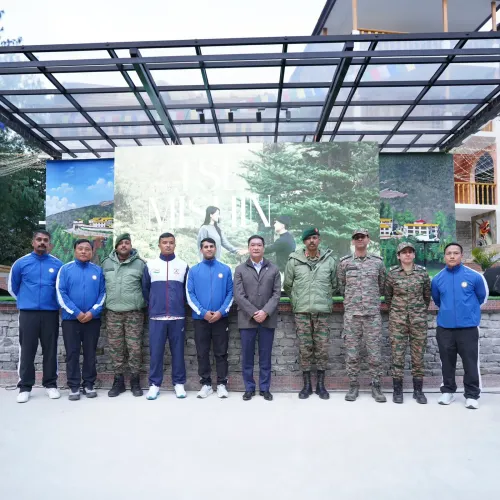
The Chief Minister's Office of Arunachal Pradesh has announced that six athletes selected from the ASI camp in Tawang will receive free education and specialised sports training. The camp is set to become an annual initiative, creating a sustained talent pipeline from the high-altitude border district to national-level competition.
Key Takeaways
Six young athletes selected from the ASI camp in Tawang will receive free education and specialised sports training.
The ASI camp in Tawang has been declared an annual initiative , creating a recurring talent identification pipeline.
Tawang is a high-altitude, strategically sensitive district in Arunachal Pradesh bordering China, now being positioned as a grassroots sports hub.
The initiative addresses both the cost barrier (free education) and the continuity barrier (structured annual camp) for remote youth athletes.
The programme aligns with a broader Northeast India push to reduce regional disparities in national sports team representation.
Six young athletes from a remote Himalayan district are about to get a shot at the national stage — and it starts with a camp in one of India's most strategically vital towns. The Chief Minister's Office of Arunachal Pradesh announced on Monday, November 2, 2026, that six talents identified at the ASI camp in Tawang will receive free education and specialised sports training, with the camp itself set to become an annual fixture.
Six seats, one camp, a pipeline begins
The announcement is compact but its logic is deliberate. By anchoring the selection process to Tawang — a high-altitude district that sits against the India-China border and has historically been more associated with strategic significance than sporting infrastructure — the state government is signalling where it wants grassroots talent identification to reach. The six selected athletes will not simply receive coaching; they will receive free education alongside specialised training, addressing the dual barrier that keeps talented youth from remote districts out of competitive sport: cost and continuity.
Why 'annual' is the word that matters
A one-off camp produces six athletes. An annual camp produces a conveyor belt. The Chief Minister's Office explicitly framed the ASI camp's recurring status as the structural anchor of this initiative — not a pilot, but a pathway. Northeastern states have long pursued grassroots talent identification through periodic camps, often linked to central sports schemes, to close the gap between regional talent pools and national team rosters. Making the Tawang camp annual plants that model firmly in Arunachal's own institutional calendar.
Northeast India's broader push to close the sports gap
Arunachal Pradesh is not alone in this direction. Across the Northeast, state governments have increasingly treated youth sports infrastructure as both a welfare investment and a soft-power asset — a way to channel the energy of a young demographic into structured competition. The region has produced standout athletes in disciplines from boxing to archery, but systemic gaps in identification and funding have meant talent often goes untracked. Tawang's inclusion in this pipeline is notable: its remoteness makes it precisely the kind of location where a structured annual camp changes the calculus for a family weighing whether to invest in a child's sporting ambitions.
The immediate test will be what happens to these six athletes in state and national competitions over the next two to three years — and whether the second edition of the camp delivers a similarly credible cohort. That track record, more than any announcement, will determine whether Tawang becomes a genuine feeder hub for Arunachal's sporting future.
Point of View
Annual pipelines anchored in underserved districts. Locating the camp in Tawang is a deliberate political and developmental signal: the government is investing visibility in a district whose profile has historically been defined by security concerns rather than social infrastructure. The free-education component suggests the state has learned that coaching alone does not retain athletes from economically marginalised families. Whether this becomes a replicable template for other remote Arunachal districts will depend entirely on how the inaugural cohort of six athletes is tracked and supported beyond the camp.
NationPress
2 Nov 2026
Frequently Asked Questions
What is the ASI camp in Tawang, Arunachal Pradesh?
The ASI camp in Tawang is a sports talent identification camp held in the high-altitude Tawang district of Arunachal Pradesh. The Chief Minister's Office announced in November 2026 that it will become an annual initiative to identify and support promising young athletes from the region.
How many athletes were selected from the Tawang ASI camp?
Six young athletes were selected from the ASI camp in Tawang. They will receive free education and specialised sports training as part of the Arunachal Pradesh government's initiative.
Will the ASI sports camp in Tawang be held every year?
Yes. The Chief Minister's Office of Arunachal Pradesh announced that the ASI camp in Tawang will be made an annual initiative, creating a sustained pipeline for youth sports talent identification.
Why is Tawang significant for sports development in Arunachal Pradesh?
Tawang is a remote, high-altitude district on the India-China border where access to structured sports training has historically been limited. Establishing an annual camp there directly targets youth in one of Arunachal's most geographically isolated communities.
What support will the selected Tawang athletes receive?
The six selected athletes will receive both free education and specialised sports training, addressing the twin barriers of cost and continuity that typically prevent talented youth from remote districts from pursuing competitive sports.