Arunachal CMO marks 80 years of Independence with decade of gains

Synopsis
On Independence Day 2026, the Arunachal Pradesh CMO's Office marked 80 years of nationhood by highlighting a decade of transformation — roads, tunnels, airports, hydropower, and women-led livelihoods — under the Viksit Arunachal development vision anchored to the national Viksit Bharat goal.
Key Takeaways
The Chief Minister's Office of Arunachal Pradesh posted an Independence Day message on 15 August 2026 marking 80 years of Indian Independence.
The post highlights a decade of development spanning roads, tunnels, airports, hydropower, healthcare, and women-led livelihoods.
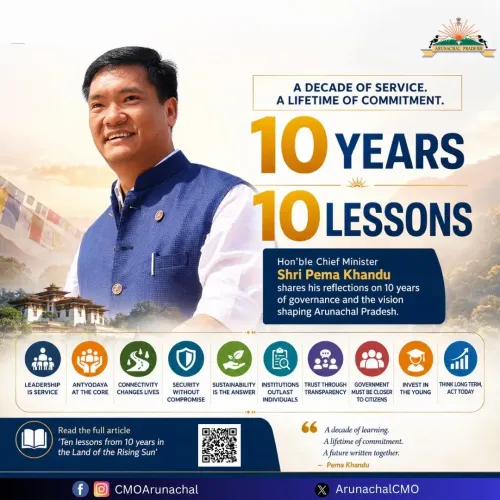
Chief Minister Pema Khandu has led the state since 2016 , overseeing much of this infrastructure push.
The Act East Policy (2014) and Bharatmala Pariyojana (2015) provided the central policy framework driving connectivity in the state.
The Viksit Arunachal frame aligns state-level development with the Centre's Viksit Bharat 2047 vision.
Infrastructure investment in Arunachal Pradesh carries strategic significance given the state's contested border with China along the Line of Actual Control .
On Independence Day, 15 August 2026, the Chief Minister's Office of Arunachal Pradesh drew a straight line between eight decades of nationhood and ten years of ground-level change — roads punched through mountain walls, airports lifting remote communities into the national grid, hydropower lighting villages that once ran on kerosene, and women turning local resources into livelihoods. The message was pointed: Viksit Arunachal is not an aspiration. It is already underway.
A decade of infrastructure in India's frontier state
The post, shared by the Chief Minister's Office led by Chief Minister Pema Khandu, captures a transformation that has been years in the making. Since 2014, Arunachal Pradesh — India's northeasternmost state, sharing a long and sensitive border with China along the Line of Actual Control — has sat at the centre of two overlapping national priorities: strategic border infrastructure and Northeast connectivity.
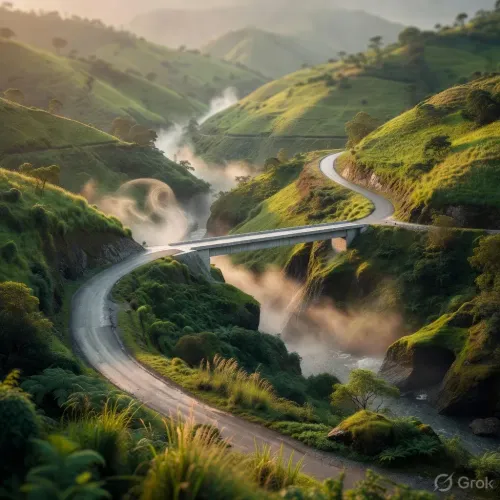
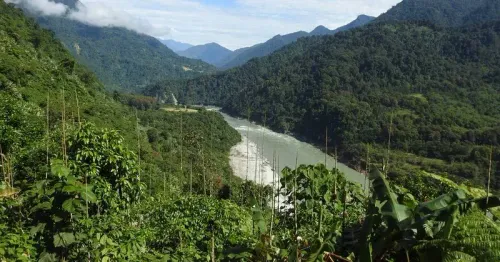
The Act East Policy, announced in 2014, and the Bharatmala Pariyojana, launched in 2015, channelled sustained central investment into highways, tunnels, and border roads across the region. The results are visible in the state's changed landscape: tunnels that slash travel time across high-altitude passes, new airport facilities connecting district headquarters to the rest of India, and hydropower projects harnessing the Brahmaputra basin's enormous potential.
Women-led livelihoods and the 'Viksit Arunachal' frame
Beyond hard infrastructure, the CMO's Independence Day message spotlights women-led livelihoods and vibrant villages — a deliberate signal that development in the state is reaching its last mile. Rural women across Arunachal Pradesh's 26 districts have been targeted through self-help group networks and state livelihood missions, weaving economic inclusion into what has historically been a connectivity-first development story.
The phrase 'Viksit Arunachal' is the state's adaptation of the Centre's Viksit Bharat vision — a developed India by 2047, the centenary of Independence. Framing the 80-year milestone as the launchpad for the next chapter, the CMO is anchoring local governance firmly within that national arc.
Strategic stakes behind the celebratory tone
The warm, forward-looking register of the post sits atop a harder strategic reality. Infrastructure investment in Arunachal Pradesh carries weight well beyond development optics — every road built toward the LAC, every tunnel that keeps a pass open through winter, every airport that can double as a logistics node is also a quiet assertion of sovereignty in a state whose territory China continues to contest. The decade of transformation the CMO celebrates is, simultaneously, a decade of strategic consolidation.
Progress on pending hydropower projects and any fresh budget allocations for women-led livelihood schemes in the coming fiscal year will test whether the momentum the post describes is sustained or symbolic.
Eighty years in, Arunachal Pradesh is no longer just India's eastern frontier — it is becoming its eastern face.
Point of View
Positioning Arunachal Pradesh as a model frontier state rather than a peripheral one. It signals that Chief Minister Pema Khandu's administration is doubling down on the infrastructure-first governance story ahead of future electoral cycles. The inclusion of women-led livelihoods alongside hard infrastructure suggests an attempt to broaden the development story beyond its traditional male, road-and-dam framing. Most significantly, celebrating a 'decade of transformation' implicitly credits the post-2014 policy era — a pointed alignment with the BJP's national governance record in a state it has held firmly since 2016.
NationPress
30 Sept 2026
Frequently Asked Questions
What is Viksit Arunachal?
'Viksit Arunachal' is the state government's adaptation of the central government's Viksit Bharat vision, which aims for a fully developed India by 2047. It frames Arunachal Pradesh's infrastructure and livelihood programmes as part of that broader national development goal.
Who is the Chief Minister of Arunachal Pradesh in 2026?
Pema Khandu has served as Chief Minister of Arunachal Pradesh since 2016 and is associated with the state's ongoing infrastructure and development push.
What infrastructure projects have been built in Arunachal Pradesh in the last decade?
Arunachal Pradesh has seen construction of mountain tunnels, upgraded highways under the Bharatmala Pariyojana, new airport facilities, and hydropower projects, all supported by the Centre's Act East Policy since 2014.
Why is infrastructure in Arunachal Pradesh strategically important?
Arunachal Pradesh shares a long border with China along the Line of Actual Control, and India's road, tunnel, and airport projects in the state serve both development and strategic purposes, improving military logistics and asserting sovereignty in a contested region.
What is the Act East Policy and how does it affect Arunachal Pradesh?
Announced in 2014, the Act East Policy prioritises connectivity and economic integration of India's Northeast with the rest of the country and with Southeast Asia. Arunachal Pradesh has been a major beneficiary through road, border infrastructure, and trade corridor investments.