CM Pema Khandu: Arunachal GST revenue up 7x since 2017

Synopsis
Arunachal Pradesh Chief Minister Pema Khandu has cited a near eight-fold rise in state GST collections — from ₹277.94 crore in 2017-18 to ₹2,177.83 crore in 2025-26 — as proof of economic growth, stronger tax compliance, and an expanding formal sector under the Viksit Bharat vision.
Key Takeaways
Arunachal Pradesh GST collections rose from ₹277.94 crore in 2017-18 to ₹2,177.83 crore in 2025-26 , a near eight-fold increase.
CM Pema Khandu attributed the growth to a stronger economy, improved tax compliance, and formalisation of the business sector.
The GST regime was launched on 1 July 2017 , replacing multiple indirect taxes and providing northeastern states with a compensation guarantee during transition.
Higher revenues are being linked to increased government capacity to fund roads, railways, healthcare, education, and infrastructure in the state.
The announcement is part of the #10YearsOfTeamArunachal campaign, connecting state fiscal milestones to the Viksit Bharat 2047 national vision.
The 2026-27 state budget and future GST Council decisions on rate rationalisation are key developments to watch.
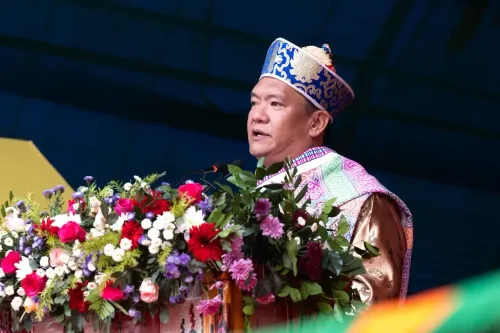
Arunachal Pradesh Chief Minister Pema Khandu on Sunday, 26 July 2026, highlighted a near eight-fold jump in the state's Goods and Services Tax (GST) collections — from ₹277.94 crore in 2017-18 to ₹2,177.83 crore in 2025-26 — calling it evidence of a growing economy, improved tax compliance, and an expanding formal sector.
Context
CM Khandu shared the figures on X (formerly Twitter), framing the revenue surge as a milestone under the #10YearsOfTeamArunachal banner. He wrote: 'That's not just an increase in GST collections, it's proof of a growing economy, better tax compliance, and a stronger formal sector.' The post was tagged with #ViksitArunachal and #ViksitBharat, linking state-level fiscal performance to the central government's long-term development vision.
The comparison spans the entire life of the GST regime, which came into effect on 1 July 2017, replacing a fragmented system of state and central indirect taxes with a unified framework designed to improve compliance tracking and reduce tax cascading.
Policy Backdrop
Arunachal Pradesh, a special category state in the northeast, has historically depended heavily on central transfers and grants. The GST architecture included a compensation guarantee for states that faced revenue shortfalls in the transition years, providing a fiscal cushion while formalisation gains took hold.
Across northeastern states, post-2017 GST collections have broadly tracked improvements in road connectivity, digital payment infrastructure, and the onboarding of previously informal traders into the tax net. CM Khandu underscored this causal link, noting that rising revenues enable greater government investment in 'roads, railways, healthcare, education, and infrastructure.'
The Viksit Bharat framework — the central government's vision for a developed India by 2047 — has become a common reference point for state governments presenting growth data, positioning local fiscal gains within a national narrative of economic transformation.
Stakeholders and Impact
The primary beneficiaries of higher GST collections in Arunachal Pradesh are formal-sector businesses, state taxpayers, and citizens who depend on publicly funded services. A larger revenue base gives the state government greater fiscal space to plan capital expenditure without proportionally increasing dependence on central devolution.
For businesses operating in the state, the figures signal a maturing compliance environment — one where digital invoicing and return-filing have progressively reduced the informal economy's share. Small traders and entrepreneurs who formalised their operations after 2017 are both contributors to and beneficiaries of this trend.
What's Next
Attention will now turn to Arunachal Pradesh's state budget presentation for 2026-27, where the revenue trajectory is expected to inform capital allocation decisions across infrastructure and social sectors. Any GST Council decisions on rate rationalisation — particularly measures affecting northeastern states — could also influence future collection figures.
With the #10YearsOfTeamArunachal campaign framing the current political moment, the state government is likely to continue presenting fiscal milestones as evidence of governance dividends, building a record ahead of the next electoral cycle.
Point of View
Demonstrating indigenous revenue growth is politically significant, as it reframes the state from a fiscal dependent to an active contributor to India's formalisation story. The broader pattern across northeastern states suggests this is not an isolated claim but part of a region-wide shift that the BJP is keen to highlight as a governance dividend.
NationPress
26 Oct 2026
Frequently Asked Questions
What is Arunachal Pradesh's GST collection in 2025-26?
According to Chief Minister Pema Khandu, Arunachal Pradesh collected ₹2,177.83 crore in GST in 2025-26 , up from ₹277.94 crore in 2017-18 .
Why have GST collections in Arunachal Pradesh grown so much?
CM Khandu attributes the growth to a stronger economy, better tax compliance, and an expanding formal sector — trends broadly seen across northeastern states after improved connectivity and digital compliance mechanisms took hold post-2017.
What is the Viksit Bharat vision mentioned by Pema Khandu?
Viksit Bharat is the central government's vision to make India a fully developed nation by 2047 , the centenary of independence. State governments frequently use it as a framework to present local economic progress.
When was GST launched in India?
GST (Goods and Services Tax) was launched on 1 July 2017 , replacing a complex system of state and central indirect taxes with a unified national regime.
How does higher GST revenue benefit Arunachal Pradesh?
Higher GST collections give the state government more fiscal space to invest in public services and infrastructure — including roads, railways, healthcare, and education — reducing proportional dependence on central grants.