CM Himanta's Assam Anchors India's Act East Policy with Japan
Synopsis
The Chief Minister's Office of Assam has spotlighted the state's role in India's Act East Policy, asserting that CM Himanta Biswa Sarma is steering Assam as India's strategic gateway to Southeast Asia through deepened India–Japan engagement spanning a decade of partnership.
Key Takeaways
The Chief Minister's Office of Assam on 1 July 2026 highlighted the state's pivotal role in India's Act East Policy and India–Japan strategic cooperation.
Himanta Biswa Sarma is credited with advancing Assam's emergence as India's gateway to Southeast Asia .
India's Act East Policy was launched in 2014 , replacing the older Look East Policy with a sharper connectivity and investment focus.
JICA -funded road and power projects in Assam have been underway since 2010 , reflecting Japan's long-standing ODA commitment to the Northeast.
Assam borders Myanmar and Bangladesh , making it a natural logistical node for overland corridors linking mainland India to ASEAN markets.
Progress on multimodal logistics hubs and new MoUs at the next India–Japan Annual Summit will be key indicators to watch.
The Chief Minister's Office of Assam on Wednesday, 1 July 2026 highlighted the state's growing centrality in India's foreign policy outreach, underscoring that Assam is emerging as India's gateway to Southeast Asia under the leadership of Chief Minister Dr. Himanta Biswa Sarma, as the India–Japan strategic partnership completes a decade of deepened engagement.
Context
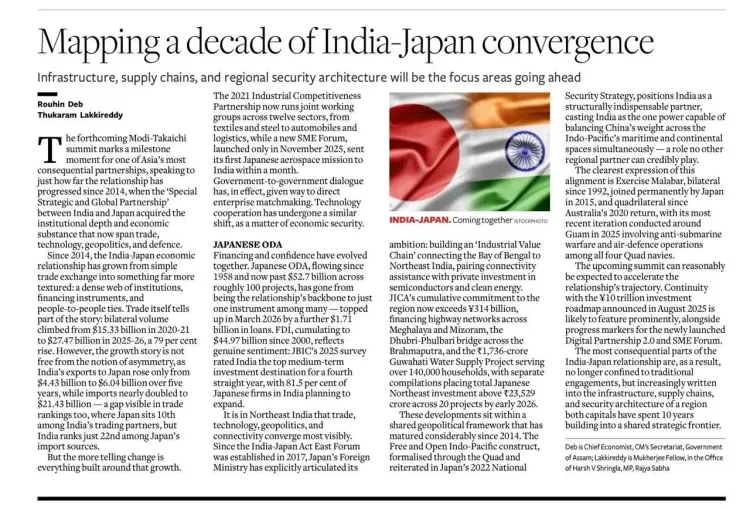
The post from the official CMO Assam account stated that 'a decade of India–Japan partnership has strengthened connectivity, investment and strategic cooperation,' and that Assam is 'playing a pivotal role in advancing India's Act East Policy, deepening engagement with Japan and emerging as India's gateway to Southeast Asia.' The message was shared alongside an article attributed to Rouhin Deb, signalling a concerted effort to amplify Assam's positioning in India's Indo-Pacific diplomatic narrative.
The reference to a decade of partnership points broadly to the sustained arc of India–Japan cooperation that has intensified since the mid-2010s, encompassing infrastructure financing, technology transfer and strategic alignment across India's northeastern corridor.
Policy Backdrop
India's Act East Policy was formally announced by Prime Minister Narendra Modi at the 2014 India-ASEAN Summit, replacing the 1990s-era Look East Policy with sharper emphasis on physical connectivity, investment and Japan as a preferred partner. The India–Japan Strategic Partnership, deepened through a series of annual summits since 2006, has channelled significant Japanese Official Development Assistance (ODA) and Japan International Cooperation Agency (JICA) funding into road and power infrastructure projects in Assam from 2010 onward.
Assam's geographic position — bordering Myanmar and Bangladesh and serving as a logistical node for overland links to ASEAN markets — makes it structurally indispensable to any multimodal corridor that bypasses the Malacca Strait. Japanese engagement in the state also mirrors broader Indo-Pacific efforts to build alternative supply chains and reduce dependence on competing regional infrastructure initiatives.
Stakeholders and Impact
The primary beneficiaries of this strategic framing include the northeastern Indian states, which stand to gain from improved road, rail and waterway links, and Japanese investors and agencies seeking stable, long-term infrastructure partnerships in South and Southeast Asia. For Assam specifically, the positioning as a 'gateway' carries tangible economic implications — potential logistics hubs, industrial corridors and people-to-people exchanges that could accelerate employment and trade within the state.
The CMO's communication also signals the state government's intent to project Dr. Himanta Biswa Sarma's leadership as a driver of India's foreign policy implementation at the sub-national level — an increasingly common but still notable assertion by a state administration.
What's Next
Attention will now turn to whether new Memoranda of Understanding or project announcements follow at the next India–Japan Annual Summit, and to the pace of state-level implementation of multimodal logistics hubs intended to serve ASEAN trade. Progress on JICA-supported projects in Assam will be a concrete measure of how much of this strategic framing translates into on-ground infrastructure. The CMO's public articulation of this role suggests Guwahati intends to remain vocal in shaping the narrative around India's eastern connectivity agenda.
Point of View
Not merely implementing it. This mirrors a wider pattern where northeastern states, long treated as peripheral, are repositioning themselves as front-line actors in India's Act East outreach. For CM Himanta Biswa Sarma, associating his administration with a decade of India–Japan partnership serves both diplomatic and domestic political purposes. The test, however, will be whether this narrative is backed by measurable project delivery on the ground.
NationPress
29 Sept 2026
Frequently Asked Questions
What is India's Act East Policy and how does Assam fit in?
India's Act East Policy, launched in 2014, aims to deepen economic and strategic ties with East and Southeast Asia. Assam, bordering Myanmar and Bangladesh, serves as a natural overland gateway for connectivity corridors linking mainland India to ASEAN markets.
What is the India–Japan partnership in Northeast India about?
India and Japan have a strategic partnership that includes Japanese ODA and JICA-funded infrastructure projects — roads and power networks — in Assam and other northeastern states, aimed at building multimodal corridors to Southeast Asia.
What role is CM Himanta Biswa Sarma playing in India's foreign policy?
According to the Chief Minister's Office of Assam, CM Dr. Himanta Biswa Sarma is leading state-level initiatives to integrate Assam into India's Act East Policy framework and deepen engagement with Japan, positioning Assam as India's gateway to Southeast Asia.
What is JICA's involvement in Assam?
The Japan International Cooperation Agency (JICA) has funded road and power infrastructure projects in Assam since around 2010, as part of Japan's broader Official Development Assistance to India's northeastern region.
Why is Assam called India's gateway to Southeast Asia?
Assam's geographic location — sharing borders with Myanmar and Bangladesh and sitting at the crossroads of South and Southeast Asia — makes it a strategic hub for proposed rail, road and waterway links connecting India to ASEAN countries.