CM Himanta writes on Modi reshaping Assam's development
Synopsis
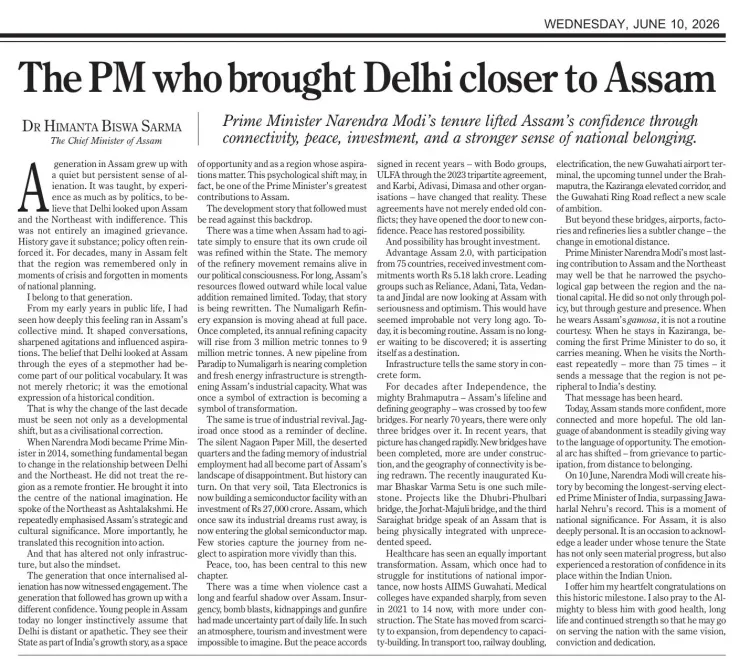
Chief Minister Himanta Biswa Sarma has penned a reflection on Prime Minister Modi's decade of governance, arguing it shifted Assam from a sense of geographic and political distance to one of national belonging through infrastructure investment, peace accords, and the Act East Policy.
Key Takeaways
The Chief Minister's Office of Assam shared CM Himanta Biswa Sarma 's authored piece on June 11, 2026 .
Sarma's writing frames the last decade under PM Narendra Modi as transformative for Assam 's development and sense of national integration.
The Act East Policy (post-2014) prioritised rail, road, and economic connectivity between the Northeast and the rest of India.
The 2020 Bodo Peace Accord resolved a long-standing ethnic conflict in Assam , combining political autonomy with development packages.
Sarma's perspective is shaped by his own political journey — from Congress to BJP in 2015 — and his role as Chief Minister since 2021 .
The piece is expected to feature in BJP's broader communication strategy on Northeast development ahead of future electoral cycles.
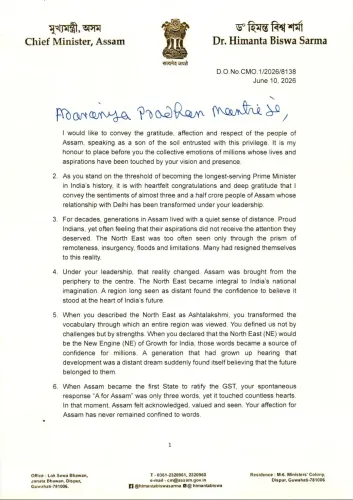
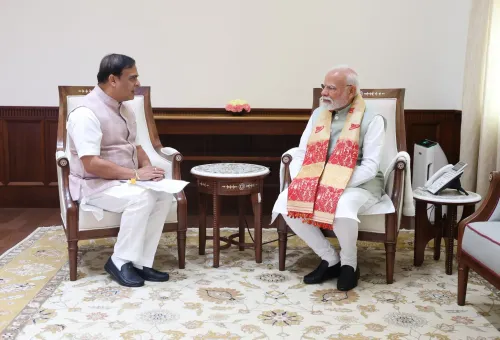
The Chief Minister's Office of Assam shared on Thursday, June 11, 2026, that Chief Minister Dr. Himanta Biswa Sarma has authored a piece reflecting on how Prime Minister Narendra Modi's decade in office transformed Assam's development trajectory and deepened the state's sense of national belonging.
Context
The CMO's post describes Sarma's writing as tracing a journey 'from distance to belonging' — a phrase that encapsulates the long-standing perception of Assam and the broader Northeast as geographically and politically peripheral to mainland India. Sarma's article, as characterised by the official post, credits Modi's leadership over the last decade with reversing that sense of estrangement through deliberate policy choices and infrastructure investment.
The piece is framed as a personal reflection by the Chief Minister, lending it both a political and a narrative dimension. It arrives at a moment when the BJP-led governments at the Centre and in Dispur have consistently amplified messaging around Northeast integration as a signature achievement of the Modi era.
Policy Backdrop
The Act East Policy, introduced after the 2014 general election, repositioned the Northeast as a gateway to Southeast Asia, prioritising rail, road, and digital connectivity across states including Assam. Large-scale rail and highway projects have since reduced travel times between the Northeast and the rest of India, with Assam serving as the logistical hub of the region.
The 2020 Bodo Peace Accord, signed under the Modi government, brought a formal resolution to one of Assam's most protracted ethnic conflicts, pairing political autonomy measures with development packages for Bodoland Territorial Council areas. That accord is frequently cited by state and central leaders as evidence that security and development can be pursued in tandem.
Sarma himself joined the BJP in 2015 after a long tenure in the Congress, and has since become one of the party's most prominent voices on Northeast affairs. His perspective carries weight both as a state executive and as a political figure who witnessed the transition from the earlier dispensation.
Stakeholders and Impact
The primary beneficiaries of the policies Sarma references are the roughly 3.5 crore residents of Assam and the wider Northeast communities who experienced decades of insurgency, economic underdevelopment, and connectivity deficits. Infrastructure improvements — bridges, highways, broadband rollout — have material consequences for daily mobility, trade, and access to services.
Beyond infrastructure, the narrative of 'belonging' speaks to a political and cultural integration that successive governments have pursued with varying success. Ethnic communities, indigenous groups, and civil society organisations in Assam have diverse views on how fully that integration has been realised, and those perspectives form an important counterpoint to the official framing.
What's Next
Sarma's article is likely to circulate widely as part of the BJP's broader communication strategy ahead of future electoral cycles, reinforcing the party's claim to ownership of Northeast development. Observers will watch whether the piece catalyses a fresh policy announcement or central scheme for the region, particularly in light of upcoming state budget allocations for Assam's infrastructure pipeline. The framing of 'national integration' through development spending will remain a live debate as communities assess the gap between connectivity metrics and lived experience on the ground.
Point of View
' the piece subtly indicts the pre-2014 era without naming it, a rhetorical device common in ruling-party messaging. The timing, shared through the official CMO account rather than Sarma's personal handle, signals institutional endorsement and suggests the article will be amplified across government channels. For analysts, the more consequential question is whether the development metrics cited translate into durable political loyalty among Assam's diverse ethnic and linguistic communities, or whether the narrative outpaces the ground reality.
NationPress
26 Oct 2026
Frequently Asked Questions
What has CM Himanta Biswa Sarma written about PM Modi and Assam?
CM Himanta Biswa Sarma has authored a piece arguing that PM Narendra Modi's decade in office reshaped Assam's development journey and transformed the state's relationship with national integration, moving from a sense of geographic distance to one of belonging.
What is the Act East Policy and how does it relate to Assam?
The Act East Policy, introduced by the Modi government after 2014, repositioned India's Northeast — with Assam as its hub — as a gateway to Southeast Asia, driving investment in rail, road, and digital connectivity that reduced the region's historical isolation.
What was the Bodo Peace Accord and what did it achieve in Assam?
The Bodo Peace Accord, signed in 2020 under the Modi government, formally resolved one of Assam's longest-running ethnic conflicts by granting political autonomy measures to Bodo communities and pairing them with targeted development packages for Bodoland Territorial Council areas.
When did Himanta Biswa Sarma become Chief Minister of Assam?
Himanta Biswa Sarma became Chief Minister of Assam in 2021. He had joined the BJP in 2015 after a long career in the Congress party, and has since become a leading BJP voice on Northeast affairs.
Why is the CMO Assam sharing this article about Modi's governance?
The Chief Minister's Office shared the piece through its official account, lending it institutional weight. It forms part of the BJP-led government's consistent messaging that infrastructure spending and peace initiatives under Modi have delivered tangible integration benefits to Assam and the Northeast.