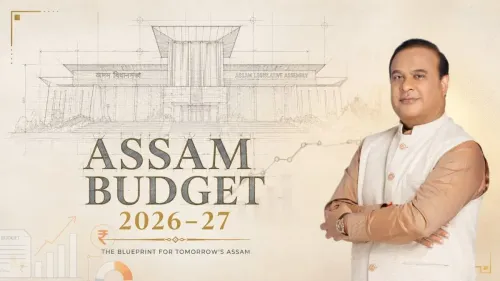
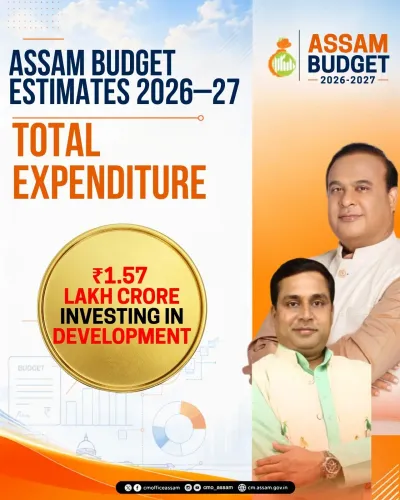
Assam Budget 2026-27: 2 lakh jobs, ₹72,000 crore power push, Dibrugarh as 2nd capital
Synopsis
Assam's 2026-27 Budget isn't incremental — it's a statement of intent. A ₹72,000 crore power bet, a second capital for Upper Assam, an airport targeting 80 million passengers, and 2 lakh government jobs: Finance Minister Jayanta Malla Baruah has placed the state's biggest development chips on the table in a single Budget speech.
Key Takeaways
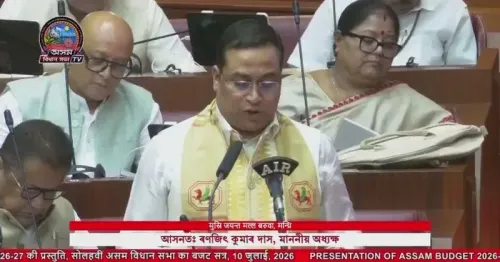
Assam Finance Minister Jayanta Malla Baruah presented the 2026-27 Budget in the Assembly on 10 July 2026 .
The government targets 2 lakh government jobs and recruitment of 33,000 healthcare personnel .
A ₹72,000 crore investment is proposed for the power sector, covering thermal, hydro, solar, and battery storage. ₹4,000 crore allocated for irrigation in the Brahmaputra valley to boost agricultural productivity.
Guwahati Airport is targeted for expansion to 80 million passenger capacity .
Dibrugarh is proposed as Assam's second capital to promote balanced regional development.
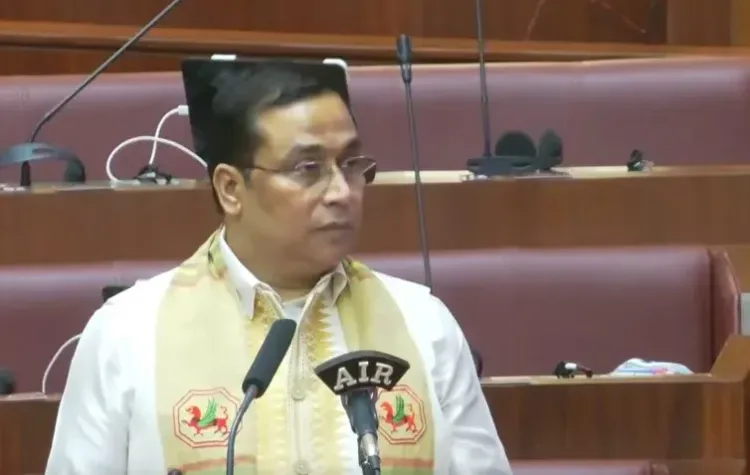
Assam Finance Minister Jayanta Malla Baruah on Friday, 10 July 2026 presented the 2026-27 state Budget in the Assam Legislative Assembly in Guwahati, laying out an employment-first roadmap anchored by 10 key initiatives spanning job creation, infrastructure, healthcare, education, and social welfare. The Budget is among the most expansive in recent Assam history, anchoring a ₹72,000 crore power-sector commitment alongside a target of 2 lakh government jobs.
Employment and Skill Development
Job creation sits at the heart of the Budget. The state government has committed to filling 2 lakh government positions, the single largest employment target announced in the Budget speech. Beyond direct recruitment, the government plans to boost youth employability through skill development programmes covering artificial intelligence, visual effects (VFX), and foreign languages including English, Japanese, and Korean — signalling an intent to connect Assam's workforce to both domestic and international job markets.
The healthcare sector will also see a major staffing push, with the government announcing plans to recruit 33,000 healthcare personnel to strengthen district hospitals and improve public health delivery across the state.
Power and Infrastructure: The Big Numbers
The Budget proposes an investment of ₹72,000 crore in the power sector, covering thermal, hydro, solar, and battery energy storage projects. The scale of the commitment reflects Assam's ambition to not only meet its own future energy demands but to position itself as an energy hub for the wider Northeast.
In aviation, the government has set a target of expanding Guwahati Airport to an 80-million-passenger capacity, a move that would make it one of India's largest airports by throughput and a critical gateway for the region. Broader infrastructure proposals include accelerated work on roads, bridges, rail, and airport connectivity across the state.
In a notable regional development move, Baruah proposed the construction of Dibrugarh as Assam's second capital, aimed at promoting balanced development in Upper Assam and improving administrative accessibility beyond Guwahati.
Agriculture and Irrigation
To strengthen the agrarian backbone of the state, the Budget allocates ₹4,000 crore for irrigation projects in the Brahmaputra valley. The outlay is intended to expand irrigation coverage and raise agricultural productivity in a region where flood cycles and water management remain perennial challenges.
Healthcare, Education and Social Welfare
The government reaffirmed continuity for flagship welfare schemes — Orunodoi, Nijut Moina, and other social security programmes — ensuring that existing beneficiaries face no disruption. Welfare programmes for tea tribe communities and plantation workers will also continue, with a focus on healthcare, nutrition, and living conditions in tea-growing belts.
In education, the Finance Minister reaffirmed ongoing recruitment of teachers across universities, colleges, and newly established institutions to address faculty shortages and improve higher education infrastructure.
What Comes Next
The Budget now moves to the Assembly for debate and passage. Implementation timelines for the Dibrugarh second-capital proposal, the Guwahati Airport expansion, and the power-sector investments are yet to be detailed. Whether the 2 lakh jobs target comes with a binding recruitment calendar will be closely watched by opposition parties and civil society groups in the months ahead.
Point of View
But the absence of a binding recruitment calendar for the 2 lakh jobs target is a familiar gap — one that has allowed similar state-level employment announcements to quietly expire between sessions. The Dibrugarh second-capital proposal is politically significant for Upper Assam but risks becoming an administrative cost centre without a clear devolution of powers. The ₹72,000 crore power commitment, if executed, would be transformational for the Northeast; the question is whether Assam's project execution machinery — historically stretched — can absorb an outlay of that scale without the usual time and cost overruns.
NationPress
8 Oct 2026
Frequently Asked Questions
What are the key highlights of the Assam Budget 2026-27?
The Assam 2026-27 Budget, presented on 10 July 2026, targets 2 lakh government jobs, proposes a ₹72,000 crore power-sector investment, allocates ₹4,000 crore for Brahmaputra valley irrigation, and plans to expand Guwahati Airport to 80 million passenger capacity. It also proposes Dibrugarh as Assam's second capital.
How many jobs does the Assam government plan to create?
The Assam government has set a target of providing 2 lakh government jobs as part of the 2026-27 Budget. Additionally, 33,000 healthcare personnel are to be recruited to strengthen district hospitals across the state.
What is the Dibrugarh second capital proposal in the Assam Budget?
Finance Minister Jayanta Malla Baruah proposed the construction of Dibrugarh as Assam's second capital to promote balanced regional development and improve administrative accessibility in Upper Assam. Detailed implementation timelines have not yet been announced.
What welfare schemes will continue under the Assam Budget 2026-27?
The Budget confirmed that flagship welfare schemes — Orunodoi, Nijut Moina, and other social security initiatives — will continue without interruption. Welfare programmes for tea tribe communities and plantation workers, focusing on healthcare and nutrition, will also be maintained.
What skill development initiatives are proposed in the Assam Budget?
The Budget proposes training young people in artificial intelligence, visual effects (VFX), and foreign languages including English, Japanese, and Korean, aimed at improving their prospects in both domestic and international job markets.