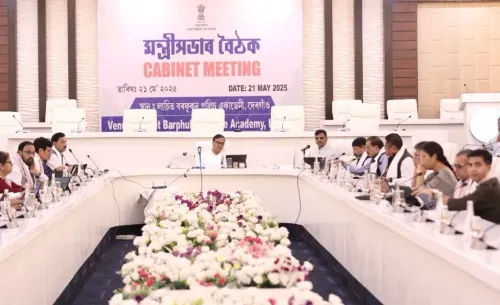
CM Himanta eyes Dibrugarh as second capital, ₹500 cr earmarked
Synopsis
Chief Minister Himanta Biswa Sarma has announced ₹500 crore for developing Dibrugarh as Assam's second capital, a new airport in Silchar, Rupsi Airport as a logistics hub, two lakh youth jobs, and new medical colleges in four districts.
Key Takeaways
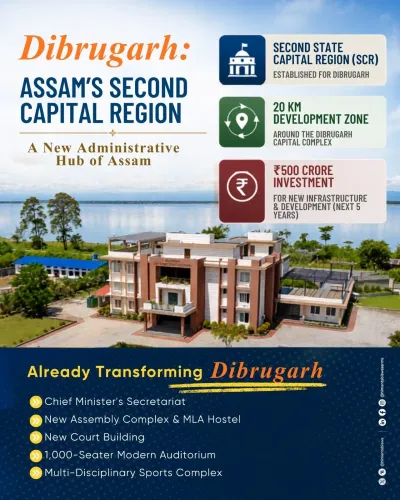
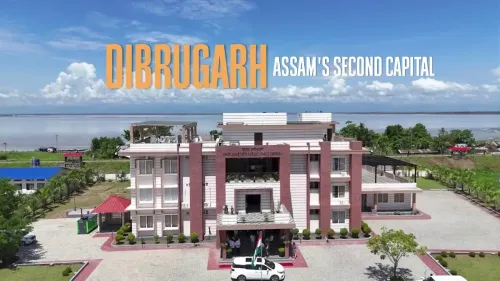
Dibrugarh is being developed as Assam's second capital with ₹500 crore allocated for development works.
A new greenfield airport in Silchar is planned to improve connectivity to the Barak Valley region.
Rupsi Airport in Dhubri district is being repurposed as a civil logistics and cargo hub .
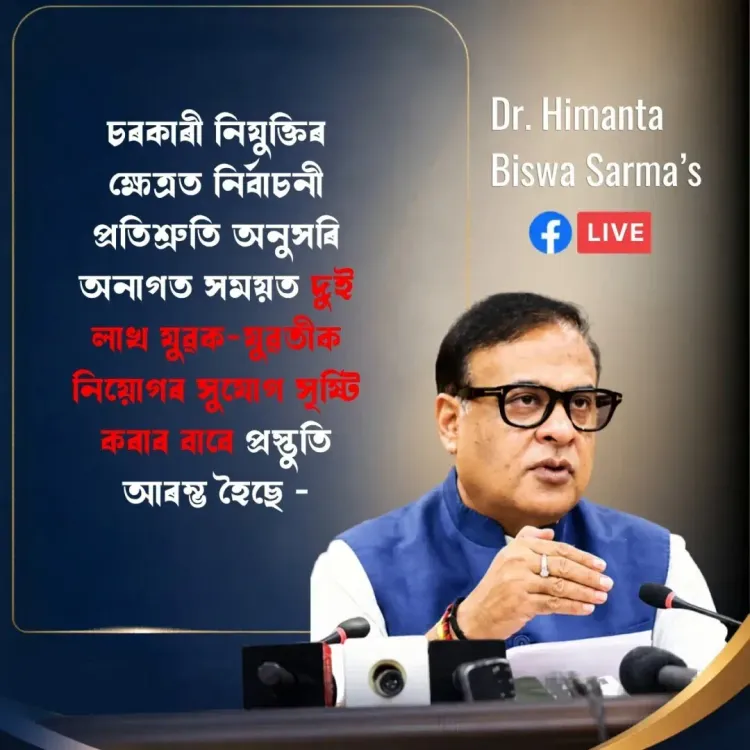
Around two lakh job opportunities are being planned for Assam's youth in the coming period.
New medical colleges are planned in Hailakandi , Hojai , Bajali , and Goalpara to expand healthcare education.
The announcements were made by CM Dr.
Himanta Biswa Sarma during a Facebook Live session.
The Chief Minister's Office of Assam on Monday, 15 June 2026 shared key announcements made by Chief Minister Dr. Himanta Biswa Sarma during a recent Facebook Live session, revealing plans to develop Dibrugarh as the state's second capital with an allocation of ₹500 crore for development works, alongside major infrastructure and employment initiatives spanning aviation, healthcare, and higher education.
Context
CM Himanta Biswa Sarma used the Facebook Live interaction to outline a multi-pronged development agenda for Assam. He stated that Dibrugarh, the commercial nerve centre of Upper Assam, is being developed as the state's second capital, with ₹500 crore set aside for associated development works. The announcement signals a deliberate policy push to shift administrative and economic weight away from Guwahati and toward the state's eastern districts.
The Chief Minister also announced plans for a new airport in Silchar, the principal city of the Barak Valley in southern Assam, aimed at improving connectivity to a region that has long remained geographically isolated. Separately, Rupsi Airport in Dhubri district — a former Indian Air Force airfield — is being developed as a logistics and cargo hub.
Policy Backdrop
The airport initiatives align with the national UDAN (Ude Desh ka Aam Naagrik) regional connectivity scheme, under which several underserved Assam airfields have been identified for civil aviation use since 2016. Repurposing Rupsi Airport as a logistics hub fits within this framework and could open freight corridors to the economically sensitive Assam-Bhutan-Bangladesh border region.
On healthcare, CM Sarma highlighted ongoing efforts to set up new medical colleges in Hailakandi, Hojai, Bajali, and Goalpara. These additions continue Assam's post-2016 district-wise medical college expansion, pursued partly under centrally sponsored schemes to raise MBBS intake in underserved areas and address long-standing spatial imbalances in health infrastructure across the state.
Stakeholders and Impact
CM Sarma announced preparations to create around two lakh job opportunities for Assam's youth in the coming period, reflecting the state government's recurring focus on absorbing a large young population entering the labour market each year. He further noted ongoing efforts to strengthen higher education infrastructure alongside the healthcare push.
Residents of Upper Assam stand to benefit most directly from the Dibrugarh second-capital proposal, while the Barak Valley population — historically underserved on connectivity — could see significant change if the Silchar airport project advances. Students and medical aspirants in Hailakandi, Hojai, Bajali, and Goalpara districts would gain access to medical education closer to home.
What's Next
Key milestones to watch include the tendering and fund utilisation process for the ₹500 crore Dibrugarh development package, formal approvals and land acquisition proceedings for the new Silchar airport, and the rollout of recruitment timelines tied to the two-lakh jobs target. Progress on the four new medical colleges — from regulatory clearances to construction — will also be closely tracked by stakeholders across the affected districts.
Together, these announcements suggest that Assam's development strategy under CM Himanta Biswa Sarma is increasingly oriented toward decentralised growth, with the state's eastern and southern peripheries positioned as the next frontier of infrastructure investment.
Point of View
Moving state investment visibly toward Upper Assam and the Barak Valley ahead of what is likely an electorally sensitive period. Designating Dibrugarh as a second capital carries strong symbolic weight for the Brahmaputra Valley's eastern constituencies, while the Silchar airport and Barak Valley healthcare push address long-standing grievances in a region that has historically felt neglected. The two-lakh jobs target, though aspirational, anchors the narrative in economic urgency and youth aspiration — a recurring theme in Assam's political communication since 2021. Whether these commitments translate into on-ground outcomes will depend on the pace of tendering, regulatory clearances, and inter-governmental coordination, particularly for the aviation projects.
NationPress
14 Sept 2026
Frequently Asked Questions
Why is Dibrugarh being made Assam's second capital?
Chief Minister Himanta Biswa Sarma announced that Dibrugarh is being developed as Assam's second capital to decentralise governance and economic activity away from Guwahati toward Upper Assam, with ₹500 crore allocated for development works.
Where will the new airport in Assam be built?
A new airport is planned in Silchar, the main city of the Barak Valley in southern Assam, aimed at improving air connectivity to a region that has limited transport links.
What is Rupsi Airport being developed for?
Rupsi Airport in Dhubri district, a former Indian Air Force airfield, is being developed as a civil logistics and cargo hub under Assam's infrastructure expansion plans.
How many jobs is the Assam government planning to create?
CM Himanta Biswa Sarma announced plans to create around two lakh job opportunities for Assam's youth in the coming period, though specific timelines were not detailed in the announcement.
Which districts will get new medical colleges in Assam?
New medical colleges are planned in Hailakandi, Hojai, Bajali, and Goalpara, as part of Assam's ongoing effort to expand healthcare education and services in underserved districts.