CM Himanta Announces ₹500 Cr Second Capital in Dibrugarh

Synopsis
Assam Chief Minister Himanta Biswa Sarma has announced a ₹500 crore Second State Capital Region in Dibrugarh, aiming to decentralise governance and ease congestion in Guwahati by bringing administration and infrastructure closer to Upper Assam's population.
Key Takeaways
₹500 crore has been committed for the development of a Second State Capital Region in Dibrugarh .
CM Himanta Biswa Sarma described 'decentralisation and decongestion' as the twin pillars of Assam's governance strategy.
The project is intended to bring state administration and infrastructure closer to residents of Upper Assam .
Assam has been governed from Dispur, Guwahati since 1973 , creating a long-standing geographic imbalance with eastern districts.
Dibrugarh already serves as the commercial and educational hub of Upper Assam, with an airport and university in place.
Tendering, land acquisition, and assembly budget allocations are the key milestones to watch for project progress.
Assam Chief Minister Himanta Biswa Sarma on Saturday, 11 July 2026 announced a ₹500 crore investment to develop a Second State Capital Region in Dibrugarh, framing the project as the centrepiece of the state's decentralisation and urban-decongestion agenda. The initiative aims to bring administrative functions, infrastructure, and economic opportunity closer to the people of Upper Assam.
Context
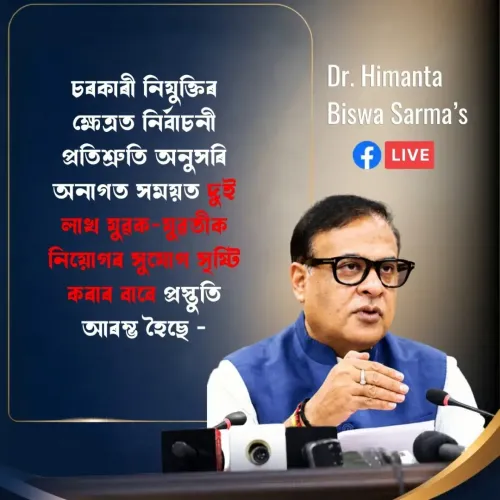
Posting on X, CM Sarma described 'decentralisation and decongestion' as the 'twin pillars' of his government's governance and urban development strategy. He stated that the Dibrugarh project would 'bring administration, infrastructure and opportunity closer to the people of Upper Assam,' signalling a deliberate eastward shift in the state's administrative centre of gravity.
Assam has been governed from Dispur in Guwahati since 1973, when the capital was relocated from Shillong following Meghalaya's formation as a separate state. Since then, Guwahati has grown into a congested metropolitan hub while the vast districts of Upper Assam — stretching toward the Arunachal Pradesh and Nagaland borders — have long pressed for a stronger administrative presence closer to home.
Policy Backdrop
Successive state governments have grappled with the geographic imbalance between Lower Assam, anchored by Guwahati, and the resource-rich but administratively distant Upper Assam belt, which encompasses the tea-garden districts and the Brahmaputra oil corridor around Dibrugarh. Periodic demands for decentralised governance have been a recurring feature of Assam's political landscape for decades.
The Sarma administration has framed the Second State Capital Region as a structural solution rather than a symbolic gesture, pairing it with a concrete ₹500 crore outlay. The approach mirrors similar spatial-development initiatives undertaken by other large Indian states seeking to reduce the primacy of a single dominant city and spread public services more evenly across their territories.
Stakeholders and Impact
The most immediate beneficiaries would be residents across Upper Assam districts — including Dibrugarh, Tinsukia, Sivasagar, Jorhat, and Charaideo — who currently must travel significant distances to access state-level administrative services concentrated in Guwahati. State government employees posted to the new complex would also face a significant change in work locations.
Dibrugarh already functions as the commercial, educational, and transport hub of Upper Assam, home to Dibrugarh University and a regional airport with direct connectivity to major cities. A formal second capital designation backed by infrastructure investment could accelerate real-estate, hospitality, and ancillary service sectors in the region.
What's Next
The immediate milestones to watch include tendering processes, land acquisition proceedings, and the construction timeline for the Dibrugarh complex. Any supplementary budget allocations in the next Assam Legislative Assembly session would provide a clearer picture of how the ₹500 crore commitment is to be phased and disbursed.
If executed as announced, the Second State Capital Region could reshape the political and administrative map of Assam, reducing the concentration of power in Guwahati and offering the BJP-led government a tangible development narrative ahead of future electoral cycles in the state's eastern districts.
Point of View
Converting a longstanding regional grievance into a funded infrastructure project. For CM Sarma, it serves a dual purpose: addressing the structural urban-pressure problem in Guwahati while consolidating the BJP's political footprint in Upper Assam, a belt of districts with distinct socio-economic identities and electoral weight. The ₹500 crore figure gives the initiative credibility beyond past symbolic gestures, though delivery timelines and land acquisition will be the real tests. Nationally, the move fits a broader pattern of state governments using spatial governance reform as both a development tool and a political differentiator.
NationPress
10 Oct 2026
Frequently Asked Questions
What is the Assam Second State Capital Region in Dibrugarh?
It is a proposed administrative and infrastructure complex in Dibrugarh, Upper Assam, announced by Chief Minister Himanta Biswa Sarma with a ₹500 crore investment, designed to shift select state government functions eastward and reduce dependence on Guwahati.
Why is Assam building a second capital in Dibrugarh?
The project aims to decentralise governance and decongest Guwahati, bringing state administration and public services closer to the people of Upper Assam, who have historically had to travel long distances to access state-level offices.
How much money is being invested in the Dibrugarh second capital project?
Chief Minister Himanta Biswa Sarma has announced an investment of ₹500 crore for the Second State Capital Region in Dibrugarh.
Where is Assam's current state capital?
Assam's current state capital is Dispur, located within Guwahati in Lower Assam. It has served as the capital since 1973, when the seat of government was moved from Shillong after Meghalaya became a separate state.
What is the significance of Dibrugarh for Upper Assam?
Dibrugarh is the principal commercial, educational, and transport hub of Upper Assam, home to Dibrugarh University and a regional airport, and sits at the heart of the state's tea-garden and petroleum belt, making it a natural anchor for a second administrative centre.