Assam Budget 2026 Allocates ₹731 Cr for Animal Husbandry
Synopsis
The Chief Minister's Office of Assam announced a ₹731 crore allocation for the Animal Husbandry and Veterinary sector in the Assam Budget 2026, aimed at boosting livestock farming, veterinary infrastructure, and sustainable rural livelihoods under CM Dr. Himanta Biswa Sarma's leadership.
Key Takeaways
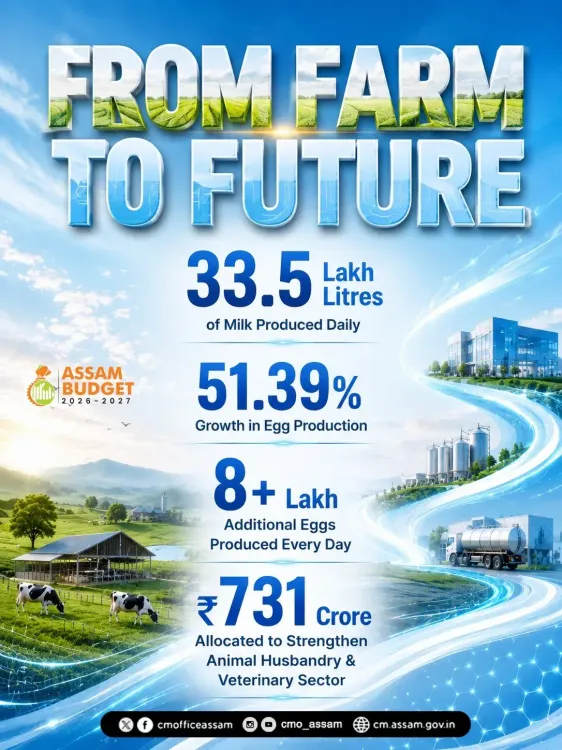
The Assam Budget 2026 allocates ₹731 crore to the Animal Husbandry and Veterinary sector.
The outlay targets strengthening livestock farming, enhancing veterinary infrastructure, and creating rural livelihoods.
The initiative is framed under the 'From Farm to Future' vision of CM Dr.
Himanta Biswa Sarma .
Assam budgets have progressively increased agriculture and allied sector outlays since 2021 .
Primary beneficiaries include rural livestock farmers, veterinary staff, and rural households across Assam .
Implementation of funded infrastructure projects and subsequent production data will be key indicators of impact.
The Chief Minister's Office of Assam announced on Sunday, 12 July 2026 that the Assam Budget 2026 has earmarked ₹731 crore for the Animal Husbandry and Veterinary sector, signalling a significant push toward strengthening livestock farming and rural livelihoods across the state.
Context
The allocation was highlighted by the Chief Minister's Office under the banner 'From Farm to Future,' framing the budgetary provision as central to the state government's rural prosperity agenda. The announcement credits the initiative to the leadership of Chief Minister Dr. Himanta Biswa Sarma, who has helmed the Assam government since May 2021. The ₹731 crore outlay is directed at strengthening livestock farming, enhancing veterinary infrastructure, and creating sustainable livelihoods in rural areas of the state.
Policy Backdrop
Since 2021, successive Assam budgets have progressively raised outlays for agriculture and allied sectors as part of the state government's strategy to diversify rural incomes beyond traditional crops. The Animal Husbandry and Veterinary Department of Assam oversees livestock health, breeding programmes, and veterinary services across the state's rural districts, making it a key vehicle for this agenda. At the national level, the National Livestock Mission, launched in 2014, provides central support to states including Assam for livestock development, breed improvement, and veterinary infrastructure expansion.
Assam's emphasis on animal husbandry aligns with a broader pattern among northeastern Indian states, which have increasingly turned to livestock and dairy development to address rural underemployment and improve nutritional security. The region's large rural population, many of whom depend on allied agricultural activities for income, makes such allocations particularly consequential.
Stakeholders and Impact
The primary beneficiaries of this allocation are expected to be rural livestock farmers, veterinary staff, and rural households across Assam. Improved veterinary infrastructure could translate into better animal health outcomes, higher livestock productivity, and more stable incomes for farming families. The sector also holds significance for nutritional security, as dairy and poultry activities contribute directly to household food access in rural communities.
Beyond direct farming households, the allocation is likely to generate downstream employment in veterinary services, feed supply chains, and allied rural enterprises. For a state where a substantial share of the population remains engaged in agriculture and related activities, such investments carry outsized economic weight.
What's Next
Attention will now turn to the rollout of specific veterinary infrastructure projects and livestock development schemes funded under the ₹731 crore allocation. Implementation timelines, district-level disbursement plans, and subsequent livestock production or rural employment data from the state government will indicate how effectively the budgetary commitment translates into ground-level impact. The Assam government's ability to deploy these funds efficiently will be closely watched by rural stakeholders and policy observers alike.
Point of View
This outlay fits a consistent pattern of using annual budgets to expand the livestock and veterinary ecosystem. The 'From Farm to Future' framing also carries political salience ahead of electoral cycles, positioning the ruling dispensation as a credible steward of agrarian welfare. Whether the allocation produces measurable gains in livestock productivity and rural employment will ultimately determine its policy legacy.
NationPress
11 Oct 2026
Frequently Asked Questions
How much has Assam allocated for Animal Husbandry in Budget 2026?
The Assam Budget 2026 has allocated ₹731 crore for the Animal Husbandry and Veterinary sector to strengthen livestock farming and rural livelihoods.
What is the 'From Farm to Future' initiative in Assam?
'From Farm to Future' is the framing used by the Chief Minister's Office of Assam to describe the Assam Budget 2026's focus on rural prosperity, particularly through investment in livestock farming and veterinary infrastructure.
Who is the Chief Minister of Assam in 2026?
Dr. Himanta Biswa Sarma is the Chief Minister of Assam, serving since May 2021 and leading the state BJP government.
What does the Animal Husbandry and Veterinary Department of Assam do?
The Animal Husbandry and Veterinary Department of Assam oversees livestock health, breeding programmes, and veterinary infrastructure across the state's rural districts to support farmers and rural households.
How does Assam's animal husbandry budget compare to previous years?
Assam budgets have progressively increased outlays for agriculture and allied sectors, including animal husbandry, since 2021, reflecting a sustained policy priority under the current state government.