CM Yogi declares Ayodhya UP's first Solar City

Synopsis
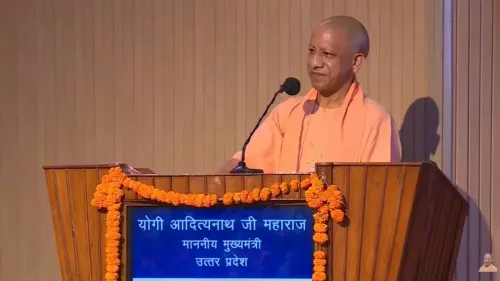
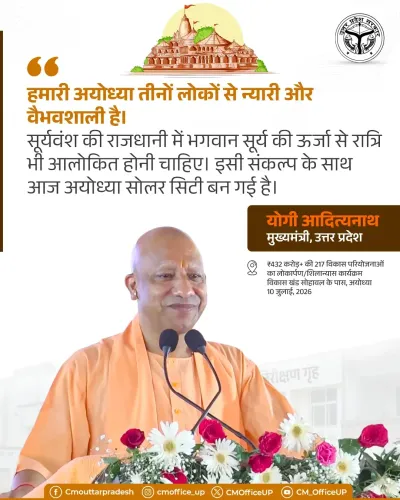
The Chief Minister's Office of Uttar Pradesh declared on 12 July 2026 that Ayodhya Dham has become the state's first Solar City, with all street lights and government buildings now powered by solar energy, under CM Yogi Adityanath's green development push.
Key Takeaways
Ayodhya Dham has been declared Uttar Pradesh's first Solar City as of 12 July 2026 .
Street lights and government buildings in Ayodhya are now powered entirely by solar energy .
The announcement was made by the Chief Minister's Office of UP , quoting CM Yogi Adityanath .
The move aligns with India's target of 500 GW non-fossil fuel capacity by 2030 and the state's Solar Energy Policy of 2017 .
Ayodhya's redevelopment, accelerated after the 2024 Ram Mandir inauguration , now incorporates large-scale renewable energy infrastructure.
The state government has signalled possible extension of the solar-city model to other UP municipalities .
The Chief Minister's Office of Uttar Pradesh announced on Sunday, 12 July 2026, that Ayodhya Dham has been established as Uttar Pradesh's first Solar City, with street lights and government buildings across the city now powered entirely by solar energy.
Quoting Chief Minister Yogi Adityanath, the official post stated: 'Aaj Ayodhya Dham Uttar Pradesh ki pehli Solar City ke roop mein sthapit ho chuka hai' — 'Today, Ayodhya Dham has been established as Uttar Pradesh's first Solar City.' The announcement was tagged under the campaigns #एक_पेड़_माँ_के_नाम, #PragatiBhiPrakritiBhi, and #GoGreen_UP, signalling the state government's effort to link development with environmental sustainability.
Context
Ayodhya has been the centrepiece of an accelerated civic redevelopment drive in Uttar Pradesh since the 2019 Supreme Court verdict and the landmark Ram Mandir inauguration in January 2024. The city's transformation has encompassed road widening, airport upgrades, beautification of the Saryu riverfront, and now the integration of renewable energy infrastructure into public utilities. The solar-city designation marks a convergence of religious tourism development and clean-energy policy.Policy Backdrop
Uttar Pradesh notified its Solar Energy Policy in 2017, the same year CM Yogi Adityanath assumed office, to promote rooftop and utility-scale solar installations across the state. At the national level, the National Solar Mission, launched in 2010, set the framework for large-scale solar deployment, and India has since committed to achieving 500 GW of non-fossil fuel capacity by 2030 and net-zero emissions by 2070. Multiple Indian states have been designating solar cities to shift public lighting and government buildings off the conventional grid, and Ayodhya's elevation to this status places UP on that national map. The central government's PM Surya Ghar Muft Bijli Yojana provides an additional financing layer for such transitions.Stakeholders and Impact
For Ayodhya's residents and urban local bodies, solar-powered street lighting reduces dependence on grid electricity and lowers municipal energy costs over the long term. Renewable energy firms operating in Uttar Pradesh stand to benefit from the state's demonstrated willingness to commission large urban solar projects at religious and heritage sites. Pilgrims and tourists — who arrive in the city in the millions following the Ram Mandir inauguration — will experience a city whose public infrastructure is visibly aligned with sustainability goals. The move also carries reputational value for the state government ahead of future urban development tenders.What's Next
The Uttar Pradesh government is expected to assess the Ayodhya model for replication in other municipalities across the state. Integration with central schemes such as the PM Surya Ghar Muft Bijli Yojana could accelerate the rollout to additional solar cities. Observers will watch whether the state formalises a solar-city designation framework and whether the Ayodhya project's energy output and coverage data are published for public accountability. The broader ambition, as signalled by the #PragatiBhiPrakritiBhi ('Progress as well as Nature') campaign, is to embed green infrastructure into UP's ongoing urban transformation.Point of View
Fusing the city's religious-tourism momentum with a green-infrastructure narrative ahead of UP's ongoing urban development cycle. By anchoring the announcement to Ayodhya — India's most politically prominent redevelopment project — the state government maximises visibility for what is otherwise a municipal energy transition. The move fits a broader pattern of Indian states using solar-city designations to demonstrate climate ambition without requiring state-level legislative action. Whether Ayodhya's model is scaled with rigour or remains a flagship showcase will be the real test of UP's renewable energy seriousness.
NationPress
11 Oct 2026
Frequently Asked Questions
What is Ayodhya Solar City and what does it mean?
Ayodhya Solar City is a designation given to Ayodhya Dham by the Uttar Pradesh government, signifying that the city's street lights and government buildings are now powered by solar energy, making it the first city in UP to achieve this status.
When did Ayodhya become UP's first Solar City?
The Chief Minister's Office of Uttar Pradesh announced the Solar City status on 12 July 2026 , with CM Yogi Adityanath credited with the declaration.
Which scheme supports solar cities in India?
The central government's PM Surya Ghar Muft Bijli Yojana and the National Solar Mission (launched 2010) are the primary national frameworks supporting solar city projects, complemented by state-level policies such as UP's Solar Energy Policy of 2017 .
Will other cities in Uttar Pradesh become solar cities?
The state government has signalled that the Ayodhya model may be extended to other UP municipalities, though no formal list of next cities has been announced.
How does the Ayodhya Solar City fit into India's climate targets?
India has committed to 500 GW of non-fossil fuel capacity by 2030 and net-zero by 2070. Designating urban centres as solar cities, as UP has done with Ayodhya, is one of the ways states contribute to these national renewable energy goals.