CM Yogi: Ayodhya is India's first Solar City
Synopsis
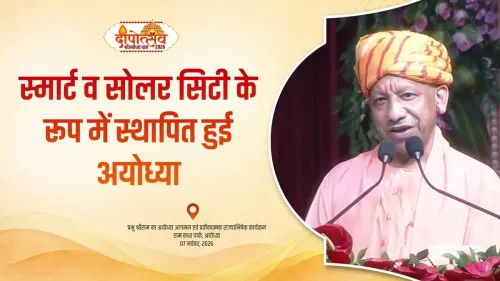
Chief Minister Yogi Adityanath declared Ayodhya India's first Solar City at Deepotsav 2026, spotlighting the city's transformation through Smart City infrastructure and grand heritage-linked corridors including Dharm Path, Bhakti Path, Shriram Path, and Janmabhoomi Path.
Key Takeaways
CM Yogi Adityanath proclaimed Ayodhya as India's first Solar City at Deepotsav 2026 on November 7, 2026 .
Ayodhya was inducted into the Smart Cities Mission in 2018 , focusing on urban mobility and heritage infrastructure.
Four key corridors — Dharm Path , Bhakti Path , Shriram Path , and Janmabhoomi Path — are highlighted as global attractions.
The Solar City status aligns with the Ministry of New and Renewable Energy's Solar City programme for urban renewable integration.
Deepotsav serves as an annual platform for the UP government to amplify Ayodhya's pilgrimage and tourism positioning.
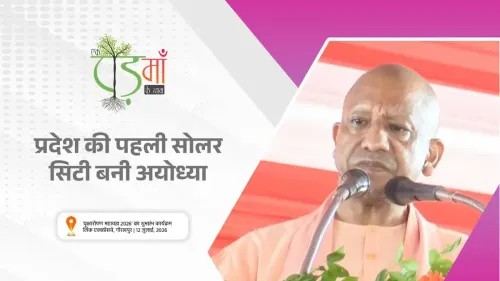
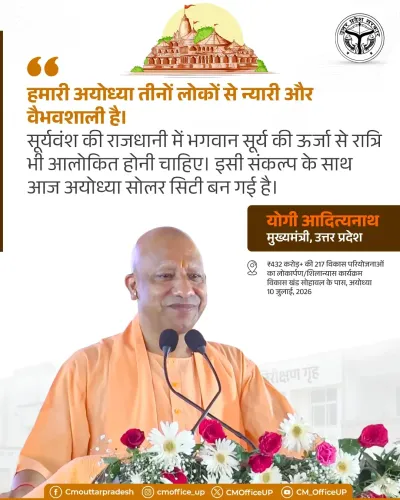
A city of ancient faith is now making a modern claim — Ayodhya, the birthplace of Lord Rama, has been declared both a Smart City and what the Chief Minister's Office of Uttar Pradesh is calling the country's first Solar City, a milestone Chief Minister Yogi Adityanath announced on Saturday, November 7, 2026, as the city marked another edition of the grand Deepotsav festival.
Speaking at the occasion, CM Yogi Adityanath said: 'Ayodhya Smart City ke saath-saath desh ki pehli Solar City ke roop mein bhi apni pehchan sthaapit kar chuki hai' — 'Ayodhya has established its identity not only as a Smart City but also as the country's first Solar City.' He added that grand thoroughfares including Dharm Path, Bhakti Path, Shriram Path, and Janmabhoomi Path are now drawing the attention of the entire world.
From pilgrimage town to planned smart corridor
Ayodhya was inducted into the Smart Cities Mission in 2018, with a mandate centred on urban mobility and heritage-linked infrastructure. The Central government programme, launched in 2015, targets integrated modernisation across 100 cities — and Ayodhya has emerged as one of its most visible showcases.
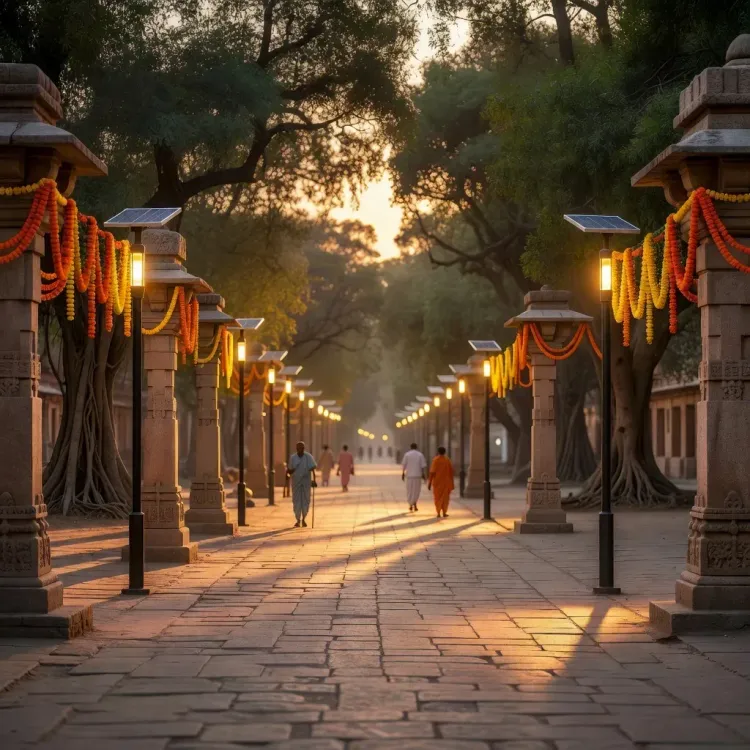
Alongside smart-city investments, the state government has pursued solar energy integration consistent with the Ministry of New and Renewable Energy's Solar City programme, which supports renewable adoption in selected urban centres. The four named paths — lined with ceremonial lighting, wide carriageways, and pilgrimage-facing amenities — form the backbone of this physical transformation.
Deepotsav as a stage for Ayodhya's reinvention
The announcement came during Deepotsav 2026 (#Deepotsav2026), the annual festival of lights that the Uttar Pradesh government has aggressively promoted as both a religious celebration and a tourism catalyst. Each year the event draws larger crowds of pilgrims and tourists, turning Ayodhya's ghats and boulevards into a spectacle that now carries deliberate brand-building intent.
The broader pattern is unmistakable: Uttar Pradesh has coordinated Central and state schemes — roads, solar lighting, smart infrastructure — into a single, coherent pitch for Ayodhya as a world-class pilgrimage destination. The question now is whether the solar and smart-city credentials translate into measurable improvements in air quality, energy costs, and the daily experience of the millions who travel here each year.
Ayodhya set out to become a city of light. By this government's account, it has arrived.
Point of View
Layering a renewable-energy credential onto Ayodhya's already high-profile Smart City and Ram Janmabhoomi narrative. By anchoring the claim to a televised, high-footfall festival, the CM's office maximises reach at a moment of peak symbolic resonance. The move fits a wider UP strategy of converging Central infrastructure schemes with state-led cultural projects to position Ayodhya as a globally recognisable destination. Whether the solar infrastructure achieves scale beyond ceremonial lighting will determine whether this remains a political talking point or a genuine urban-energy milestone.
NationPress
7 Nov 2026
Frequently Asked Questions
Is Ayodhya really India's first Solar City?
Chief Minister Yogi Adityanath has claimed this title for Ayodhya at Deepotsav 2026, citing solar energy integration under the Central government's Solar City programme. The claim has not been independently verified against other cities.
What is the Smart Cities Mission and when did Ayodhya join?
Ayodhya was included in the Smart Cities Mission in 2018 . The Central programme, launched in 2015 , aims to develop integrated infrastructure across 100 Indian cities.
What are Dharm Path, Bhakti Path, Shriram Path, and Janmabhoomi Path?
These are four grand new road corridors developed in Ayodhya as part of its urban redevelopment drive, designed to improve pilgrim access and tourism infrastructure around the Ram Janmabhoomi complex.
What is Deepotsav and why is it significant?
Deepotsav is an annual festival of lights held in Ayodhya , promoted by the Uttar Pradesh government as both a religious celebration and a major tourism event, drawing large crowds of pilgrims and visitors each year.
What is the Solar City programme in India?
The Solar City programme, initiated by the Ministry of New and Renewable Energy in the 2010s , supports selected urban areas in integrating renewable solar energy into their power mix and urban infrastructure.