CM Yogi pitches Ayodhya as India's first solar city
Synopsis
Uttar Pradesh Chief Minister Yogi Adityanath declared on 24 October 2026 that Ayodhya is set to become India's first solar city, with the city's entire street-lighting network already powered by solar green energy rather than thermal or hydro sources.
Key Takeaways
CM Yogi Adityanath announced on 24 October 2026 that Ayodhya is being positioned as India's first solar city.
Every street light in Ayodhya now reportedly runs on solar energy, with no dependence on thermal or hydro power.
The move aligns with the Central government's Solar City programme under the Ministry of New and Renewable Energy.
Uttar Pradesh has been installing solar infrastructure at key religious and tourist sites as part of broader state renewable energy policy.
The initiative feeds into India's national target of 500 GW of non-fossil fuel capacity by 2030 .
The 'first solar city' claim is yet to be formally verified or officially designated by the Central government.
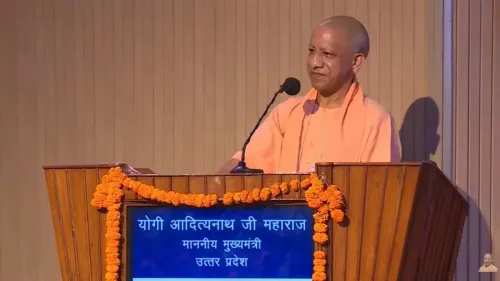
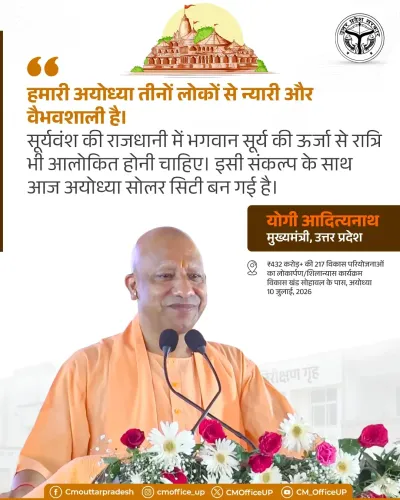
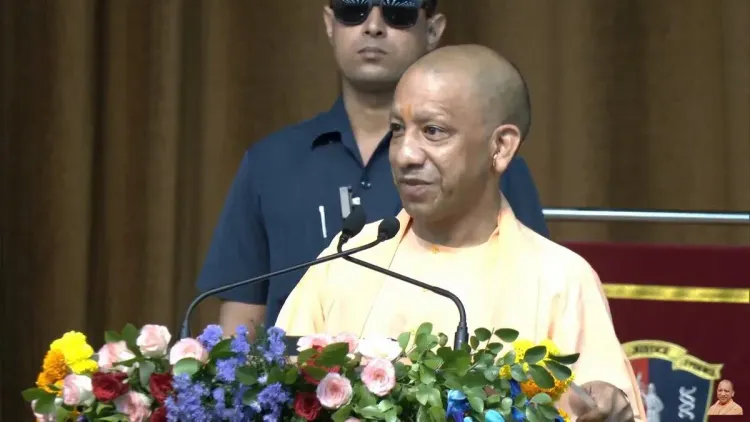
Every street lamp glowing in Ayodhya today draws its power not from a coal plant or a dam, but from the sun — and Uttar Pradesh Chief Minister Yogi Adityanath wants the world to know it. On Saturday, 24 October 2026, the Chief Minister took to X to declare that his government has made the arrangements to position Ayodhya as the country's first solar city, with the city's entire street-lighting network now running on green energy.
In his post, CM Yogi stated: 'हम लोगों ने ये व्यवस्था कर दी कि देश की पहली सोलर सिटी अयोध्या बने।' ('We have made the arrangement for Ayodhya to become the country's first solar city.') He added that every street light burning in Ayodhya today runs not on thermal or hydro power, but on solar light — on green energy.
Ayodhya's green makeover alongside its religious renaissance
Ayodhya has been at the centre of one of India's most ambitious urban redevelopment drives, accelerated after the consecration of the Ram Temple. The city has attracted massive infrastructure investment, and the Uttar Pradesh government has consistently layered renewable energy projects onto that broader transformation. Positioning the pilgrimage city as a solar showcase gives the redevelopment a dual identity — spiritual and sustainable.
The push aligns with the Central government's Solar City programme, run by the Ministry of New and Renewable Energy, which encourages selected urban centres to shift a significant share of their energy consumption to solar. Uttar Pradesh has rolled out solar installations at several key religious and tourist sites as part of its state renewable energy policy, feeding into India's national target of 500 GW of non-fossil fuel capacity by 2030.
Street lighting as the proof point
Street lighting is a highly visible, politically legible metric — residents and pilgrims see it every night. By anchoring the solar-city claim to street lamps rather than to an abstract megawatt figure, the Chief Minister makes the transition tangible. It is a deliberate communication choice: green energy as lived experience, not a policy document.
India's National Solar Mission, launched in 2010, specifically targeted urban solar applications including street lighting as an early-adoption pathway. Ayodhya's street-lighting transition, if fully realised at the scale claimed, would represent a meaningful downstream outcome of that decade-and-a-half-old policy architecture.
What the 'first solar city' tag means for UP's energy politics
The branding carries weight beyond Ayodhya's city limits. Uttar Pradesh — India's most populous state — has historically been associated with chronic power shortages. A solar-city milestone in its most symbolically charged city reframes that narrative sharply. Other cities in the state are likely watching: if the model holds, it becomes a template the state government can replicate and publicise.
The road from announcement to verified outcome is where the real story will be told — in measured energy savings, grid-integration data, and whether the 'first solar city' designation is formally conferred by the Centre. For now, Ayodhya's lit streets are the argument CM Yogi is making to the country.
Point of View
Giving the BJP a dual narrative of cultural revival and environmental progress in its most symbolically loaded city. Street lighting is a shrewdly chosen proof point: visible, everyday, and impossible to miss for the millions of pilgrims who now pass through the city. If the claim holds up to independent verification, it hands the UP government a replicable model and a powerful counter to the state's long-standing image as a power-deficit zone. The real test will be whether the Centre formally confers the solar-city designation and whether energy-savings data backs the headline.
NationPress
25 Oct 2026
Frequently Asked Questions
What is India's first solar city?
Uttar Pradesh Chief Minister Yogi Adityanath has claimed that Ayodhya is being made India's first solar city, with its entire street-lighting network running on solar energy. This designation has not yet been formally verified by the Central government.
What is the Solar City programme in India?
The Solar City programme is a Central government initiative under the Ministry of New and Renewable Energy that encourages selected urban centres to shift a significant portion of their energy consumption to solar power.
Is Ayodhya's street lighting fully solar-powered?
According to CM Yogi Adityanath's statement on 24 October 2026 , all street lights in Ayodhya are powered by solar energy and do not draw from thermal or hydro power sources. Independent verification of the full scale of this transition is pending.
How does Ayodhya's solar city plan fit India's renewable energy targets?
India has a national target of 500 GW of non-fossil fuel capacity by 2030 . Ayodhya's solar street-lighting network is part of Uttar Pradesh's broader push to install solar infrastructure at religious and tourist sites, contributing to this national goal.
What is the National Solar Mission and how does it relate to Ayodhya?
India's National Solar Mission , launched in 2010 , set targets for grid-connected solar power and specifically included urban solar applications like street lighting. Ayodhya's street-lighting transition is a downstream outcome of the policy framework established by that mission.