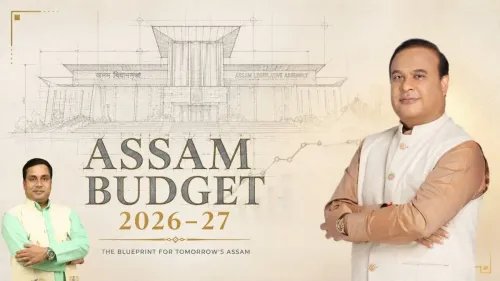
Assam Budget 2026 to Spotlight State's Cultural Heritage Globally
Synopsis
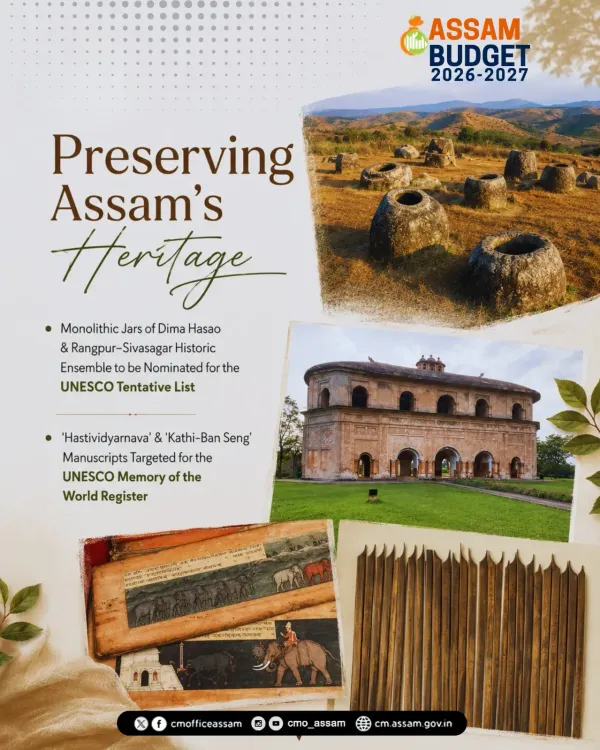
The Chief Minister's Office of Assam has announced that Assam Budget 2026 will adopt a comprehensive strategy to preserve, protect, and globally showcase the state's rich cultural and historical heritage, signalling culture as a headline budget priority.
Key Takeaways
The Chief Minister's Office of Assam announced on 19 July 2026 that Assam Budget 2026 will prioritise cultural and historical heritage preservation.
The budget envisions a 'comprehensive approach' to preserving, protecting, and showcasing Assam's heritage on the global stage.
Assam is home to two UNESCO World Heritage Sites — Kaziranga and Manas national parks — alongside Ahom-era monuments and diverse tribal traditions.
Chief Minister Himanta Biswa Sarma has consistently linked heritage conservation with tourism and economic development since taking office in May 2021 .
Specific allocations, named sites, and implementing agencies are expected to be revealed when the budget is formally presented.
The move aligns with a broader national pattern of Indian states treating regional culture as a soft-power and revenue asset.
The Chief Minister's Office of Assam announced on Sunday, 19 July 2026 that the upcoming Assam Budget 2026 will take a comprehensive approach to preserving, protecting, and showcasing the state's rich cultural and historical heritage, with the stated aim of bringing Assam's legacy to the global stage.
Context
The official announcement, shared under the hashtag #AssamBudget2026, describes the budget as envisioning a framework that goes beyond routine conservation — positioning Assam's timeless heritage for 'global recognition.' The post signals that cultural preservation will be a headline priority in the forthcoming budget document, though specific allocations and project details are yet to be formally presented.
Assam carries a layered historical identity: the centuries-long legacy of the Ahom dynasty, a mosaic of tribal traditions, and internationally recognised natural and cultural landmarks. The state is home to Kaziranga National Park, a UNESCO World Heritage Site celebrated for its biodiversity and closely intertwined with the state's cultural-tourism identity, alongside Manas National Park, another UNESCO-listed site.
Policy Backdrop
Chief Minister Himanta Biswa Sarma, who has led the state since May 2021, has consistently linked heritage conservation with tourism promotion and economic development in state planning. This budget signal follows a broader pattern visible across Indian state governments — treating regional culture as both a soft-power asset and a revenue driver.
Northeast India has received increasing central policy attention in recent years for safeguarding indigenous monuments and intangible heritage alongside infrastructure expansion. A dedicated heritage-focused budget line in Assam Budget 2026 would align the state with that wider national trajectory, reinforcing the Northeast's positioning as a cultural and tourism frontier.
Stakeholders and Impact
The tourism industry and local communities stand to be the most immediate beneficiaries if the budget translates its heritage vision into concrete allocations. For local artisans, performers of traditional arts, and custodians of historical sites, formal budgetary support could mean sustained livelihoods and institutional recognition.
For the tourism sector, global showcasing of Assam's heritage could translate into increased footfall at sites ranging from Ahom-era monuments in Sivasagar to the wetlands and wildlife corridors that define the state's landscape. The announcement is also likely to draw attention from cultural organisations and international bodies interested in heritage preservation partnerships.
What's Next
The formal presentation of Assam Budget 2026 will be the moment of reckoning — when the vision articulated in this announcement is tested against specific allocations, named sites, implementing agencies, and timelines. Observers will watch for whether the budget ring-fences dedicated funds for heritage documentation, site restoration, and international promotion, or integrates these goals within existing tourism and culture department lines.
If the budget delivers on its stated ambition, Assam could emerge as a benchmark for how Indian states translate cultural identity into structured policy — with implications for how the Northeast positions itself on the global heritage map.
Point of View
' the Chief Minister's Office is signalling ambition beyond domestic tourism, potentially courting UNESCO partnerships, diaspora engagement, and international cultural circuits. This mirrors a broader shift in Indian state governance where heritage is no longer treated as a welfare obligation but as a strategic investment. The real test will come when the budget is tabled — whether the rhetoric is matched by ring-fenced allocations and institutional capacity to execute at scale.
NationPress
19 Jul 2026
Frequently Asked Questions
What does Assam Budget 2026 plan for cultural heritage?
Assam Budget 2026 envisions a comprehensive approach to preserving, protecting, and showcasing the state's rich cultural and historical heritage, with the goal of bringing Assam's legacy to the global stage, according to the Chief Minister's Office.
Who is the Chief Minister of Assam in 2026?
Himanta Biswa Sarma is the Chief Minister of Assam, a post he has held since May 2021 . His office made the Assam Budget 2026 heritage announcement on 19 July 2026.
What UNESCO World Heritage Sites does Assam have?
Assam has two UNESCO World Heritage Sites: Kaziranga National Park , recognised for its biodiversity including the one-horned rhinoceros, and Manas National Park , known for its wildlife and landscape.
When will the details of Assam Budget 2026 heritage plans be known?
Specific allocations, project names, and implementing agencies for the heritage component of Assam Budget 2026 will be known when the budget is formally presented to the state legislature.
How does Assam's heritage budget plan fit into India's broader policy trends?
Assam's approach mirrors a wider Indian state-level strategy of treating regional culture as both a soft-power asset and a revenue driver, with Northeast states receiving increasing central policy attention for heritage safeguarding alongside infrastructure growth.