Assam CM Himanta clears law to regulate coaching centres
Synopsis
The Assam Cabinet has approved legal safeguards to regulate private coaching centres, mandating that student well-being take precedence over commercial pressures. Chief Minister Himanta Biswa Sarma announced the decision on August 18, 2026, signalling a proactive state-level push to address India's coaching industry accountability gap.
Key Takeaways
The Assam Cabinet approved legal safeguards for coaching centres on August 18, 2026 .
The law is designed to ensure coaching institutes prioritise students' well-being over commercial or performance pressure.
Chief Minister Himanta Biswa Sarma announced the decision, framing it as a student-welfare measure.
Assam joins a small group of states taking proactive legislative action on coaching centre regulation ahead of any central framework.
Detailed provisions — including registration norms, penalties, and inspection mechanisms — are yet to be made public.
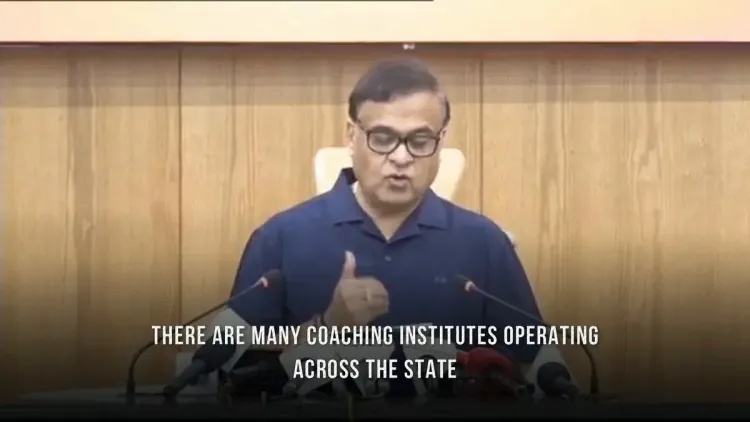
Pressure over performance. Assam Chief Minister Himanta Biswa Sarma has drawn a firm line — coaching centres in the state must put students' well-being first, or face legal consequences. The Assam Cabinet, in its meeting on Tuesday, August 18, 2026, approved dedicated legal safeguards to regulate how private coaching institutes operate across the state.
What the Cabinet decision covers
The approved framework is designed to ensure that coaching centres function as genuine academic support systems rather than high-pressure commercial operations. While the full text of the legislation is yet to be made public, the Cabinet's stated intent is to place students' mental and physical well-being at the centre of how these institutions are governed and monitored.
Chief Minister Sarma framed the move in direct terms: 'Coaching centres should help students succeed, not become centres of pressure.' The formulation signals that the law will likely address issues such as aggressive marketing, unrealistic performance guarantees, and the psychological burden placed on enrolled students.
Why Assam is acting now
India's coaching industry has faced sustained scrutiny over student welfare. Incidents of extreme academic stress — including student suicides at major coaching hubs — have prompted calls for regulation at both the state and national level. Assam's move places it among the states choosing to legislate proactively rather than wait for a central framework. For a state government that has positioned itself as a governance-first administration, the coaching centre law fits a broader pattern of assertive executive action on social issues.
The decision also carries political weight. Coaching centres are a lived reality for millions of middle-class families in Assam, and any law that promises to reduce student stress while bringing accountability to a largely unregulated sector is likely to find wide public approval.
What comes next for Assam's coaching sector
The specifics — registration requirements, inspection mechanisms, penalties for violations, and grievance redressal — will emerge when the legislation is tabled or notified. Coaching institutes operating in cities like Guwahati will be watching closely for compliance timelines. Students and parents, meanwhile, have reason to expect that the state now has a legal instrument to act when institutes cross the line.
Assam has put the welfare of its students on the statute book. The real test will be in the enforcement.
Point of View
Chief Minister Sarma is staking out a governance identity — responsive, welfare-oriented, willing to regulate private commercial interests when public harm is at stake. The political calculus is sound: middle-class families who spend heavily on coaching are a core constituency, and a law that promises accountability without banning the sector entirely is difficult to oppose. The harder question is whether enforcement infrastructure will match the legislative intent.
NationPress
19 Aug 2026
Frequently Asked Questions
What did the Assam Cabinet decide about coaching centres?
The Assam Cabinet on August 18, 2026 approved legal safeguards to regulate private coaching centres, requiring them to operate with students' well-being as the primary concern rather than as high-pressure commercial operations.
Why is Assam regulating coaching centres?
The move responds to widespread concerns across India about extreme academic pressure in coaching institutes, including student mental health crises. Assam is acting proactively at the state level in the absence of a comprehensive central law.
What will the Assam coaching centre law cover?
Full details are yet to be notified, but the law is expected to address issues such as student welfare standards, accountability norms, and safeguards against exploitative or high-pressure practices by coaching institutes.
Which coaching centres in Assam will be affected?
The law will apply to private coaching institutes operating across Assam, including in major cities like Guwahati where the coaching sector is most concentrated.
Who announced the Assam coaching centre regulation?
Assam Chief Minister Himanta Biswa Sarma announced the Cabinet decision on August 18, 2026, stating that coaching centres should help students succeed rather than become centres of pressure.