Assam CM Himanta scraps post-mortem rule for flood ex gratia
Synopsis
Assam CM Himanta Biswa Sarma has eliminated the post-mortem report requirement for flood ex gratia claims, replacing it with a Circle Officer's certificate. The government also added ₹5 lakh from the CM's Relief Fund, raising total assistance to ₹9 lakh per flood-deceased family.
Key Takeaways
Families of flood victims in Assam no longer need a post-mortem report to claim ex gratia assistance.
A Circle Officer's certificate will now serve as the qualifying document for the ₹4 lakh SDRF payout.
The government is adding ₹5 lakh from the Chief Minister's Relief Fund on top of the standard ₹4 lakh.
Total assistance per flood-deceased family now stands at ₹9 lakh .
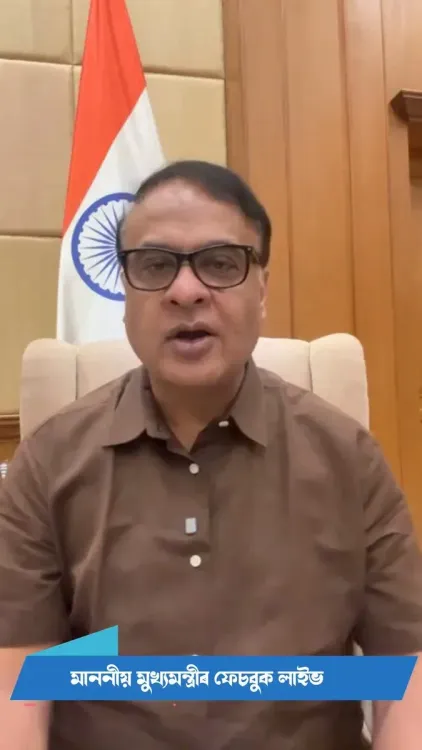
The announcement was made by CM Himanta Biswa Sarma during a Facebook Live session on July 28, 2026 .
The reform targets faster delivery of relief to bereaved families during Assam's recurring annual flood crisis.
For flood-bereaved families in Assam, the paperwork burden just got lighter — and the cheque got bigger. Chief Minister Dr. Himanta Biswa Sarma announced on Tuesday, July 28 that families of flood victims will no longer need to produce a post-mortem report to claim the standard ₹4 lakh ex gratia payment — a procedural shift that could mean the difference between weeks of bureaucratic delay and timely relief during the most desperate hours of grief.
The announcement, made during a Facebook Live session, replaces the post-mortem requirement with a Circle Officer's certificate — a far more accessible document that local administrative officers can issue without routing families through hospital and forensic formalities. The Chief Minister's Office of Assam confirmed the change via an official post on Wednesday, July 29, 2026.
₹9 lakh total: the numbers behind the relief
The procedural reform is only half the announcement. Sarma's government has also decided to top up the standard State Disaster Response Fund payout with an additional ₹5 lakh drawn from the Chief Minister's Relief Fund — bringing total assistance to ₹9 lakh per deceased. The combined figure represents more than double what families would have received under the previous arrangement, and it arrives through a single, simplified pipeline.
Why the post-mortem rule was a barrier
Assam's annual battle with Brahmaputra floods is one of the most predictable humanitarian crises on India's calendar, yet relief delivery has historically lagged behind the scale of destruction. The post-mortem requirement — standard across many Indian states for disaster ex gratia — often meant families had to navigate hospital systems, forensic queues, and documentation chains while simultaneously managing funerals and displacement. A Circle Officer's certificate, by contrast, is issued at the block level, closer to where flood deaths actually occur.
Successive Assam administrations have periodically simplified disaster-relief procedures, but the elimination of the post-mortem requirement for ex gratia eligibility marks a meaningful structural change. The shift aligns with a broader national pattern of states reducing documentation barriers in disaster compensation — but the simultaneous doubling of the payout makes this iteration more consequential than a routine procedural tweak.
What bereaved families need to know
Under the new framework, the process flows through the local Circle Officer, who certifies the flood-related death, triggering the ₹4 lakh SDRF component. The additional ₹5 lakh from the CM's Relief Fund is layered on top, bringing the total to ₹9 lakh. Implementation of the certificate-based process — and how quickly it moves on the ground during the current monsoon season — will be the real test of whether the reform delivers on its promise.
When Assam's next flood season ends, the question won't be what was announced — it will be how many families actually received ₹9 lakh, and how fast.
Point of View
Not just announced amounts. Eliminating the post-mortem requirement is politically low-cost but administratively high-impact, shifting the bottleneck from forensic systems to local block officers who are already embedded in flood-affected areas. The ₹5 lakh top-up from a discretionary fund rather than a statutory revision also gives the CM's office direct visibility over the relief narrative heading into what is typically a difficult monsoon news cycle for any Assam government. Whether the Circle Officer pipeline can absorb the volume without creating new delays will determine if this reform is remembered as a genuine relief measure or a well-timed announcement.
NationPress
29 Jul 2026
Frequently Asked Questions
What is the new Assam flood ex gratia amount in 2026?
The total flood ex gratia assistance in Assam is now ₹9 lakh per deceased — ₹4 lakh from the State Disaster Response Fund and an additional ₹5 lakh from the Chief Minister's Relief Fund.
Is a post-mortem report still required for flood compensation in Assam?
No. CM Himanta Biswa Sarma announced that a post-mortem report is no longer required. Families can now claim the ₹4 lakh ex gratia on the basis of a Circle Officer's certificate.
What is a Circle Officer's certificate and how does it help flood victims?
A Circle Officer's certificate is issued by a block-level administrative officer. It is far easier to obtain than a post-mortem report, allowing bereaved families to access compensation faster without navigating hospital or forensic systems.
Who announced the flood relief changes in Assam?
Chief Minister Dr. Himanta Biswa Sarma announced the changes during a Facebook Live session on July 28, 2026 . The official confirmation was shared by the Chief Minister's Office of Assam on July 29.
What is the Chief Minister's Relief Fund in Assam?
The Chief Minister's Relief Fund is a state-level discretionary fund used to supplement standard disaster compensation. In this case, it provides the additional ₹5 lakh on top of the statutory ₹4 lakh SDRF payment.