Assam CM Office: Orunodoi impact seen in NFHS-6 data
Synopsis
The Chief Minister's Office of Assam says NFHS-6 data validates Orunodoi's impact beyond its Rs 1,250 monthly cash transfer, pointing to stronger women's empowerment and household dignity indicators across the state.
Key Takeaways
Orunodoi is Assam's direct-benefit transfer scheme providing Rs 1,250 per month to eligible women from economically weaker households.
The scheme was launched in October 2020 and has been expanded in coverage and amount since its inception.
The Chief Minister's Office of Assam cited NFHS-6 data on June 1, 2026 to argue the scheme has improved social indicators beyond financial assistance.
Key improvements highlighted include women's empowerment , household dignity , and broader social indicators tracked by the survey.
The government's framing positions NFHS-6 as independent corroboration of Orunodoi's qualitative social impact.
Full state-level NFHS-6 reports and the next Assam budget will be key markers for the scheme's future trajectory.
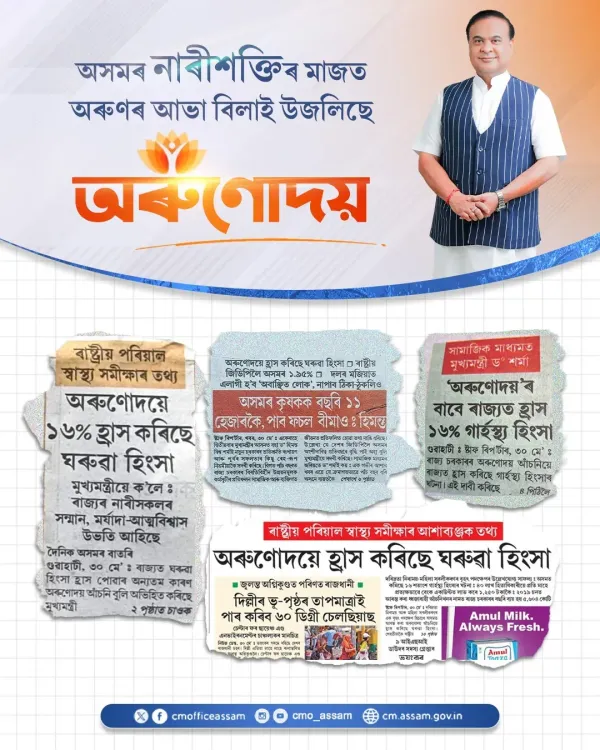
The Chief Minister's Office of Assam on Monday, June 1, 2026 highlighted that the state's flagship direct-benefit transfer scheme Orunodoi is now demonstrating measurable social impact beyond financial assistance, citing data from the Sixth National Family Health Survey (NFHS-6) as evidence of stronger women's empowerment and household dignity indicators across the state.
Context
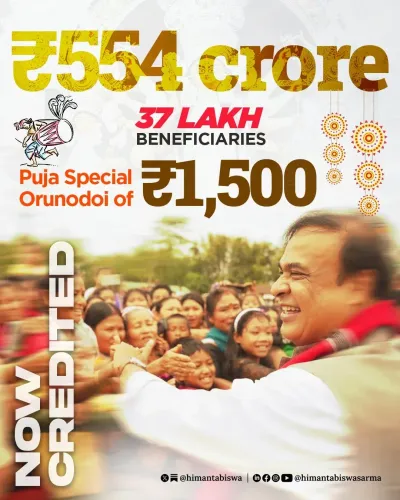
The official post from the Chief Minister's Office stated that 'Orunodoi continues to bring smiles to countless faces across Assam' and that NFHS-6 data now reflects its impact through 'stronger social indicators, greater women's empowerment and enhanced dignity within households.' The office also noted that this 'story of transformation' is receiving widespread media recognition. The statement positions the scheme not merely as a cash-transfer programme but as a driver of qualitative social change.
Policy Backdrop
Orunodoi was launched in October 2020 as a direct-benefit transfer scheme providing monthly cash assistance of Rs 1,250 to eligible women from economically weaker households in Assam. Initially covering one lakh women, the scheme was subsequently expanded in both coverage and transfer amounts, making it one of the most visible welfare initiatives under Chief Minister Himanta Biswa Sarma's government. The scheme's design targets one adult woman per household, placing financial agency directly in women's hands.
Across India, state governments have increasingly used direct cash transfers to women as a dual-purpose tool — alleviating immediate poverty while also shifting measurable social indicators tracked by periodic surveys such as the NFHS. States including Madhya Pradesh and West Bengal have pursued similar approaches, and public communication around such schemes routinely invokes survey-round data to demonstrate impact beyond income support.
Stakeholders and Impact
The primary beneficiaries of Orunodoi are women from rural and economically weaker households across Assam, a northeastern state with a significant proportion of tribal and agrarian communities historically underserved by formal welfare infrastructure. By routing transfers directly to women, the scheme is designed to increase their bargaining power and decision-making authority within households — dimensions that NFHS rounds measure through indicators such as financial autonomy, mobility, and participation in household decisions.
The Chief Minister's Office's citation of NFHS-6 data signals that the government views the survey results as independent corroboration of the scheme's social effectiveness, lending institutional credibility to its welfare narrative ahead of potential budget revisions or coverage expansions.
What's Next
Attention will now turn to the release of full NFHS-6 state-level reports for Assam, which would allow independent scrutiny of the specific indicators cited by the government. Any revisions to Orunodoi's eligibility criteria or monthly transfer amounts in the next Assam state budget will be closely watched as a signal of the government's commitment to scaling the programme. If NFHS-6 findings confirm broad-based improvement in women's empowerment metrics, the data could also inform similar schemes in other northeastern states looking to replicate Assam's model.
Point of View
A more politically durable argument. By anchoring the scheme's success in a nationally recognised survey, the Chief Minister's Office insulates its flagship programme from criticism that direct cash transfers are merely electoral instruments. This approach mirrors a broader pattern among state governments that are increasingly competing not just on scheme design but on the ability to demonstrate verifiable impact through institutional data. The real test will come when full NFHS-6 state reports are published and independent analysts can assess whether the specific empowerment indicators cited align with the government's claims.
NationPress
21 Oct 2026
Frequently Asked Questions
What is the Orunodoi scheme in Assam?
Orunodoi is an Assam government direct-benefit transfer scheme launched in October 2020 that provides a monthly cash transfer of Rs 1,250 to eligible women from economically weaker households, with the amount and coverage expanded since its launch.
What does NFHS-6 say about Orunodoi?
The Chief Minister's Office of Assam stated on June 1, 2026 that NFHS-6 data reflects Orunodoi's impact through stronger social indicators, greater women's empowerment, and enhanced household dignity, though full state-level NFHS-6 reports are awaited for independent verification.
Who benefits from the Orunodoi scheme?
Women from economically weaker and rural households in Assam are the primary beneficiaries, with the scheme designed to place financial agency directly in the hands of one adult woman per household.
How much money does Orunodoi give per month?
Orunodoi provides Rs 1,250 per month as a direct cash transfer to eligible women beneficiaries, a figure that has been revised upward since the scheme's original launch in 2020.
What is NFHS-6 and why does it matter for welfare schemes?
NFHS-6 is the Sixth National Family Health Survey of India, measuring health, nutrition, demographic, and women's empowerment indicators. State governments cite its findings to demonstrate that welfare schemes produce social improvements beyond income support.