Assam Governor sets ₹10 lakh crore GSDP target by FY 2028-29

Synopsis
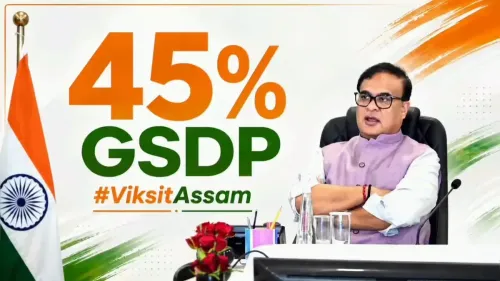
Governor Laxman Acharya, addressing the 16th Assam Legislative Assembly on 22 May 2026, highlighted five years of GSDP growth and presented a roadmap to make Assam a ₹10 lakh crore economy by FY 2028-29, underscoring the state's accelerating economic ambitions.
Key Takeaways
Governor Laxman Acharya addressed the 16th Assam Legislative Assembly on 22 May 2026 .
The address highlighted GSDP growth over the last five years as the foundation of Assam's economic transformation.
A formal roadmap was outlined targeting a ₹10 lakh crore economy by FY 2028-29 .
The target is embedded within the central government's Act East Policy framework for northeastern states.
Key growth drivers are expected to include agro-processing, tourism, textiles, and infrastructure-linked sectors.
Subsequent state budgets and annual GSDP estimates will serve as the primary benchmarks for progress.
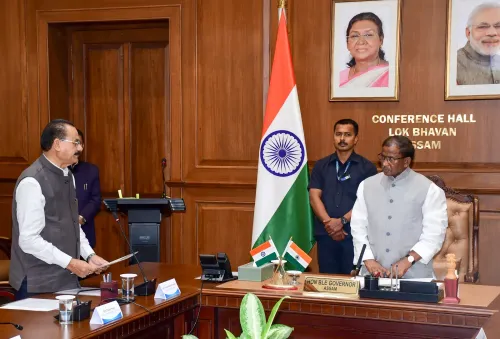
The Chief Minister's Office of Assam on Friday, 22 May 2026 shared highlights from Governor Laxman Acharya's address to the 16th Assam Legislative Assembly, in which he outlined the state's economic transformation over the past five years and set a firm target of reaching a ₹10 lakh crore economy by FY 2028-29.
Context
Delivering the customary gubernatorial address to the assembled legislature, Governor Laxman Acharya pointed to sustained growth in Gross State Domestic Product (GSDP) over the last five years as evidence of Assam's economic momentum. The address, a constitutional formality that typically opens a budget session, was used to lay out the administration's broader economic vision. The Governor described a 'robust roadmap' charting the state's trajectory toward the ten-lakh-crore milestone.
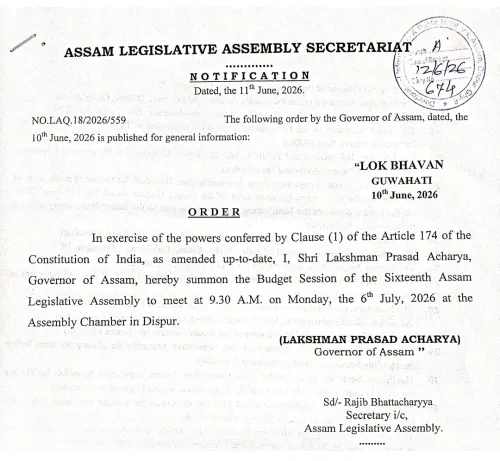
The 16th Assam Legislative Assembly is the current legislative body of the state, constituted after the 2021 assembly elections. Gubernatorial addresses to the assembly are closely watched as they reflect the government's stated policy priorities for the year ahead.
Policy Backdrop
Following the 2021 change of government, Assam introduced a series of industrial and investment policy reforms aimed at accelerating GSDP growth. These included ease-of-doing-business measures, sector-specific incentives, and infrastructure push programmes. The Governor's address frames the ₹10 lakh crore target as the logical culmination of this multi-year policy effort.
Assam's economic ambitions are also embedded within the central government's Act East Policy framework, which has directed significant connectivity and investment attention toward the northeastern states. Improved road, rail, and waterway links have been cited consistently as enablers of the region's growth story. Several other northeastern states have similarly announced multi-year GSDP targets in the post-COVID-19 period.
Stakeholders and Impact
The roadmap outlined by Governor Acharya has direct implications for Assam's roughly 3.5 crore residents, particularly in terms of employment generation, per-capita income growth, and access to public services funded by an expanding state revenue base. Private investors and local industries are the other key stakeholders, as the government's ability to attract and retain capital will be central to meeting the target.
Sectors likely to drive GSDP growth include agro-processing, tourism, textiles, and infrastructure-linked construction — areas that successive state budgets have prioritised. The realisation of investment commitments made at state investor summits will be a critical variable in the coming two fiscal years.
What's Next
Attention will now turn to subsequent Assam state budgets and any new industrial policy documents that spell out concrete measures — sector targets, capital expenditure allocations, and investment facilitation steps — needed to reach the ₹10 lakh crore mark by FY 2028-29. Annual GSDP estimates published by the state's directorate of economics and statistics will serve as the primary scorecard.
If Assam sustains its current growth trajectory and successfully converts announced investments into on-ground activity, the northeastern state could emerge as a significant data point in India's broader story of regional economic convergence — with implications for how central funds and private capital are directed toward the region in the years ahead.
Point of View
While ambitious, follows a recognisable pattern of multi-year economic roadmaps that state governments across India have used to frame long-term governance intent. The real test will be whether investment commitments translate into verifiable output growth — a gap that has tripped up similar announcements in other states. Assam's positioning within the Act East Policy gives it a structural advantage, but execution on connectivity and ease-of-doing-business reforms will determine whether the target is a milestone or a talking point.
NationPress
23 Sept 2026
Frequently Asked Questions
What is Assam's GSDP target for FY 2028-29?
Assam has set a target of reaching a ₹10 lakh crore economy by FY 2028-29 , as outlined by Governor Laxman Acharya in his address to the 16th Legislative Assembly on 22 May 2026.
Who is the Governor of Assam in 2026?
Laxman Acharya is the Governor of Assam. He delivered the address to the 16th Assam Legislative Assembly on 22 May 2026 outlining the state's economic roadmap.
What is the 16th Assam Legislative Assembly?
The 16th Assam Legislative Assembly is the current legislative body of the state, constituted after the 2021 assembly elections. The Governor addresses it at the start of budget sessions to outline the government's policy agenda.
How has Assam's economy grown in the last five years?
Governor Acharya's address highlighted sustained GSDP growth over the last five years as the basis for Assam's economic transformation, though specific figures from the May 2026 address are yet to be confirmed from established public records.
What is India's Act East Policy and how does it relate to Assam?
India's Act East Policy directs investment, connectivity, and diplomatic attention toward the northeastern states. Assam's economic roadmap is framed within this policy, which has funded road, rail, and waterway projects intended to boost the region's growth potential.