Assam Governor Summons Budget Session for July 6
Synopsis
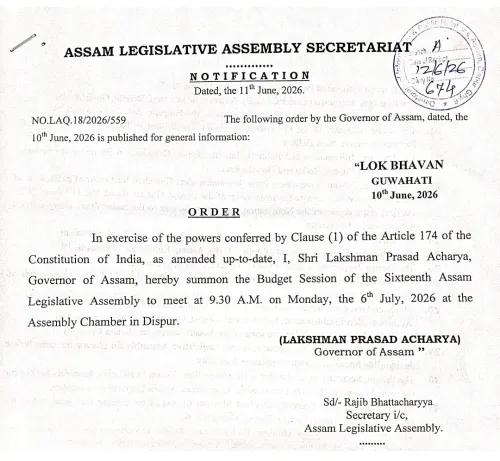
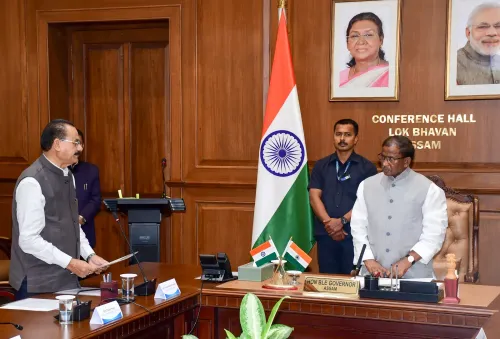
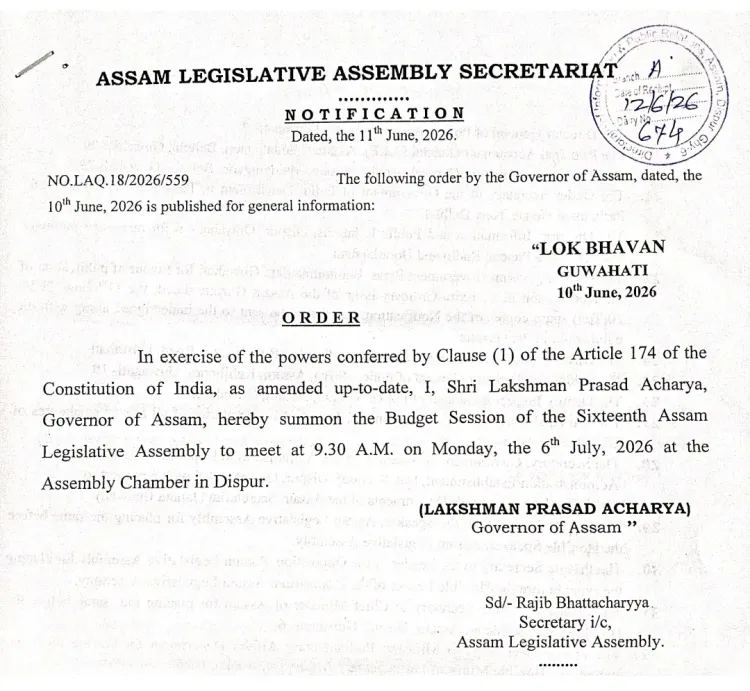
Assam Governor Lakshman Prasad Acharya has formally summoned the Budget Session of the Sixteenth Assam Legislative Assembly to begin at 9:30 AM on July 6, 2026, invoking constitutional powers under Article 174. The session will enable the state government to present its annual financial proposals for legislative approval and debate.
Key Takeaways
Governor Lakshman Prasad Acharya has officially summoned the Budget Session of the Sixteenth Assam Legislative Assembly.
The session is scheduled to convene at 9:30 AM on Monday, July 6, 2026 .
The summons was issued under Article 174 of the Indian Constitution , which empowers the Governor to call legislative sessions on the advice of the council of ministers.
The Assam Legislative Assembly is a unicameral body with 126 elected members .
The budget session is the primary occasion for the state government to present annual revenue and expenditure proposals for legislative scrutiny and approval.
The Chief Minister's Office of Assam announced on Friday, June 12, 2026 that Governor Lakshman Prasad Acharya has summoned the Budget Session of the Sixteenth Assam Legislative Assembly to convene at 9:30 AM on Monday, July 6, 2026.
Context
The official notification from the Chief Minister's Office states that the Hon'ble Governor has formally called the Budget Session to order. The session will mark a key constitutional moment for the Sixteenth Assam Legislative Assembly, the unicameral legislature comprising 126 elected members.
The announcement was made through the government's official social media handle, signalling the start of preparations across the state secretariat and legislative machinery ahead of the July date.
Policy Backdrop
Under Article 174 of the Indian Constitution, the Governor holds the authority to summon and prorogue sessions of the state legislative assembly, acting on the advice of the council of ministers. This procedure is followed uniformly across all Indian states for every legislative session, including the annual budget session.
Governor Lakshman Prasad Acharya exercises this constitutional role as the formal head of the state, ensuring that the elected government can present its revenue and expenditure proposals before the legislature for scrutiny and approval. The budget session is traditionally the most significant of the multiple sessions held by Indian state assemblies each year.
Stakeholders and Impact
The session directly concerns all 126 MLAs of the Assam Legislative Assembly, the state finance department, and the broader administrative machinery of Assam. The budget session provides the primary legislative forum for the government to table its annual financial proposals and for the opposition to scrutinise spending priorities.
Citizens, civil society groups, and industry bodies in Assam closely follow the budget session, as it sets the fiscal direction for the state — covering allocations for infrastructure, welfare schemes, agriculture, and public services for the financial year.
What's Next
When the session convenes on July 6, 2026, the primary business is expected to include the presentation of the Assam state budget speech and subsequent voting on demands for grants. Legislators from both the treasury and opposition benches will have the opportunity to debate fiscal policy, move amendments, and raise questions on government expenditure.
Any significant policy announcements, revised revenue projections, or opposition motions introduced during the session will shape the state's governance agenda for the months ahead.
Point of View
But the timing and political context lend it significance beyond routine procedure. With the Sixteenth Assembly in session, the budget will serve as a key indicator of the ruling government's fiscal priorities and welfare commitments heading into the latter half of the financial year. The Governor's role here is largely ceremonial but constitutionally indispensable, reinforcing the separation of powers between the executive and the legislature. How the opposition uses the session's floor time for scrutiny will determine whether the budget becomes a political flashpoint or a procedural formality.
NationPress
26 Oct 2026
Frequently Asked Questions
When is the Assam Budget Session 2026?
The Assam Budget Session 2026 is scheduled to convene at 9:30 AM on Monday, July 6, 2026, as summoned by Governor Lakshman Prasad Acharya.
Who has the power to summon the Assam Legislative Assembly session?
Under Article 174 of the Indian Constitution, the Governor of Assam has the constitutional authority to summon and prorogue sessions of the state legislative assembly, acting on the advice of the council of ministers.
What is the Sixteenth Assam Legislative Assembly?
The Sixteenth Assam Legislative Assembly is the current unicameral legislature of Assam, comprising 126 elected members responsible for approving the state budget and enacting legislation.
What happens during the Assam Budget Session?
During the Budget Session, the state government presents its annual revenue and expenditure proposals, followed by voting on demands for grants, legislative debates, and potential opposition motions on fiscal policy.
Who is the current Governor of Assam?
Lakshman Prasad Acharya serves as the Governor of Assam and holds constitutional authority to summon sessions of the state legislative assembly.