CM Himanta Boosts Assam MLA Fund to ₹2 Cr by FY28
Synopsis
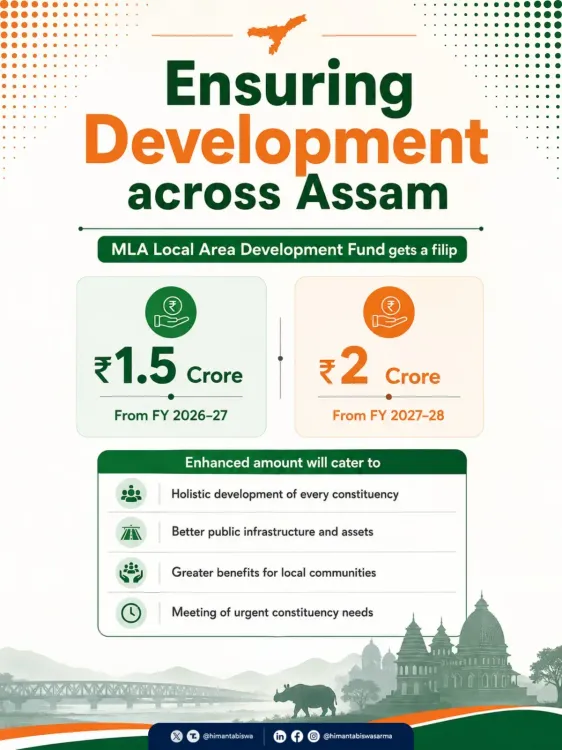
The Assam Cabinet, led by Chief Minister Himanta Biswa Sarma, has approved a phased hike in the MLA Local Area Development Fund — to ₹1.5 crore from FY 2026-27 and ₹2 crore from FY 2027-28 — aiming to strengthen constituency-level development and reduce regional imbalances across the state.
Key Takeaways
The Assam Cabinet has approved an increase in the MLA Local Area Development Fund effective FY 2026-27 .
Each MLA will receive ₹1.5 crore from FY 2026-27 , rising to ₹2 crore from FY 2027-28 .
The stated objective is to ensure balanced development and address grassroots priorities more effectively.
The decision follows a national pattern of states raising legislator-level discretionary funds to improve local responsiveness.
The enhancement aligns with the BJP-NEDA governance emphasis on grassroots delivery in North-East India .
Assam budget documents for FY 2026-27 will detail the fund-release and monitoring mechanisms.
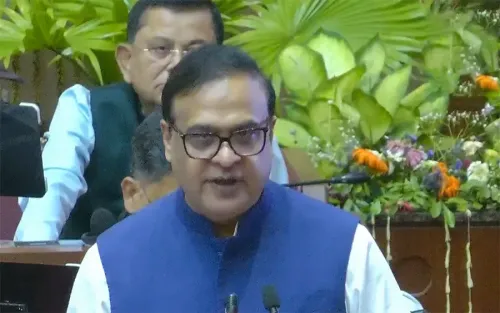
Assam Chief Minister Himanta Biswa Sarma announced on Saturday, 13 June 2026 that the Assam Cabinet has approved a phased increase in the MLA Local Area Development Fund, raising the per-legislator allocation to ₹1.5 crore from FY 2026-27 and further to ₹2 crore from FY 2027-28, citing the need for balanced development across the state.
Context
In his post on X, CM Sarma stated that the enhanced allocation 'will help address grassroots level priorities more effectively.' The cabinet decision signals a deliberate push to empower each Member of the Legislative Assembly with greater discretionary resources for constituency-level works. The two-stage rollout — ₹1.5 crore in the first year and ₹2 crore in the second — suggests a calibrated fiscal approach rather than an immediate lump-sum revision.
Policy Backdrop
The MLA Local Area Development Fund is a state-level counterpart to the Members of Parliament Local Area Development Scheme (MPLADS), which the central government launched in 1993 to channel discretionary development funds through elected representatives. Several Indian states adopted and periodically revised similar legislator-level schemes in the years that followed. The latest Assam enhancement fits a broader national pattern seen through the 2010s and 2020s, where state governments have incrementally raised such allocations to strengthen local-level responsiveness and narrow regional development gaps.
In Assam and other North-East states, the BJP-led administration under the North-East Democratic Alliance (NEDA) — of which CM Sarma serves as convenor — has consistently emphasised grassroots delivery as a governance priority. Shifting modest fiscal resources toward legislator-controlled heads is part of this wider strategy to reduce dependence on centrally sponsored scheme timelines and give MLAs more agility in responding to local needs.
Stakeholders and Impact
Assam has 126 constituencies in its Legislative Assembly. If all seats receive the enhanced allocation, the aggregate fund pool would rise substantially at each stage of the revision, directing more resources toward small-scale infrastructure, sanitation, roads, and other community works at the ward and village level. Constituency residents — particularly in underserved or geographically remote areas — stand to benefit most directly from the increased discretionary spend.
MLAs gain greater fiscal bandwidth to respond to hyper-local demands without routing requests through departmental bureaucracies, which can slow project execution. Critics of such schemes, however, have historically flagged utilisation gaps and the need for robust audit mechanisms to ensure funds translate into completed, quality assets on the ground.
What's Next
The Assam budget documents for FY 2026-27 will be closely watched for the detailed fund-release mechanism, eligibility criteria for works, and any new monitoring provisions accompanying the enhanced allocation. State finance department utilisation reports and eventual audit findings will determine whether the increased envelope delivers the balanced development outcomes the cabinet has cited as its rationale. The FY 2027-28 step-up to ₹2 crore may also be reviewed against ground-level absorption capacity before it takes effect.
Point of View
Strengthens party-worker networks at the booth level, and lets the ruling dispensation claim a concrete fiscal win for each of its 126 constituencies. By structuring the increase in two tranches rather than one, the Sarma cabinet also retains a lever to course-correct if utilisation lags in FY 2026-27 before committing the full ₹2 crore envelope. Within the NEDA framework, the decision reinforces Assam's role as a policy-setter for BJP-aligned North-East states, potentially prompting similar revisions in Manipur, Meghalaya, or Nagaland. The real test, however, will be whether enhanced allocations translate into auditable, completed assets — a gap that has dogged MLA fund schemes across India for decades.
NationPress
28 Oct 2026
Frequently Asked Questions
What is the new MLA Local Area Development Fund amount in Assam?
The Assam Cabinet has enhanced the MLA Local Area Development Fund to ₹1.5 crore per MLA from FY 2026-27, rising further to ₹2 crore per MLA from FY 2027-28.
What is the MLA Local Area Development Fund used for?
The MLA Local Area Development Fund gives each Member of the Legislative Assembly discretionary resources to undertake small-scale constituency-level development works such as roads, sanitation, and community infrastructure.
Why did the Assam Cabinet increase the MLA fund?
Chief Minister Himanta Biswa Sarma stated the enhancement is intended to ensure balanced development and help address grassroots-level priorities more effectively across Assam's constituencies.
How does Assam's MLA fund compare to the central MPLADS scheme?
Assam's MLA Local Area Development Fund is a state-level counterpart to the central MPLADS scheme, which has provided a template for legislator-level discretionary funds since its launch in 1993.
When will the increased MLA fund take effect in Assam?
The enhanced allocation of ₹1.5 crore takes effect from FY 2026-27, with a further increase to ₹2 crore scheduled from FY 2027-28.