CM Himanta Flags Assam's 222% Surge in Live Events
Synopsis
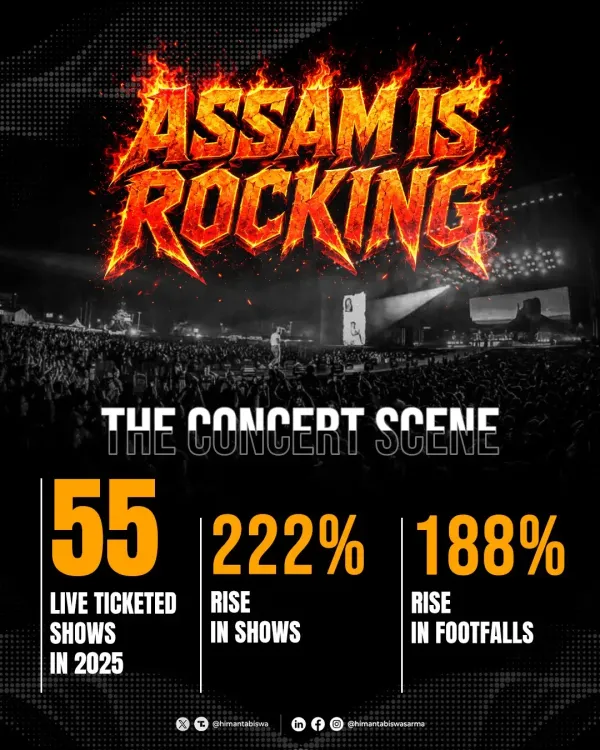
Assam CM Himanta Biswa Sarma has cited 55 live shows, 222% event growth, and 188% footfall growth to argue that Assam has rapidly transformed into a credible destination on India's live-entertainment circuit, building on improved connectivity and cultural branding efforts since the mid-2010s.
Key Takeaways
Assam CM Himanta Biswa Sarma posted on 18 June 2026 highlighting the state's live entertainment boom.
The state has hosted 55 live shows with a 222% growth in events and a 188% growth in footfalls , per the CM's figures.
The CM noted Assam 'wasn't even on most concert calendars a few years ago,' underscoring the scale of the shift.
Growth is underpinned by improved air connectivity to Guwahati and the state's broader economic diversification strategy.
The live-events boom benefits event organisers, local hospitality, transport, and youth employment in Assam .
Official Assam tourism statistics for 2025-26 are awaited to corroborate the growth trajectory.
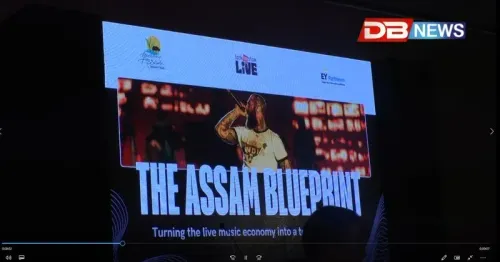
Assam Chief Minister Himanta Biswa Sarma on Thursday, 18 June 2026, highlighted a sharp rise in the state's live entertainment industry, citing 55 live shows, a 222% growth in events, and a 188% growth in footfalls — figures he presented as evidence of a dramatic cultural and economic transformation in the northeastern state.
Context
In his post, CM Sarma noted that Assam 'wasn't even on most concert calendars a few years ago,' framing the current numbers as a marker of substantial progress. The claim positions the state as an emerging destination on India's live-events circuit, a space long dominated by metros such as Mumbai, Delhi, and Bengaluru.
The growth figures, as cited by the Chief Minister, suggest that Assam has moved from near-invisibility in the live entertainment sector to a measurable presence in a relatively short window. The post does not specify the baseline year against which the percentages are measured.
Policy Backdrop
Assam's push into live entertainment sits within a broader economic diversification strategy that successive state governments have pursued since the mid-2010s. The Act East Policy, articulated at the national level in 2014, encouraged northeastern states to invest in connectivity infrastructure and cultural branding to attract investment and visitors.
Assam has historically been associated with its tea gardens, petroleum sector, and the Bihu festival tradition. The expansion into modern live concerts and large-format events represents a deliberate effort to build a new economic layer — one that generates income for local vendors, hospitality businesses, and youth employment in event management and logistics.
Improved air connectivity to Guwahati, the state's commercial capital, has been a key enabler, making it feasible for national and international acts to schedule performances in the Northeast without prohibitive logistical costs.
Stakeholders and Impact
The primary beneficiaries of this growth are event organisers, the local tourism and hospitality industry, and the state's youth demographic — both as audiences and as workers in the events ecosystem. A sustained rise in footfalls also benefits ancillary sectors including transport, food and beverage, and retail.
For the broader Northeast India region, Assam's emergence as an events hub could have a multiplier effect, encouraging promoters to consider neighbouring states such as Meghalaya and Manipur as part of regional tour circuits. This aligns with the North-East Democratic Alliance (NEDA) framework that CM Sarma convenes, which seeks to coordinate development narratives across the region.
What's Next
Analysts and industry observers will look to official Assam tourism statistics for 2025-26 to independently verify the trajectory indicated by the Chief Minister's figures. Any new state-supported music festivals or cultural event announcements in the upcoming assembly session would signal whether the government intends to formalise and fund this growth through dedicated policy.
If the momentum holds, Assam could seek to anchor a signature annual live-events property — similar to what Sunburn did for Goa — that places it firmly on the national and international entertainment map.
Point of View
Using entertainment metrics to signal that Assam is no longer a peripheral market — a message aimed as much at investors and event promoters as at local voters. The live-events frame is politically useful because it speaks to urban youth aspirations without the ideological friction of other policy domains. It also fits a broader NEDA-level narrative that the Northeast is open for business and culturally vibrant. Whether the momentum translates into a durable industry or remains event-driven optics will depend on the policy and infrastructure commitments that follow this public claim.
NationPress
19 Sept 2026
Frequently Asked Questions
How many live shows has Assam hosted recently?
According to Assam CM Himanta Biswa Sarma's post on 18 June 2026, Assam has hosted 55 live shows, with a 222% growth in events and 188% growth in footfalls, though an official baseline year for these figures has not been specified.
Why is Assam becoming popular for live concerts?
Improved air connectivity to Guwahati, active state-level cultural branding, and the broader Act East Policy framework since 2014 have made Assam a more viable destination for national and international event promoters.
What is Himanta Biswa Sarma's role in Assam's development?
Himanta Biswa Sarma has been Assam's Chief Minister since May 2021 and is a BJP leader who also convenes the North-East Democratic Alliance (NEDA), focusing on infrastructure, connectivity, and regional image-building.
How does Assam's live events growth fit into Northeast India's economy?
Assam's emergence as a live-events hub could encourage promoters to include neighbouring northeastern states in tour circuits, supporting the NEDA framework's goal of coordinated economic development across the region.
When will official Assam tourism data confirm these growth figures?
Official Assam tourism statistics for 2025-26 are expected to be released in the coming months and will provide an independent measure of the footfall and event growth claimed by CM Sarma.