CM Himanta Launches 20,000 LPD Milk Plant in Sonitpur
Synopsis
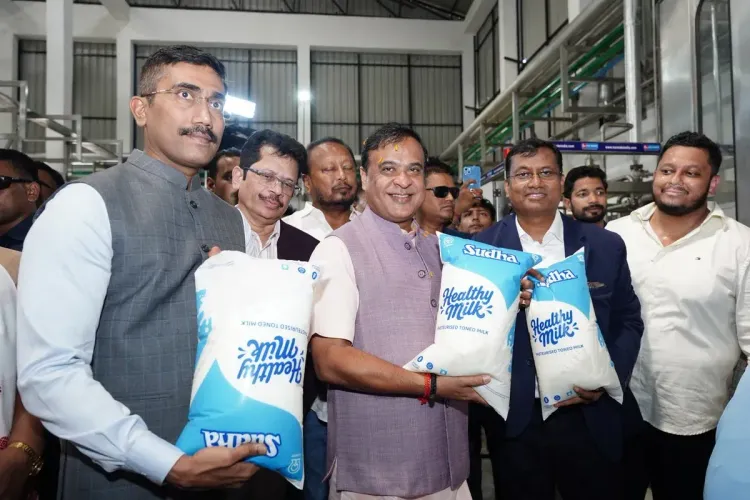
Assam CM Himanta Biswa Sarma inaugurated a 20,000 LPD milk processing plant in Sonitpur on 8 October 2026, entirely sourced from local dairy cooperatives, as part of a broader push toward a 10 lakh litre daily milk production target backed by subsidies, digital registration, and youth-women schemes.
Key Takeaways
Assam CM Himanta Biswa Sarma launched the 20,000 LPD Milk Processing Plant in Sonitpur on 8 October 2026 .
All milk will be sourced exclusively from farmers enrolled in Dairy Cooperative Societies in the North Bank of Brahmaputra region.
The plant advances Assam's target of 10 lakh litres of daily milk production .
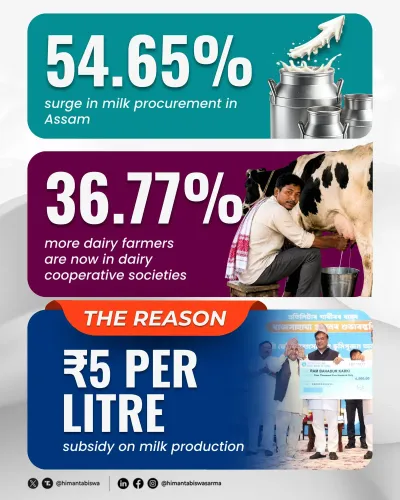
The government is deploying a direct milk subsidy and digital registration of cooperatives alongside the plant.
Schemes #CMAAA and #MMUA are channelling youth and women into dairy farming and allied activities.
The launch continues the state's 'Made in Assam' value-addition strategy for agricultural produce.
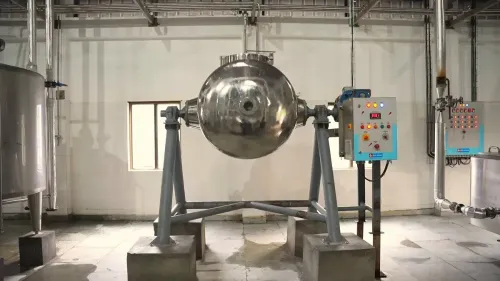
A new milk processing plant switched on in Sonitpur, Assam on 8 October 2026 — and Assam Chief Minister Himanta Biswa Sarma wants every farmer on the North Bank of the Brahmaputra to feel it. The 20,000 litres-per-day (LPD) facility, entirely fed by local dairy cooperative members, marks the latest concrete push toward the state's declared target of 10 lakh litres of daily milk production.
What the Sonitpur plant means for cooperative farmers
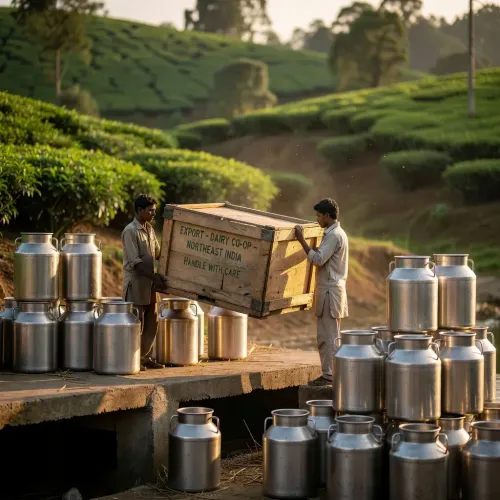
The plant's design is its most consequential feature: 100 per cent of the raw milk will be sourced from farmers enrolled in Dairy Cooperative Societies across the region. That guarantee of an assured, organised market removes the single biggest anxiety of small dairy farmers — the fear of having no buyer when production peaks. For households that have long depended on informal, price-volatile local sales, a processing plant with fixed offtake is a structural income stabiliser, not just a subsidy.
The North Bank of the Brahmaputra — the belt of districts stretching from Kamrup to Dhemaji along the river's northern flank — has historically lagged the more industrialised southern bank in agri-processing infrastructure. A 20,000 LPD anchor facility in Sonitpur anchors an emerging dairy corridor in that zone, creating downstream demand for fodder, veterinary services, chilling centres, and transport logistics.
The policy stack behind the launch
CM Sarma outlined four interlocking initiatives the state is deploying alongside the plant. A direct milk subsidy shores up farmer income at the production end. Digital registration of Milk Cooperative Societies formalises the cooperative network, enabling traceability and easier access to government schemes. Two dedicated programmes — #CMAAA (Chief Minister's Atmanirbhar Asom Abhijan) and #MMUA (Mukhyamantri Mahila Udyamita Abhiyan) — specifically channel youth and women into dairy farming and allied activities, embedding inclusion into the growth model rather than treating it as an afterthought.
The framing of the launch as another 'Made in Assam' product is deliberate. Sarma's government has consistently used that branding to signal self-reliance and local value addition — positioning Assam's dairy output not as a raw commodity shipped out, but as a finished, branded product that captures margin within the state.
Chasing the 10 lakh litre target
The 10 lakh litres per day production target is ambitious for a state that has historically been a milk-deficit region, relying partly on supplies from neighbouring states. Reaching that number requires not just processing capacity but a sustained expansion of the milch-cattle herd, improved veterinary coverage, and reliable chilling infrastructure at the village level. The Sonitpur plant addresses the demand-side pull; the subsidy, digital cooperative registration, and skilling schemes are meant to build the supply side in parallel.
If the model holds, Sonitpur becomes a replicable template — processing plants seeded in underserved districts, each anchored to a cooperative network, each feeding a branded output stream. That is a structural bet, not a one-off ribbon-cutting.
Point of View
Cooperative-linked agri-processing — a model the BJP-led state government has been road-testing across sectors. Anchoring the facility entirely to cooperative milk, rather than open-market sourcing, is a politically smart move: it ties measurable income gains directly to card-carrying cooperative members, a constituency CM Sarma is actively cultivating ahead of future electoral cycles. The parallel push on digital registration of cooperatives is significant — it creates a traceable farmer database that can be leveraged for direct-benefit transfers and scheme targeting. The 10 lakh LPD target remains a stretch goal for a historically deficit state, but the layered policy stack — subsidy, formalisation, skilling, and infrastructure — suggests a more coherent architecture than one-off announcements.
NationPress
8 Oct 2026
Frequently Asked Questions
What is the capacity of the new milk processing plant in Sonitpur, Assam?
The plant has a processing capacity of 20,000 litres per day (LPD) and will source all its milk from local Dairy Cooperative Society members in the North Bank of the Brahmaputra region.
What is Assam's milk production target?
The Assam government has set a target of 10 lakh litres of milk production per day . The Sonitpur plant is one of several infrastructure steps being taken to reach this goal.
What is the CMAAA scheme in Assam?
CMAAA refers to the Chief Minister's Atmanirbhar Asom Abhijan , a scheme designed to support youth and women in taking up dairy farming and allied activities in Assam.
What is the MMUA scheme in Assam?
MMUA stands for Mukhyamantri Mahila Udyamita Abhiyan , a state government programme specifically aimed at empowering women entrepreneurs, including those in the dairy and allied sectors.
How is Assam supporting its dairy farmers?
Assam is supporting dairy farmers through a direct milk subsidy , digital registration of Milk Cooperative Societies , assured procurement through cooperative-linked processing plants, and skilling schemes like #CMAAA and #MMUA for youth and women.