CM Himanta Targets 10 Lakh Litres Daily Milk Output in Assam
Synopsis
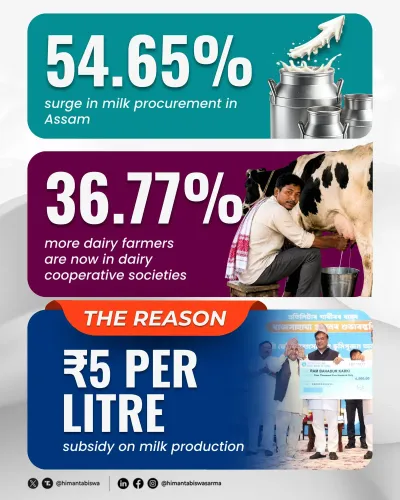
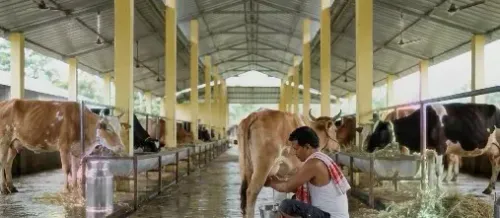
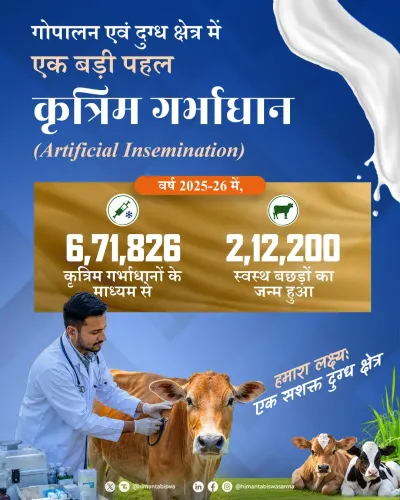
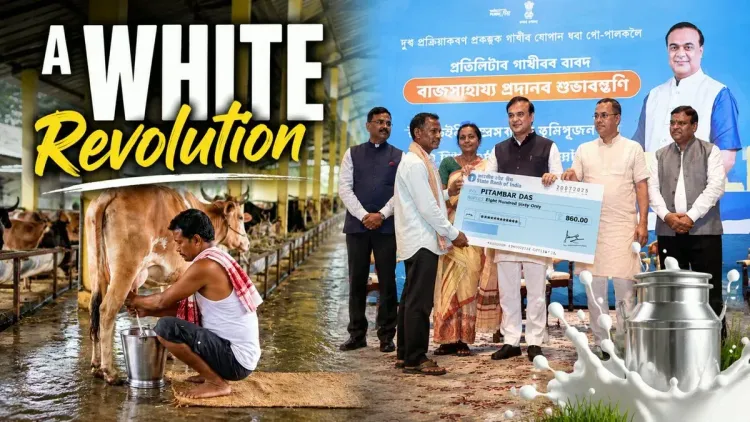
Assam Chief Minister Himanta Biswa Sarma has announced state subsidies for over 25,000 dairy farmers and set a target of 10 lakh litres of daily milk production, positioning dairy development as a pillar of rural income growth and agricultural diversification in the north-east.
Key Takeaways
Assam CM Himanta Biswa Sarma announced subsidies covering more than 25,000 dairy farmers across the state.
The government has set a mission target of producing 10 lakh litres of milk every day .
The initiative aims to raise rural incomes, improve household nutrition, and reduce Assam's dependence on milk supplies from other states.
The state programme aligns with the central government's Rashtriya Gokul Mission (launched 2014 ) for cattle development and dairy infrastructure.
India's cooperative dairy model, established under Operation Flood in 1970 , provides the long-term policy foundation for such state-level efforts.
Progress will be tracked through Assam animal husbandry department data and future state budget allocations for dairy processing.
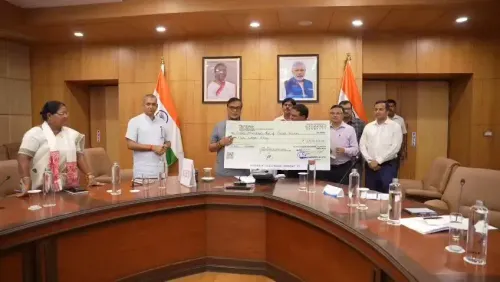
Assam Chief Minister Himanta Biswa Sarma on Thursday, 2 July 2026, announced that the state government is subsidising more than 25,000 dairy farmers to raise productivity and rural incomes, with an overarching mission to produce 10 lakh litres of milk every day.
Context
In a post on X, CM Sarma framed the dairy push in both economic and social terms: 'Every glass of milk nourishes a family and strengthens rural economy.' The statement signals that the Assam government views dairy not merely as an agricultural sub-sector but as a lever for household nutrition and village-level income generation.
The announcement comes as Assam continues to depend partly on milk supplies from other states to meet local demand. Raising in-state output would reduce that dependence while keeping more income within the rural economy of the north-east.
Policy Backdrop
India's modern cooperative dairy model traces its roots to Operation Flood, launched in 1970, which expanded milk production and distribution infrastructure nationwide. Building on that foundation, the central government introduced the Rashtriya Gokul Mission in 2014 to conserve indigenous cattle breeds and strengthen dairy infrastructure in states including Assam.
The state-level subsidy programme for 25,000-plus farmers aligns with this national policy emphasis on dairy as a dependable source of supplementary farm income. Animal husbandry has increasingly featured in Assam's agricultural diversification strategy, mirroring similar efforts across other north-eastern states seeking to reduce dependence on paddy cultivation alone.
Stakeholders and Impact
Dairy farmers across Assam stand to benefit most directly through subsidies aimed at improving herd quality, feed, and processing access. For rural households more broadly, higher milk output translates into improved nutrition and additional cash income from surplus sales.
The 10 lakh litre daily production target, if achieved, would represent a significant scale-up for the state's dairy sector. Milk processors, cooperative societies, and cold-chain logistics operators would all need to expand capacity to absorb and distribute that volume efficiently.
What's Next
Attention will now turn to the Assam animal husbandry department's production data releases and any fresh provisions in the state budget for dairy processing facilities or breed-improvement programmes. Progress toward the 10 lakh litre daily target will be a key metric by which the scheme's success is measured.
If the subsidy programme scales as envisioned, Assam could emerge as a model for dairy-led rural development in the north-east, potentially influencing similar policy choices in neighbouring states within the North-East Democratic Alliance (NEDA) framework.
Point of View
The communication is designed for mass resonance among farming communities ahead of any future electoral cycle. The move also reflects a north-east-specific imperative: reducing the region's supply-chain dependence on mainland India is both an economic and a strategic priority. Whether the subsidy architecture for 25,000-plus farmers can deliver at that scale will determine if this remains an aspirational headline or becomes a verifiable policy achievement.
NationPress
30 Sept 2026
Frequently Asked Questions
What is Assam's daily milk production target announced by CM Himanta?
Assam Chief Minister Himanta Biswa Sarma has set a mission target of producing 10 lakh litres of milk every day , supported by subsidies for more than 25,000 dairy farmers.
How many dairy farmers are getting subsidies in Assam?
The Assam government is providing subsidies to more than 25,000 dairy farmers to enhance productivity and increase rural incomes.
What is the Rashtriya Gokul Mission and how does it relate to Assam's dairy push?
The Rashtriya Gokul Mission , launched by the central government in 2014 , provides financial assistance to states for indigenous cattle conservation and dairy infrastructure — a framework within which Assam's state-level dairy subsidies operate.
Why is dairy development important for Assam's rural economy?
Dairy provides supplementary income to rural households, reduces Assam's dependence on milk supplies from other states, and supports agricultural diversification beyond traditional paddy cultivation.
What is Operation Flood and why is it relevant to India's dairy sector?
Operation Flood , launched in 1970 , established India's cooperative dairy model and expanded milk production and distribution infrastructure, forming the long-term policy foundation for current state-level dairy schemes including those in Assam.