Assam CMO Highlights Decade of School Gains, Girls' Enrolment Rise

Synopsis
The Chief Minister's Office of Assam said the state has achieved near-universal school infrastructure and a significant rise in girls' enrolment over the past decade, pledging to further strengthen grassroots access to quality education under Chief Minister Dr. Himanta Biswa Sarma.
Key Takeaways
Assam CMO claims near-universal school infrastructure coverage over the past decade.
State reports a significant rise in girls' enrolment in government schools.
Himanta Biswa Sarma has led the state since May 2021.
Reforms align with the Right to Education Act 2009 and National Education Policy 2020.
Gunotsav, launched in 2017, remains the state's flagship school evaluation exercise.
Next markers: UDISE+ data and the 2026-27 state budget for school education.
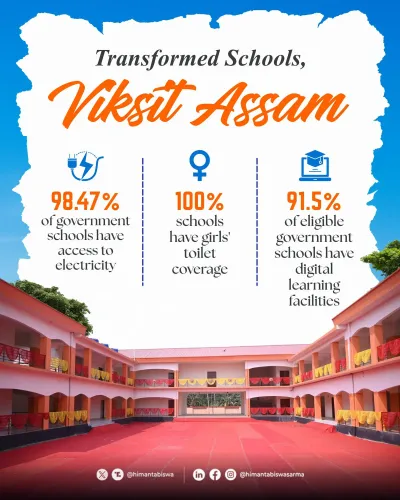
The Chief Minister's Office of Assam on Wednesday, 3 June 2026, said the state has achieved 'near-universal school infrastructure coverage' and a significant rise in girls' enrolment over the past decade, framing the milestone as a foundation for further reforms under Chief Minister Dr. Himanta Biswa Sarma. The post, accompanied by an image, positioned school education as a continuing priority area for the Government of Assam.
'Over the last decade, Assam has witnessed a remarkable transformation in school education, achieving near-universal school infrastructure coverage and recording a significant rise in girls' enrolment,' the CMO said. It added that the state government 'remains committed to building on these achievements and further strengthening access to quality education at the grassroots.'
Context
The statement consolidates a decade-long narrative on school education in Assam, a period that overlaps with two state governments and multiple centrally sponsored programmes. Dr. Himanta Biswa Sarma, who has led the state since May 2021, previously held the education portfolio in earlier state cabinets, giving him a long association with the sector.
The claim of near-universal school infrastructure refers to the saturation of basic facilities — classrooms, toilets, drinking water and boundary walls — that successive audits have tracked across government schools. Girls' enrolment, particularly at the upper primary and secondary levels, has been a stated focus for both the Centre and the state through scholarship and retention schemes.
Policy backdrop
The trajectory the CMO references is rooted in a layered policy framework. The Sarva Shiksha Abhiyan, launched in 2001, set the template for universal elementary education and infrastructure norms, later subsumed under the Samagra Shiksha umbrella. The Right to Education Act, 2009 made free and compulsory schooling a justiciable right and mandated minimum infrastructure standards.
At the state level, Assam introduced the Gunotsav school evaluation exercise in 2017 to grade government schools on learning outcomes, infrastructure and community participation. The state has also been aligning its school system with the National Education Policy, 2020, which restructures schooling into a 5+3+3+4 format and emphasises foundational literacy and numeracy.
Stakeholders and impact
The primary beneficiaries cited in the official messaging are school-going girls and rural students, two cohorts where dropout rates have historically been higher in the Northeast. Improvements in toilet access, separate facilities for girls and proximity of schools have been linked in policy literature to better retention, particularly at the secondary stage.
For the state education department, the messaging signals continued political backing for ongoing programmes and a likely emphasis on quality indicators — learning levels, teacher vacancies and digital access — in the next phase. Teachers' unions and parent bodies have in the past flagged uneven implementation across districts, particularly in char (riverine) areas and tea-garden belts.
What's next
The next set of measurable indicators is expected through the UDISE+ data release on school infrastructure and enrolment, and through learning-outcome surveys that periodically cover Assam. The state's 2026-27 budget allocations for school education will be a near-term marker of how the government translates the stated commitment into spending.
With the Chief Minister's Office framing the decade's gains as a base rather than an end-point, attention will turn to the specifics of the next phase — whether through expansion of model schools, teacher recruitment drives or curriculum changes tied to the National Education Policy. The post stops short of announcing new programmes, but signals that school education will remain a headline priority area for the Government of Assam.
Point of View
Where a state government consolidates a decade's data points into a single narrative of progress. By foregrounding infrastructure saturation and girls' enrolment, the Assam CMO is signalling a pivot from access-led metrics to quality-led ones, in line with the National Education Policy's emphasis. The framing also positions Chief Minister Himanta Biswa Sarma as a continuity figure in education policy, an area where political dividends accrue slowly but durably. Watch for whether the next budget converts this rhetoric into specific allocations on teacher recruitment and learning outcomes.
NationPress
21 Sept 2026
Frequently Asked Questions
What did the Assam Chief Minister's Office say about school education?
The Assam CMO said the state has achieved near-universal school infrastructure coverage and a significant rise in girls' enrolment over the past decade, and that the government will keep strengthening grassroots access to quality education.
Who is the Chief Minister of Assam in 2026?
Dr. Himanta Biswa Sarma is the Chief Minister of Assam, a position he has held since May 2021.
What is the Gunotsav programme in Assam?
Gunotsav is a school evaluation exercise launched by the Assam government in 2017 that grades government schools on learning outcomes, infrastructure and community participation.
How does the National Education Policy 2020 apply to Assam?
Assam is aligning its school system with the National Education Policy 2020, which restructures schooling into a 5+3+3+4 format and emphasises foundational literacy, numeracy and equitable access.
What are the key central schemes behind Assam's school education gains?
The main central schemes include Sarva Shiksha Abhiyan launched in 2001, later subsumed under Samagra Shiksha, and the Right to Education Act 2009, which set infrastructure norms and made elementary education a right.