Assam's ₹5/Litre Milk Subsidy Spurs 54.65% Procurement Rise
Synopsis
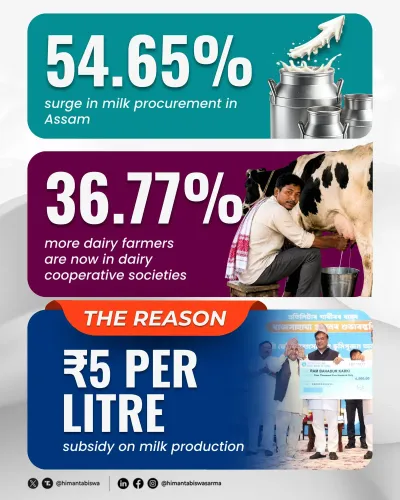
The Chief Minister's Office of Assam says the state's ₹5 per litre milk subsidy has delivered a 54.65 per cent rise in milk procurement, strengthening incomes for dairy farmers and cooperatives across the northeastern state.
Key Takeaways
The Chief Minister's Office of Assam announced on 18 July 2026 that the ₹5 per litre milk subsidy is yielding tangible results.
Milk procurement in Assam has risen by 54.65 per cent since the subsidy's introduction, according to the CMO.
The scheme is aimed at improving livelihoods for dairy farmers and strengthening milk cooperatives across the state.
Chief Minister Himanta Biswa Sarma has positioned dairy development as a pillar of Assam's rural economy strategy since taking office in 2021 .
The policy mirrors a broader national pattern of state-level price interventions to raise domestic milk output and farmer incomes.
Sustained procurement growth could support future investment in cold-chain and processing infrastructure in Assam .
The Chief Minister's Office of Assam announced on Saturday, 18 July 2026 that the state's ₹5 per litre milk subsidy scheme is producing measurable results, citing a 54.65 per cent rise in milk procurement and improved livelihoods across the dairy sector.
Context
The CMO's post stated that the subsidy is 'delivering results, driving a 54.65% rise in milk procurement and strengthening livelihoods across the dairy sector.' The announcement comes as Assam, a northeastern state with a large rural population, continues to push allied agricultural sectors as engines of income growth. Chief Minister Himanta Biswa Sarma, who has helmed the state since 2021, has positioned dairy development as part of a broader rural economy agenda.
Policy Backdrop
The ₹5 per litre milk subsidy is a state-level direct intervention designed to raise the effective price received by milk producers, incentivising higher volumes of milk flowing into formal procurement channels. Across India, state governments have periodically deployed targeted price subsidies in dairy and agriculture to boost output and rural incomes — a pattern Assam is now replicating at scale. The move also aligns with national objectives of expanding domestic milk production and improving returns for farmers in the allied livestock sector.
Assam's dairy sector has historically operated below its potential, with a significant share of milk produced outside formal cooperative or private procurement networks. A direct per-litre subsidy addresses the price gap that often discourages producers from channelling milk through organised systems, which in turn limits their access to better markets and quality inputs.
Stakeholders and Impact
The primary beneficiaries of the scheme are dairy farmers and milk cooperatives operating across Assam. A 54.65 per cent increase in procurement — if sustained — would represent a structural shift in how milk moves from farm to market in the state, strengthening cooperative balance sheets and giving producers a more reliable income stream. Rural households that depend on one or two milch animals as a supplementary livelihood stand to gain the most from a guaranteed price floor backed by state support.
Milk cooperatives and private dairy processors operating in Assam also benefit from a larger, more predictable raw-material supply, which can support investments in processing capacity and cold-chain infrastructure over time.
What's Next
Analysts and sector observers will watch for updated state milk production figures that corroborate the procurement growth cited by the CMO, as well as any reference to the scheme's continuation or expansion in the next Assam state budget or assembly session. A sustained rise in procurement volumes would strengthen the case for scaling the subsidy or linking it to quality-based incentives. The government's ability to maintain fiscal headroom for the subsidy over successive budget cycles will be a key test of the policy's long-term viability.
Point of View
Where schemes are increasingly framed by measurable impact rather than outlay alone. For CM Himanta Biswa Sarma, the dairy subsidy serves a dual purpose: it generates tangible rural goodwill ahead of future electoral cycles and positions Assam as a model for allied-sector policy in the Northeast. The scheme fits into a wider national conversation about direct price support versus market-linkage approaches in agriculture. Whether the procurement gains prove durable will depend on the state's fiscal capacity to sustain the subsidy and on whether cooperative infrastructure can absorb the higher milk volumes efficiently.
NationPress
18 Jul 2026
Frequently Asked Questions
What is Assam's ₹5 per litre milk subsidy?
It is a state government scheme that provides a direct subsidy of ₹5 for every litre of milk procured, aimed at raising the effective price received by dairy farmers in Assam and encouraging more milk to flow through formal procurement channels.
By how much has milk procurement increased in Assam due to the subsidy?
According to the Chief Minister's Office of Assam, milk procurement has risen by 54.65 per cent since the introduction of the ₹5 per litre subsidy.
Who benefits from the Assam milk subsidy scheme?
The primary beneficiaries are dairy farmers and milk cooperatives across Assam, particularly rural households that depend on one or two milch animals as a supplementary source of income.
Who announced the results of Assam's milk subsidy in July 2026?
The Chief Minister's Office of Assam made the announcement on 18 July 2026, citing the procurement rise and improved livelihoods in the dairy sector.
How does Assam's milk subsidy fit into India's broader dairy policy?
Assam's scheme mirrors a broader national pattern where state governments use targeted price subsidies to boost domestic milk production and improve farmer returns, aligning with central objectives for the allied livestock sector.