Is it Premature to Evaluate Khaleda Zia's Legacy Against Tarique Rahman's Future Stance on India?
Synopsis
As Bangladesh braces for unprecedented elections, the absence of key political figures raises questions about the future dynamics of power. Tarique Rahman steps into the spotlight, but can he reshape relations with India while navigating a turbulent political landscape? Explore the implications of his return for Bangladesh's future.
Key Takeaways
Bangladesh's elections will occur without Khaleda Zia and Sheikh Hasina.
Tarique Rahman is leading the BNP after 17 years in exile.
The BNP is distancing itself from Jamaat-e-Islami .
Sheikh Hasina's exile raises questions about the Awami League's future.
India's relationship with Bangladesh may evolve as political dynamics change.
New Delhi, Dec 30 (NationPress) For the first time in decades, general elections in Bangladesh are set to occur without the two primary female political adversaries, following the passing of former Prime Minister Khaleda Zia, while her counterpart, ex-premier Sheikh Hasina, remains in exile in India.
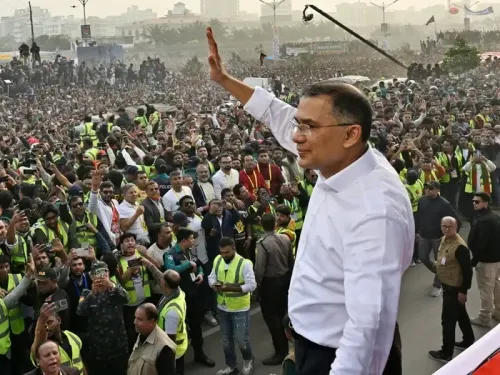
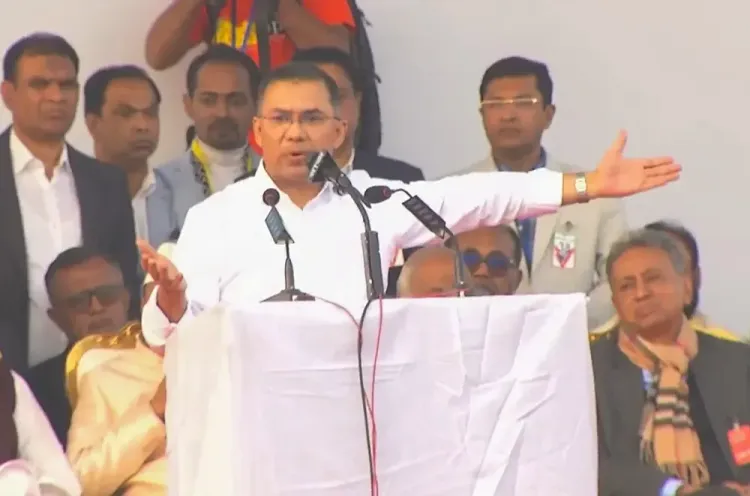
As Bangladesh approaches a new political chapter amidst turmoil and violence, attention turns to Zia’s son, Tarique Rahman, who is spearheading an alliance as the acting Chairman of the Bangladesh Nationalist Party (BNP).
His return to Dhaka after 17 years abroad has sparked discussions regarding the future of India–Bangladesh relations.
His inaugural address to a significant assembly on Thursday, after his arrival in the country, was closely scrutinized. While appealing to the BNP’s nationalistic supporters, who often harbor skepticism towards India, he presented himself as a guardian of Bangladesh’s sovereignty, advocating for a balanced relationship with India, China, and Pakistan.
Rahman emphasized the importance of an inclusive society, welcoming citizens of all faiths and beliefs.
He articulated a vision for a nation characterized by peace, security, and unity, particularly in light of the current instability threatening law and order.
Domestically, his primary challenge arises from a faction led by Bangladesh Jamaat-e-Islami.
Historically, the BNP and Jamaat have collaborated, notably during Khaleda Zia’s administration in the early 2000s, when her cabinet included ministers from Jamaat.
However, the BNP now seems to be distancing itself from Jamaat, which has formed its own coalition for the February 2026 elections. Among its members is the recently established National Citizens Party (NCP), a student-led political organization that emerged from the Students Against Discrimination (SAD) movement, which was at the forefront of last year’s protests against the then Hasina-led government.
Nevertheless, there is significant discontent within the NCP regarding the alliance, leading to resignations among some of its leaders.
Previously, Jamaat leaders such as Ali Ahsan Mohammad Mujahid and Motiur Rahman Nizami held cabinet positions during the 2001–2006 government when the BNP was in coalition with Jamaat. This alliance granted Jamaat political legitimacy despite its controversial past related to the 1971 liberation war.
It also helped the BNP consolidate conservative and Islamist votes, strongly opposing the principal rival, the Awami League.
The coalition served as a counterbalance to the Sheikh Hasina-led party, which aligned itself with secular and pro-India policies.
Electoral collaboration persisted throughout the 2010s, despite allegations of harboring an Islamist agenda.
Sheikh Hasina’s coalition government prohibited Jamaat and its student wing, Islami Chhatrashibir, after violent protests last year, a ban later lifted by the interim administration led by Chief Adviser Muhammad Yunus.
As the 2026 elections approach, the BNP seems to have officially severed ties with Jamaat, with Tarique Rahman focusing on a more centrist and secular message, aiming for the former support base of Sheikh Hasina.
Intriguingly, the Awami League is barred from participating in the 2026 elections, with Hasina facing a death sentence for alleged crimes during her tenure.
This marks the first occasion since Bangladesh's independence in 1971 that the party founded by Sheikh Mujibur Rahman has been excluded from national elections.
By distancing itself from Jamaat, the BNP may broaden its appeal among secular voters and enhance its international standing, despite the ongoing issue of Sheikh Hasina's exile.
For India, the split with Jamaat could be viewed positively, given its historical alignment with pro-Pakistan and anti-India sentiments.
Even considering the proverbial slip between the political cup and the lip, it may still be premature to compare Khaleda Zia's legacy to assess Tarique Rahman’s future stance on relations with New Delhi.
Point of View
The situation in Bangladesh highlights a significant political transition. The absence of prominent leaders like Khaleda Zia and Sheikh Hasina opens up new avenues for dialogue and alliances. As Tarique Rahman emerges, his approach could redefine relationships both domestically and internationally, particularly with India. The BNP's distancing from Jamaat may enhance its appeal among secular voters, reflecting a potential shift in the political landscape.
NationPress
14 Oct 2026
Frequently Asked Questions
What is the significance of Tarique Rahman's return?
Tarique Rahman's return after 17 years is significant as it marks a potential shift in Bangladesh's political landscape, particularly regarding its relations with India.
How has the BNP distanced itself from Jamaat?
The BNP has distanced itself from Jamaat by officially severing ties and emphasizing a more centrist, secular appeal as it prepares for upcoming elections.
What challenges does Tarique Rahman face?
Tarique Rahman faces challenges from other political factions, particularly from the Bangladesh Jamaat-e-Islami, and must navigate a volatile political environment.
What is the impact of Sheikh Hasina's exile?
Sheikh Hasina's exile complicates the political landscape, as her party, the Awami League, is barred from the upcoming elections, which may change voter dynamics.
How might India view the BNP's distancing from Jamaat?
India may view the BNP's distancing from Jamaat positively, as Jamaat has historically been seen as pro-Pakistan and anti-India.