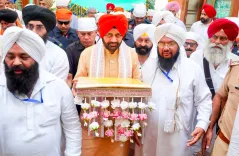
CM Rekha Gupta Hails Sawan Barwal's Asian Games Silver

Synopsis
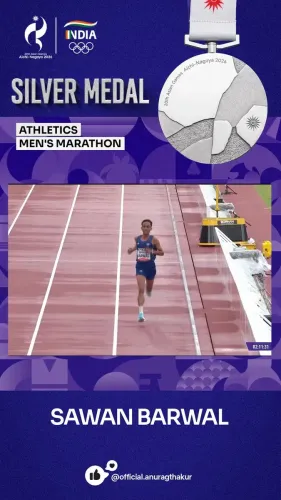
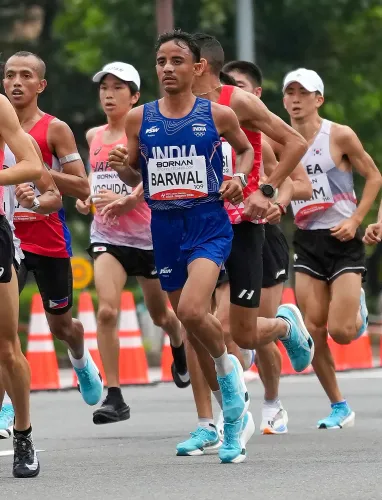
Delhi Chief Minister Rekha Gupta celebrated Sawan Barwal's Silver Medal in the Men's Marathon at Asian Games 2026, where Barwal set a new National Record of 2:11:37, ending a 44-year wait for India in the event.
Key Takeaways
Sawan Barwal won the Silver Medal in Men's Marathon at the Asian Games 2026 .
His winning time of 2:11:37 set a new Indian National Record in men's marathon.
India's last comparable men's marathon medal at the Asian Games came 44 years ago .
Delhi CM Rekha Gupta publicly congratulated Barwal via X on 26 September 2026 .
The achievement marks a significant milestone for Indian endurance athletics on the continental stage.
Forty-four years after India last stood on the podium in men's marathon at the Asian Games, Sawan Barwal crossed the finish line and rewrote history. Delhi Chief Minister Rekha Gupta took to X on Saturday, 26 September 2026, to congratulate Barwal on winning the Silver Medal in the Men's Marathon at the Asian Games 2026 — a result accompanied by a new National Record timing of 2:11:37.
A 44-Year Wait Ends on the Road
The weight of that number — 44 years — is worth pausing on. India's last comparable men's marathon medal at the Asian Games dates back to an era before most of today's athletes were born. Barwal's 2:11:37 did not just secure silver; it shattered the previous national record, planting a new benchmark for every Indian distance runner who comes after him.
CM Gupta described the achievement as 'a triumph of endurance and determination that has made the nation proud' — a phrase that, in this case, carries genuine statistical weight behind it.
What 2:11:37 Means for Indian Athletics
Running a sub-2:12 marathon is a standard that separates elite club from aspirational runners on the global circuit. For India, where endurance running has historically lagged behind field events in investment and visibility, a national record at this mark signals a structural shift — not just an individual feat. The Asian Games, a quadrennial continental competition contested by the continent's top sporting nations, provides exactly the high-stakes stage where such records carry maximum credibility.
National records in Indian athletics have been updated periodically through individual breakthroughs at events of this calibre, but a record paired with a continental medal is a rarer double — and one that tends to trigger follow-on investment in training programmes and coaching infrastructure.
Delhi's Chief Minister and the Bigger Sports Picture
Rekha Gupta, who leads the BJP government in Delhi, used the occasion to amplify national pride around an achievement that crosses regional lines. Marathon medals belong to no single city; they belong to the road, the lungs, and years of solitary training. That a Delhi CM is among the first political voices to celebrate Barwal speaks to the broader political premium now placed on sporting success as a symbol of national aspiration.
India's performance in subsequent international athletics competitions — and any government announcements on endurance-sports training support — will determine whether Barwal's record becomes a ceiling or a floor.
One silver medal, one shattered record, and a 44-year chapter finally closed — the question now is whether India's athletics ecosystem will build on this moment or let it stand alone.
Point of View
An area where the country has historically underinvested relative to its population. The 44-year gap between medals at this event underscores how rare such breakthroughs are, making the National Record timing all the more significant as a structural signal. Political leaders celebrating the moment quickly, as CM Gupta has done, reflects the premium the current establishment places on sporting success as soft-power currency. The real test of that enthusiasm will be whether it translates into sustained infrastructure and coaching support for distance runners.
NationPress
26 Sept 2026
Frequently Asked Questions
Who is Sawan Barwal?
Sawan Barwal is an Indian long-distance runner who won the Silver Medal in the Men's Marathon at the Asian Games 2026, setting a new National Record with a time of 2:11:37.
What is India's new national record in men's marathon?
India's new national record in men's marathon is 2:11:37 , set by Sawan Barwal at the Asian Games 2026.
When did India last win a men's marathon medal at the Asian Games?
According to Delhi CM Rekha Gupta's post, India's last men's marathon medal at the Asian Games came 44 years before the 2026 edition.
What did Delhi CM Rekha Gupta say about Sawan Barwal?
CM Rekha Gupta congratulated Barwal on X, calling his achievement 'a triumph of endurance and determination that has made the nation proud.'
Where are the Asian Games 2026 being held?
The specific host city of the Asian Games 2026 was not mentioned in the post. The Asian Games are a quadrennial multi-sport event contested by Asian nations.