How Did Bengal's Agriculture Dept Develop Four New Weather-Suitable Rice Varieties?
Click to start listening

Synopsis
Kolkata's agriculture sector is taking a leap forward with the introduction of four new rice varieties. Developed by the State Agriculture department under Mamata Banerjee, these varieties are set to enhance crop resilience against climate challenges, promising hope for farmers in drought and flood-prone areas.
Key Takeaways
- Four new rice varieties developed for West Bengal's climate.
- Subhashini, Lachhmanti, and Musafir target drought-prone areas.
- Iravati is designed for flood resilience.
- Expected yield is 52 to 55 quintals per hectare.
- Total of 25 new crop varieties developed since 2011.
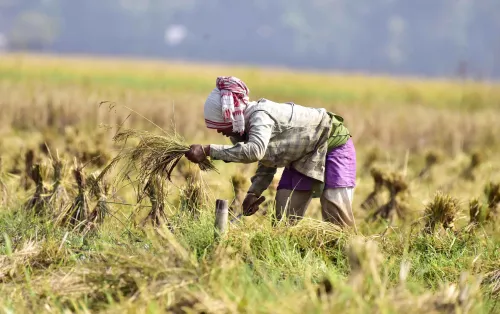
Kolkata, Jan 20 (NationPress) The Chief Minister of West Bengal, Mamata Banerjee, announced on Tuesday that the State Agriculture department has successfully developed four innovative rice varieties that are well-suited to the local climate and weather conditions.
"After extensive research conducted at the Purulia Drought Resistance Research Centre and the Chinsurah Rice Research Centre, we have achieved the creation of these varieties. I extend my sincere congratulations to all the scientists who contributed to this significant effort," the Chief Minister remarked.
Among these four new varieties, three—Subhashini, Lachhmanti, and Musafir—are specifically designed for the drought-prone regions of western Bengal, including West Medinipur, Purulia, and Bankura.
“These varieties have the potential to yield between 52 and 55 quintals per hectare during the kharif season,” the Chief Minister asserted.
Additionally, another variety called Iravati has been developed to withstand flooding in southern Bengal.
This variety is resilient enough to remain undamaged even when submerged in water for extended periods and does not collapse during storms.
Since 2011, the state government has introduced a total of 25 new crop varieties through research, with 15 of them being rice varieties aimed at improving the livelihood of farmers.
Agricultural scientists believe that, if the Chief Minister's claims hold true, these four new varieties could significantly mitigate the annual crop losses caused by prolonged droughts and heavy flooding.
The introduction of Iravati is particularly crucial, given that flooding in the paddy-growing belts of South Bengal has become a recurring issue. Seedbeds that remain submerged for too long often result in substantial crop losses every year. This new Iravati variety is expected to address this problem effectively, a local agricultural expert stated.
Point of View
It's crucial to highlight the positive impact of agricultural innovation on local farmers. The development of these four new rice varieties not only addresses immediate climate challenges but also showcases the ongoing commitment of the West Bengal government to enhance agricultural productivity and sustainability. It's a step forward that deserves recognition and support.
NationPress
20/01/2026
Frequently Asked Questions
What are the new rice varieties developed?
The new rice varieties developed are Subhashini, Lachhmanti, Musafir, and Iravati, each tailored for specific climatic conditions.
What areas do these new varieties target?
Subhashini, Lachhmanti, and Musafir target drought-prone areas in western Bengal, while Iravati is designed for flood-prone regions in southern Bengal.
What is the expected yield from these varieties?
The expected yield from these varieties is between 52 to 55 quintals per hectare during the kharif season.
How many new crop varieties has the state developed since 2011?
Since 2011, the state has developed a total of 25 new crop varieties, with 15 being rice varieties.
Why is the Iravati variety significant?
Iravati is significant because it can withstand flooding, which is a recurring issue in southern Bengal, helping to prevent crop loss.