Gehlot-Pilot fault lines resurface after Rajasthan civic poll results
Synopsis
A near-identical vote share, a BJP ward-count advantage, and now a public clash between Ashok Gehlot and Sachin Pilot — the Rajasthan Congress's civic poll result has done what decades of internal tensions never quite resolved: forced the leadership question back into the open, just years before the 2028 assembly election.
Key Takeaways
BJP won the Rajasthan urban local body elections; the statewide vote-share gap was just 0.94 percentage points ( 35.18% vs 34.24% ).
Former Chief Minister Ashok Gehlot criticised the Congress's campaign planning and organisational preparedness without naming PCC president Govind Singh Dotasra directly.
Sachin Pilot defended the PCC's grassroots efforts and noted the BJP's structural advantage as the ruling party.
Dotasra attributed the gap between vote share and ward wins partly to what he described as unfair delimitation — a claim that remains publicly disputed.
Slogans calling for Gehlot to return as Chief Minister were raised at a party event, further fuelling leadership speculation.
The internal clash sets the stage for a contested Congress leadership dynamic heading into the 2028 Rajasthan Assembly election .
The Rajasthan Congress's long-running internal fault lines have cracked open again, with former Chief Minister Ashok Gehlot and senior party leader Sachin Pilot trading sharp remarks over the party's showing in the recently concluded urban local body elections in Rajasthan. The fresh war of words, following a civic poll in which the Bharatiya Janata Party (BJP) emerged as the largest party, has once again placed the Congress's state leadership and organisational credibility under a harsh internal spotlight.
The Civic Poll Numbers and What They Sparked
The BJP finished ahead in the urban local body elections, yet the statewide vote-share contest was remarkably tight. The BJP polled 35.18% of votes against the Congress's 34.24% — a gap of just 0.94 percentage points. Despite this narrow margin, the gap between vote share and ward wins has become the flashpoint for competing narratives within the party.
Rajasthan Pradesh Congress Committee (PCC) president Govind Singh Dotasra has attributed part of the disparity between vote share and seats won to what he described as unfair delimitation — a claim that has drawn public dispute and remains contested. Meanwhile, others within the party have questioned whether the campaign machinery itself fell short.
Gehlot Questions the Congress Strategy
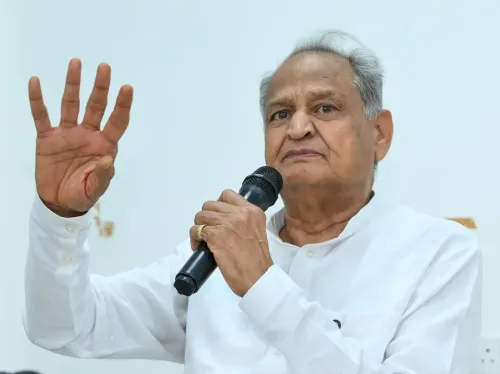
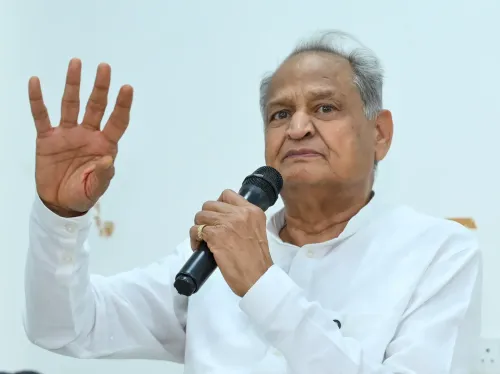
Speaking to the media, Gehlot argued that the Congress could have done considerably better with stronger campaign planning and organisational coordination. He said the Pradesh Congress Committee should have drawn up a more effective programme, ensured that all senior leaders campaigned together, and matched the BJP's aggressive roadshow strategy — roadshows led by Chief Minister Bhajanlal Sharma and other BJP leaders.
Though Gehlot did not name Dotasra explicitly, his remarks have been widely interpreted as a pointed critique of the state unit's handling of the campaign. He further contended that the political environment had offered the Congress a genuine opportunity, and that better-coordinated campaigning could have translated that opportunity into more ward victories.
Pilot Defends the PCC's Ground Work
Pilot pushed back sharply, defending both the Pradesh Congress Committee and the state leadership's efforts. He said the PCC had done a good job during the local body elections, having worked at the grassroots level through door-to-door campaigns and by assigning responsibilities to leaders and workers in their respective areas.
Pilot also drew a distinction between the resources available to a ruling party and those available to an opposition, noting that the BJP's incumbency gave it structural advantages the Congress could not match. His defence was, by implication, also a rebuttal of Gehlot's suggestion that the organisational effort fell short.
A Divide That Runs Deeper Than One Election
The current exchange is not simply a post-poll post-mortem. It has reopened persistent questions about who sets the Congress's political strategy in Rajasthan, how the organisation should be run, and what space established leaders like Gehlot retain alongside newer organisational centres around Dotasra and Leader of Opposition Tikaram Jully.
This comes amid a series of episodes that have exposed competing power centres within the Rajasthan Congress. Dotasra has previously emphasised the primacy of the party organisation over individual leaders — remarks that arrived amid renewed discussion about Gehlot's influence in the state unit. Separately, slogans calling for Gehlot to return as Chief Minister were raised at a party-related event following the entry of workers from the Bharat Adivasi Party into the Congress, though leaders involved distanced themselves from any suggestion of open confrontation.
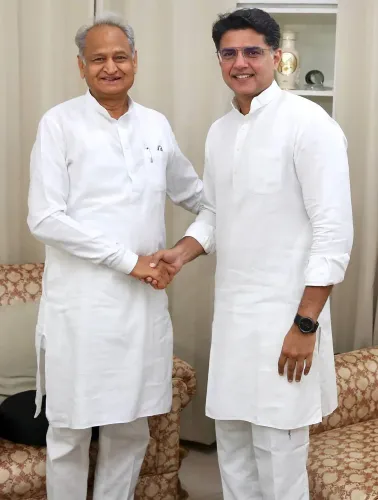
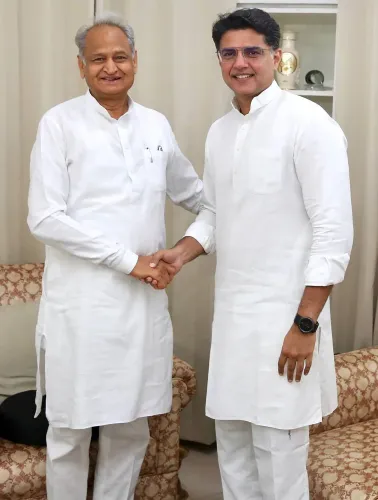
The Gehlot-Pilot rivalry has defined Rajasthan Congress politics for years, including a near-collapse of the state government in 2020. The latest exchange signals that the rivalry remains politically alive, even as a new layer of organisational leadership has taken shape. With the 2028 Rajasthan Assembly election now on the horizon, the internal leadership question is unlikely to resolve quietly.
Point of View
Not fights over internally. What the post-poll sparring reveals is that the Rajasthan Congress has never resolved its core structural problem: two competing power centres, each with a legitimate claim to influence, and a PCC leadership caught in between. Gehlot's critique lands as the voice of an elder statesman asserting relevance; Pilot's defence reads as the new establishment protecting its turf. Neither framing serves the party's electoral interest. With 2028 approaching, the BJP need not do much — Rajasthan Congress appears capable of fragmenting its own political capital without external pressure.
NationPress
18 Sept 2026
Frequently Asked Questions
What triggered the latest Gehlot-Pilot clash in Rajasthan Congress?
The latest clash was triggered by the outcome of Rajasthan's urban local body elections, in which the BJP emerged as the largest party despite a razor-thin statewide vote-share gap of just 0.94 percentage points. Gehlot publicly questioned the Congress's campaign strategy and organisational preparedness, prompting Pilot to defend the PCC's work.
What were the vote-share figures in the Rajasthan urban local body elections?
The BJP polled 35.18% of votes, while the Congress polled 34.24%, a difference of just 0.94 percentage points. Despite the narrow margin, the BJP finished ahead in ward wins, creating two competing narratives within the Congress about what the results actually mean.
What did Ashok Gehlot say about the Congress's campaign?
Gehlot said the Congress should have prepared a stronger campaign strategy to counter the BJP's aggressive roadshows led by Chief Minister Bhajanlal Sharma. He argued that had all senior leaders campaigned together under a stronger PCC programme, the party could have converted its vote base into more ward victories.
How did Sachin Pilot respond to the criticism?
Pilot defended the Pradesh Congress Committee, saying it had done a good job by running door-to-door campaigns and assigning responsibilities to leaders and workers in specific areas. He also noted that ruling parties have structural resource advantages that opposition parties cannot match.
Why does this matter ahead of the 2028 Rajasthan Assembly election?
The public exchange has reopened unresolved questions about who controls the Congress's political strategy in Rajasthan — Gehlot's established influence, Pilot's organisational standing, or PCC president Dotasra's formal authority. With the 2028 assembly election approaching, a fractured leadership structure could blunt the party's ability to mount a unified challenge against the ruling BJP.