Modi, Chandrababu Launch Bhogapuram Airport, Key AP Projects
Synopsis
Prime Minister Narendra Modi virtually inaugurated the Alluri Sitarama Raju International Airport at Bhogapuram and launched a semiconductor unit, 3,500 MW of solar transmission capacity, expressways, and a bridge across Andhra Pradesh, with Chief Minister Chandrababu Naidu presiding on 1 August 2026.
Key Takeaways
Alluri Sitarama Raju International Airport at Bhogapuram was inaugurated on 1 August 2026 , giving Uttarandhra its first international air hub.
Foundation stone laid for an ASIP Technologies semiconductor packaging and testing unit at Tarluvada, Visakhapatnam , linked to India's 2021 Semiconductor Mission.
Solar energy zone transmission schemes totalling 3,500 MW — 2,500 MW in Anantapur and 1,000 MW in Kurnool — were launched, along with the Kurnool Wind and Solar Energy Zone Transmission System .
The Khammam–Devarapalli Greenfield four-lane expressway and Tadpatri four-lane bypass road were inaugurated.
Foundation stone laid for a bridge between Penchalakona and Erpedu and the Kurnool-IV Renewable Energy Zone Transmission Project .
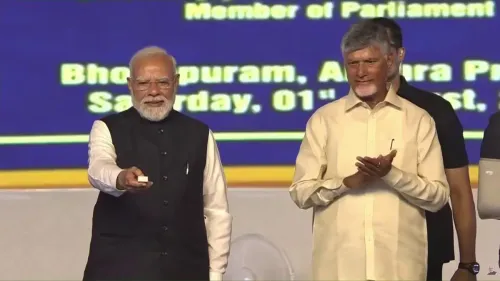
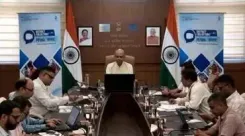
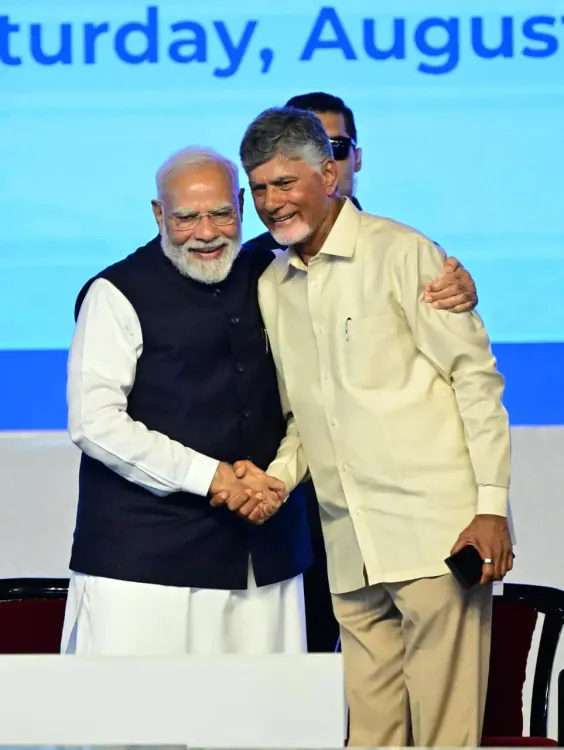
PM Modi participated virtually while CM Chandrababu Naidu presided at the Bhogapuram venue.
A new gateway opened for Andhra Pradesh's north on Saturday, 1 August 2026, as Prime Minister Narendra Modi virtually inaugurated and laid foundation stones for a sweeping cluster of infrastructure projects — from a long-awaited international airport to semiconductor facilities and gigawatt-scale solar transmission lines — with Chief Minister Nara Chandrababu Naidu presiding from the dais in Bhogapuram. The Chief Minister's Office of Andhra Pradesh announced the launches, framing them as a defining moment for the state's connectivity and clean-energy ambitions.
Bhogapuram Airport: Uttarandhra's Long-Awaited Sky Bridge
The centrepiece of the day was the inauguration of the Alluri Sitarama Raju International Airport at Bhogapuram, a project designed to give the Uttarandhra region — the northern coastal belt of Andhra Pradesh — its own international air hub. The airport carries the name of the legendary tribal freedom fighter Alluri Sitarama Raju, a deliberate nod to the region's identity and history. For decades, Uttarandhra travellers depended entirely on Visakhapatnam's airport; Bhogapuram changes that calculus entirely.
Semiconductor Foothold at Tarluvada, Visakhapatnam
From the same stage, Modi laid the foundation stone for an ASIP Technologies semiconductor packaging and testing unit at Tarluvada, Visakhapatnam. The facility plugs directly into India's Semiconductor Mission, approved in 2021 to build domestic chip-packaging and testing capacity and reduce reliance on foreign supply chains. Andhra Pradesh, with its established electronics corridor near Visakhapatnam, is positioning itself as a key node in that national ambition. The commissioning timeline for the Tarluvada plant will be the number to watch.
Solar and Wind Transmission: 3,500 MW of Green Capacity Unlocked
The renewable energy announcements were the day's most numerically striking package. Modi inaugurated the Wind and Solar Energy Zone Transmission System in Kurnool, and separately launched solar energy zone transmission schemes covering 2,500 megawatts in Anantapur and 1,000 megawatts in Kurnool — a combined 3,500 MW of solar transmission capacity set in motion in a single ceremony. A foundation stone was also laid for the Kurnool-IV Renewable Energy Zone Transmission Project. Andhra Pradesh has cultivated these Kurnool-Anantapur renewable corridors since the mid-2010s; today's launches represent the next generation of that buildout.
Expressways and Bridges: Moving People and Goods Faster
Road infrastructure rounded out the programme. The Khammam–Devarapalli Greenfield four-lane expressway was inaugurated, along with the Khammam–Devarapalli package and the Tadpatri four-lane bypass road. A foundation stone was also laid for a bridge between Penchalakona and Erpedu. Together, these corridors target freight movement, pilgrim traffic, and last-mile connectivity across the state's interior — the unglamorous but essential arteries of any growth story.
Virtual Inaugurations, Real Stakes
The format — Modi joining virtually while Naidu anchored the physical event at Bhogapuram — has become the signature mode of Centre-state infrastructure rollouts under the current national government. It allows a single high-profile moment to compress multiple project launches across geographies into one political and administrative statement. For Chandrababu Naidu, a Chief Minister who built his first political brand on technology and infrastructure in the early 2000s, the optics of standing at a new international airport while simultaneously flagging off semiconductor plants and gigawatt-scale solar grids is precisely the image he has sought to project in this term.
Andhra Pradesh now watches to see which of these projects moves from foundation stone to functioning facility — and how fast.
Point of View
A semiconductor plant, gigawatt-scale solar transmission, and expressways into a single virtual ceremony maximises political optics while compressing timelines on paper. The semiconductor component is the most strategically significant: if the Tarluvada facility commissions on schedule, Andhra Pradesh could claim a tangible role in India's chip self-sufficiency drive — a high-value narrative for a state still rebuilding its economic identity after bifurcation. The real test, as always, is execution speed.
NationPress
15 Sept 2026
Frequently Asked Questions
Where is Bhogapuram airport located?
Bhogapuram airport is located in Bhogapuram , in the Vizianagaram district of Andhra Pradesh, and is designed to serve the Uttarandhra region of the state.
What is the full name of the new Bhogapuram airport?
The airport is officially named the Alluri Sitarama Raju International Airport , after the legendary tribal freedom fighter from the region.
What is the ASIP Technologies semiconductor unit in Visakhapatnam?
The ASIP Technologies facility at Tarluvada, Visakhapatnam is a semiconductor packaging and testing unit whose foundation stone was laid by PM Modi on 1 August 2026, as part of India's national Semiconductor Mission.
How much solar energy transmission capacity was launched in Andhra Pradesh?
A combined 3,500 MW of solar energy zone transmission capacity was launched — 2,500 MW in Anantapur and 1,000 MW in Kurnool — along with the Kurnool Wind and Solar Energy Zone Transmission System.
What new roads were inaugurated in Andhra Pradesh on 1 August 2026?
The Khammam–Devarapalli Greenfield four-lane expressway and the Tadpatri four-lane bypass road were inaugurated, and a foundation stone was laid for a bridge between Penchalakona and Erpedu .