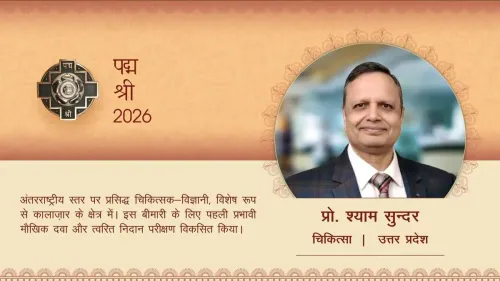
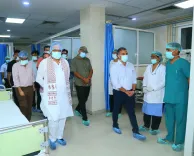
How has BHU's Prof. Shyam Sundar Agrawal been recognized with the Padma Shri for pioneering Kala-azar treatment?

Synopsis
BHU's Professor Shyam Sundar Agrawal has earned the prestigious Padma Shri award for his pioneering work in treating Kala-azar, a neglected tropical disease. His innovative approaches have revolutionized treatment and marked significant progress in India's public health landscape.
Key Takeaways
Professor Shyam Sundar Agrawal has been awarded the Padma Shri for his work on Kala-azar .
He developed a revolutionary single-dose treatment regimen.
His research supports India's national Kala-azar elimination program.
Agrawal's work exemplifies the importance of innovative solutions in public health.
His legacy promotes continued efforts towards eradicating Kala-azar .
Varanasi, January 25 (NationPress) Banaras Hindu University (BHU) is filled with pride as Professor Shyam Sundar Agrawal, a renowned faculty member at the Institute of Medical Sciences, has received the esteemed Padma Shri award in the Republic Day honours list of 2026.
This accolade recognizes his innovative efforts in addressing visceral leishmaniasis, popularly known as Kala-azar, a serious neglected tropical illness that has significantly impacted the impoverished regions of India. Prof. Agrawal, an authority in infectious diseases, has transformed the treatment of Kala-azar through years of diligent research.
He introduced and promoted a single-dose, lipid-based liposomal amphotericin B regimen, leading to a remarkable enhancement in cure rates for Indian visceral leishmaniasis. This breakthrough received endorsement from the World Health Organization (WHO) and was incorporated into India’s national Kala-azar elimination strategy, representing a significant advancement in disease control.
Moreover, he was instrumental in validating multi-drug therapy regimens, including the WHO-recommended combination of “paromomycin and miltefosine.” This oral treatment is now implemented at primary health centres, shortening treatment times, lowering costs, and minimizing the risk of resistance.
Additionally, Prof. Agrawal informed IANS about his role in the development of miltefosine as a potent oral medication and in conducting the initial successful trials of the RK-39 rapid diagnostic strip test, which allows for quicker and more precise field diagnostics.
In response to the recognition, Prof. Shyam Sundar Agrawal expressed profound humility and gratitude, stating, “This award is not solely for me, but for the numerous patients who endured Kala-azar and the committed teams that worked relentlessly to discover solutions.”
“Kala-azar once claimed thousands of lives every year in Bihar, Jharkhand, and West Bengal. Witnessing the disease nearing elimination through evidence-based treatments brings me immense joy. I dedicate this recognition to the tenacity of affected communities and aspire that it motivates ongoing efforts toward total eradication.”
The announcement of two BHU professors among this year’s Padma award recipients has ignited widespread celebration in Varanasi. Colleagues, students, and local leaders have applauded this achievement as a testament to the university's excellence in medical research.
Prof. Agrawal's contributions have not only saved lives but have also fortified India’s public health infrastructure against vector-borne diseases.
As India moves closer to the eradication of Kala-azar — achieving zero indigenous cases in numerous blocks — Prof. Agrawal’s legacy shines as a symbol of scientific advancement for global health.
The Padma Shri award highlights his lasting influence in transforming a once deadly disease into a manageable condition.
Point of View
We recognize the significance of Professor Shyam Sundar Agrawal's achievements and the positive impact his work has on public health in India. His dedication to innovative research stands as a model for future medical advancements, reflecting the importance of collaboration and community involvement in tackling health crises.
NationPress
25 Sept 2026
Frequently Asked Questions
What is the Padma Shri award?
The Padma Shri is one of the highest civilian awards in India, recognizing individuals for their exceptional service in various fields, including medicine, arts, and social work.
How has Prof. Agrawal contributed to Kala-azar treatment?
Prof. Agrawal has revolutionized Kala-azar treatment through research and development of effective therapies, including a single-dose lipid-based regimen and multi-drug therapies endorsed by WHO.
Why is the recognition significant?
This recognition highlights the importance of innovative research in addressing neglected diseases and improving public health systems, inspiring further efforts towards disease eradication.
What impact has Prof. Agrawal made on public health?
His contributions have not only saved lives but have also strengthened India’s health infrastructure, providing effective solutions for managing vector-borne diseases.