CM Nitish's Office Flags Skill Initiative for Bihar Youth
Synopsis
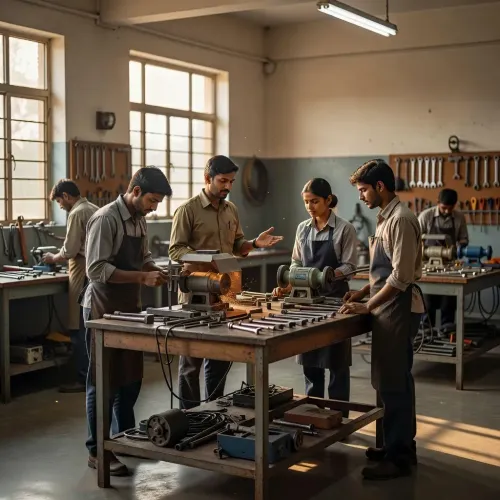
The Chief Minister's Office of Bihar on 23 July 2026 announced an initiative to equip state youth with skills, self-reliance, and global job opportunities, framing it as a driver of a prosperous Bihar and developed India under the Viksit Bharat vision.
Key Takeaways
The Chief Minister's Office of Bihar announced a skill and employment initiative on 23 July 2026 .
The initiative aims to connect Bihar's youth with skill development, self-reliance, and global employment opportunities .
The announcement explicitly invokes the Viksit Bharat (Developed India) framework, aligning state goals with national policy.
Bihar has historically faced high youth out-migration due to low local industrialisation, making such schemes a recurring state priority.
Specific scheme details, partnerships, and beneficiary targets have not yet been officially disclosed.
The Skill India Mission and PMKVY , both launched in 2015 , form the national policy backdrop for this state-level effort.
The Chief Minister's Office of Bihar shared remarks on Thursday, 23 July 2026, highlighting a new initiative aimed at connecting Bihar's youth with skill development, self-reliance, and global employment opportunities — framing it as a step toward a prosperous Bihar and a developed India.
The post quoted a statement saying the initiative would link young people in Bihar with skills, self-reliance (aatmanirbharta), and global job opportunities, giving 'new momentum to the resolve of a prosperous Bihar and a developed India' (samridh Bihar evam viksit Bharat ke sankalp ko nayi gati).
Context
Bihar is among India's most populous states, with a large and young workforce that has historically sought employment outside the state due to limited local industrial opportunity. Addressing this out-migration through skill-building and overseas employment linkages has been a recurring policy priority for the state government under Chief Minister Nitish Kumar, who has led Bihar since 2005.
The language of the announcement — invoking both a 'prosperous Bihar' and a 'developed India' — aligns the state's agenda with the broader national vision of Viksit Bharat, a framework that has shaped central and state policy discourse in recent years.
Policy Backdrop
The initiative sits within a well-established national policy architecture. The Skill India Mission, launched in 2015, set out to train hundreds of millions of Indians in industry-relevant skills. The Pradhan Mantri Kaushal Vikas Yojana (PMKVY), also introduced in 2015, offered short-term vocational training and monetary incentives to participants across the country.
Bihar has historically supplemented central schemes with state-level interventions, particularly those targeting global job markets, given the state's significant diaspora and migration patterns. The explicit reference to 'global employment opportunities' in the announcement suggests this initiative may have an overseas placement or international skilling component, though specific details have not been officially released.
Stakeholders and Impact
The primary beneficiaries identified are Bihar's youth — a demographic that represents both the state's greatest challenge and its largest potential asset. High youth unemployment and low local industrialisation have long driven migration to states such as Delhi, Maharashtra, and Punjab, as well as to Gulf countries.
If the initiative delivers on its stated aims of skill certification and global job linkages, it could reduce dependence on informal migration channels and improve income security for families across Bihar's rural and semi-urban districts. Industry partners, foreign employers, and vocational training providers are likely to be key implementation stakeholders, though no formal partnerships have been announced.
What's Next
Observers will watch for the release of rollout details, including the name and structure of the specific scheme, target beneficiary numbers, funding allocation, and any tie-ups with domestic industries or foreign employers. Placement and certification data in subsequent months will be the clearest measure of the initiative's reach.
With Bihar's next electoral cycle on the horizon, skill and employment announcements carry both policy and political weight — and the framing of this initiative within the Viksit Bharat narrative signals an intent to position the state government as an active partner in India's development agenda.
Point of View
Not merely a recipient of central schemes. Anchoring a state announcement in the language of global employment is notable for Bihar, a state whose skill-migration story has long been informal and unstructured. The absence of specific scheme details at the time of the post suggests this may be an early-stage rollout or a political signalling exercise ahead of a formal launch. Whether the initiative produces measurable placement outcomes will determine whether it becomes a genuine policy milestone or remains aspirational messaging.
NationPress
22 Oct 2026
Frequently Asked Questions
What is the Bihar youth skill initiative announced in July 2026?
The Chief Minister's Office of Bihar announced on 23 July 2026 an initiative designed to connect Bihar's youth with skill training, self-reliance, and global employment opportunities, though specific scheme details have not yet been released.
Who is the Chief Minister of Bihar?
Nitish Kumar is the Chief Minister of Bihar and has held the post since 2005, with a policy focus on education, infrastructure, and employment generation.
What is Viksit Bharat and how does it relate to Bihar's skill programme?
Viksit Bharat, meaning 'Developed India', is a national development vision that state governments have increasingly used to frame their own policy goals. Bihar's announcement explicitly invokes this vision to align the state's skill initiative with the broader national agenda.
What is the Skill India Mission?
The Skill India Mission is a national programme launched in 2015 to provide vocational training and industry-relevant certification to millions of Indians, aiming to improve employability and promote self-employment.
Why does Bihar focus on global employment for its youth?
Bihar has historically faced low industrialisation and high youth out-migration, with many workers seeking jobs in other Indian states or abroad. State-level skill initiatives targeting global job markets aim to make this migration more structured and economically beneficial.