CM Bihar Backs Home-Stay Model Near Skill Training Hubs

Synopsis
Bihar CM Nitish Kumar on 23 June 2026 called for promoting home-stays near skill-training institutes, arguing the model will create self-employment and local economic growth. The move extends Bihar's long-standing strategy of linking vocational infrastructure with community-level service-sector activity.
Key Takeaways
The Chief Minister's Office of Bihar on 23 June 2026 shared CM Nitish Kumar 's remarks backing a home-stay model near skill-training institutions.
CM Kumar stated the model will create new employment and self-employment opportunities at the local level.
The initiative is intended to strengthen regional economies by activating service-sector activity around training campuses.
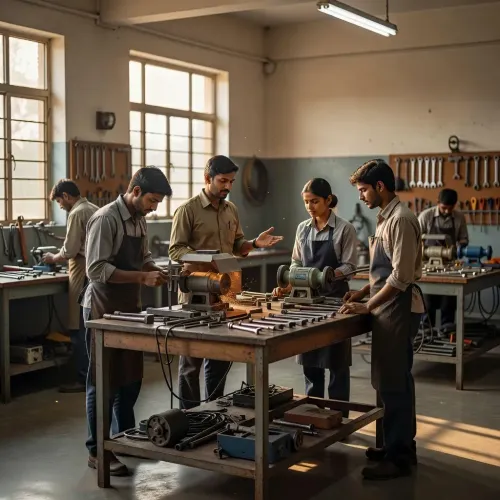
The approach aligns with the Bihar Skill Development Mission and the state's broader strategy of treating training centres as district-level economic anchors.
Primary beneficiaries include local households near training institutes and youth trainees seeking affordable accommodation.
Concrete policy follow-through — such as budget allocations or home-stay subsidy guidelines — is yet to be announced.
The Chief Minister's Office of Bihar on Tuesday, 23 June 2026, shared remarks by Chief Minister Nitish Kumar emphasising the promotion of a home-stay model around skill-training institutions, stating that such a push would generate new employment and self-employment opportunities at the local level while strengthening regional economies.
Context
The post, shared as part of a reply thread, quotes CM Nitish Kumar as saying — 'इससे स्थानीय स्तर पर रोजगार एवं स्वरोजगार के नए अवसर सृजित होंगे तथा क्षेत्रीय अर्थव्यवस्था को भी मजबूती मिलेगी' — ('This will create new opportunities for employment and self-employment at the local level and will also strengthen the regional economy'). The statement underlines the Chief Minister's intent to treat skill-training centres not merely as vocational hubs but as anchors for broader neighbourhood economic activity.
By encouraging households near training institutes to offer home-stay facilities to trainees and visitors, the government aims to activate a service-sector layer that supplements formal skill development infrastructure.
Policy Backdrop
Bihar has, since the early 2000s, pursued integrated strategies linking tourism-friendly hospitality models with state-run training infrastructure. The Bihar Skill Development Mission has been a cornerstone of this approach, establishing vocational training centres across districts with the goal of improving employability among the state's large youth population.
Encouraging home-stays near these institutes extends that logic: trainees who travel from distant districts need affordable accommodation, and local families who provide it earn supplementary income — a self-reinforcing cycle that state planners have long advocated but rarely formalised into policy guidelines. CM Nitish Kumar has repeatedly emphasised self-employment and district-level economic strengthening as complements to large industrial investment.
Stakeholders and Impact
The primary beneficiaries of such a model would be local households in the vicinity of skill-training campuses, who could convert spare rooms into registered home-stays, and youth trainees who would gain access to affordable, community-integrated lodging. District-level service sectors — food, transport, and retail — are also expected to see incremental demand.
For the broader Bihar economy, which has historically struggled with out-migration driven by limited local employment, home-stay promotion near training hubs represents a low-capital, high-reach intervention. It does not require large industrial outlays and can be activated with relatively modest state support such as subsidies, registration facilitation, or quality certification.
What's Next
Observers will watch for concrete follow-through in the form of state budget allocations, district-level guidelines, or a formal home-stay subsidy scheme linked to the skill-training ecosystem. Whether the Chief Minister's remarks translate into a notified policy or remain directional guidance will determine the actual impact on local employment numbers. Any rollout of district-level targets or empanelment of home-stay providers near training centres would be the clearest signal that the initiative is moving from rhetoric to implementation.
Point of View
High-optics interventions that layer self-employment onto existing state infrastructure without requiring fresh industrial land or large fiscal outlays. It signals that the administration is aware of the accommodation gap that limits the reach of training centres, particularly for trainees from distant districts. The remarks also reflect a political calculation — self-employment narratives resonate strongly in a state where out-migration remains a persistent electoral pressure point. Whether this remains a directional statement or acquires the scaffolding of a formal scheme will be the real test of its policy weight.
NationPress
22 Sept 2026
Frequently Asked Questions
What did Bihar CM Nitish Kumar say about home-stays near skill training centres?
CM Nitish Kumar said that promoting home-stays near skill-training institutions will create new employment and self-employment opportunities at the local level and strengthen regional economies.
What is the Bihar Skill Development Mission?
The Bihar Skill Development Mission is a state initiative that establishes vocational and skill-training centres across Bihar's districts to improve employability, especially among youth.
How will home-stays near training institutes help local people in Bihar?
Local households can earn supplementary income by hosting trainees, while the increased footfall also benefits nearby food, transport, and retail businesses, creating a broader service-sector boost.
Has Bihar announced a formal home-stay subsidy scheme linked to training centres?
As of 23 June 2026, no formal subsidy scheme or district-level guidelines have been announced; CM Kumar's remarks are directional, and concrete policy details are awaited.
Why is self-employment important for Bihar's economy?
Bihar faces persistent out-migration due to limited local jobs. Self-employment models like home-stays offer low-capital income options that can reduce the need for residents to leave the state for work.