Bihar CM Samrat hails NSE as world's 3rd-largest exchange
Synopsis
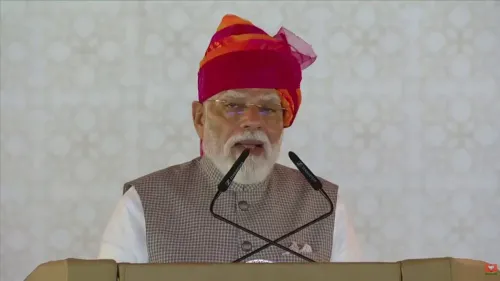
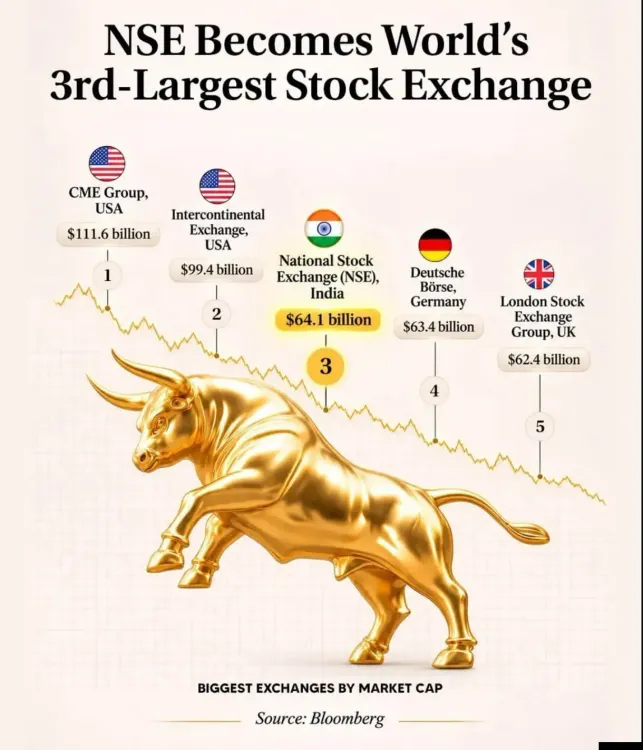
Bihar Chief Minister Samrat Choudhary on 27 November 2026 said India's NSE had become the world's third-largest listed stock exchange, with a 64.1 billion dollar market capitalisation, overtaking Deutsche Boerse and the London Stock Exchange Group. He credited Prime Minister Narendra Modi's financial policies.
Key Takeaways
Bihar Chief Minister Samrat Choudhary posted on X on 27 November 2026 hailing NSE's global ranking.
He put NSE's market capitalisation at 64.1 billion dollars and said it was the world's third-largest listed stock exchange.
He said NSE had overtaken Germany's Deutsche Boerse and the London Stock Exchange Group.
He credited Prime Minister Narendra Modi's leadership and India's financial policies for the milestone.
NSE, established in 1992, pioneered electronic trading and derivatives and is India's largest exchange by trading volume.
The 1991 liberalisation and 2014-era SEBI reforms sit behind the widening of retail and foreign participation.
India's home-grown bourse has, in the words of Bihar Chief Minister Samrat Choudhary, just muscled past two of Europe's oldest market names. In a post on X on 27 November 2026, he said the National Stock Exchange had become the world's third-largest listed stock exchange, putting its market capitalisation at 64.1 billion dollars and placing it ahead of Germany's Deutsche Boerse and the London Stock Exchange Group.
The Chief Minister called the moment एक और शानदार प्रमाण (another splendid proof) of India's growing strength in the global financial market. He tied the leap to robust financial policies, effective economic management and rising prestige under Prime Minister Narendra Modi, even as global conditions remain unsettled.
What a listed-exchange ranking actually measures
The figure he cited is about NSE as a listed company, not the combined value of every share that changes hands on its platform. A listed stock exchange is ranked by the market capitalisation of the exchange operator itself. That is a different number from the far larger universe of companies listed on NSE, and it is the snapshot the Chief Minister put at 64.1 billion dollars.
He said that valuation had taken NSE past Deutsche Boerse, the German operator of the Frankfurt market, and the London Stock Exchange Group, the UK-based owner of the London Stock Exchange. Those two houses have long sat at the centre of European market infrastructure. A change in their relative standing, if it holds, would be read in dealing rooms as another sign that capital-market gravity is moving east.
From 1992 screens to a listed heavyweight
NSE was established in 1992, after the 1991 liberalisation dismantled industrial licensing and opened equity markets to foreign institutional investors. It pioneered electronic trading and derivatives in India and is the country's largest exchange by trading volume. Those rails, built for speed and nationwide access, later carried a much deeper retail market.
A second wave of rules followed after 2014. The Securities Laws (Amendment) Act 2014 and later SEBI reforms tightened oversight and widened household participation. Retail investors, foreign portfolio investors and Indian listed companies feel those changes first: more accounts, more flows, more paper coming to market.
Why Asian venues are rewriting the old map
Indian equity markets have expanded rapidly over the last decade alongside sustained GDP growth and a shift of household savings into financial assets. Globally, that has coincided with a gradual rebalancing of market-capitalisation shares away from traditional European centres toward Asian exchanges. The ranking the Chief Minister celebrated sits inside that longer pattern, not outside it.
Markets will now watch SEBI's next consultation papers on market microstructure, and the coming quarter's growth and capital-flow prints. Rankings move. The harder question is whether India's financial plumbing keeps matching the size of the claim.
Point of View
Foreign flows and retail participation still deepen if global risk appetite turns.
NationPress
27 Nov 2026
Frequently Asked Questions
Is NSE the third largest stock exchange in the world?
Bihar Chief Minister Samrat Choudhary said on 27 November 2026 that NSE had become the world's third-largest listed stock exchange. He cited a 64.1 billion dollar market capitalisation and said it had overtaken Deutsche Boerse and the London Stock Exchange Group. That ranking is of the exchange as a listed company, not of all stocks traded on it.
What did Samrat Choudhary say about NSE?
He called NSE's standing another splendid proof of India's growing strength in global financial markets. He credited Prime Minister Narendra Modi's leadership, robust financial policies and economic management, and said NSE had moved ahead of Deutsche Boerse and the London Stock Exchange Group.
What is NSE market capitalisation versus listed companies?
The 64.1 billion dollar figure cited by the Chief Minister is the market value of NSE as a listed exchange operator. It is not the combined market capitalisation of companies listed on NSE, which is a much larger universe. Confusing the two numbers is a common error in ranking debates.
When was the National Stock Exchange of India established?
NSE was established in 1992. It pioneered electronic trading and derivatives in India and is the country's largest stock exchange by trading volume, growing after the 1991 opening of equity markets to foreign institutional investors.
How did 2014 SEBI reforms affect Indian stock markets?
The Securities Laws (Amendment) Act 2014 and later SEBI reforms strengthened regulatory oversight and expanded retail participation. Those changes, alongside earlier liberalisation, are part of the policy lineage behind deeper household and foreign activity in Indian equities.