CM Samrat Choudhary sends 1,100 pilgrims to Somnath
Synopsis
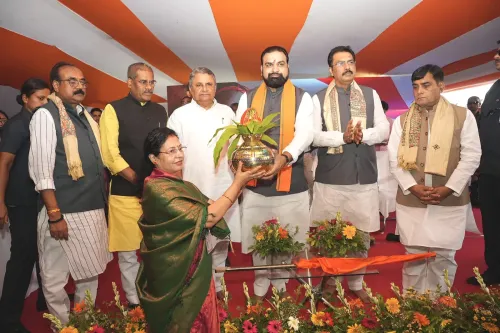
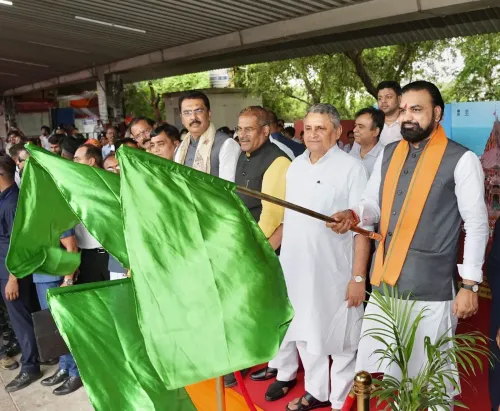
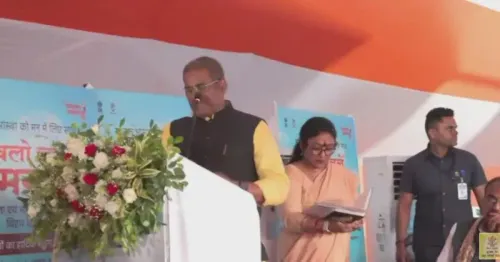
Bihar Chief Minister Samrat Choudhary announced on 19 July 2026 that over 1,100 state-sponsored pilgrims will leave Patliputra Junction for Somnath, marking the 1,000th year of Mahmud of Ghazni's attack and the 75th year of the temple's post-independence consecration.
Key Takeaways
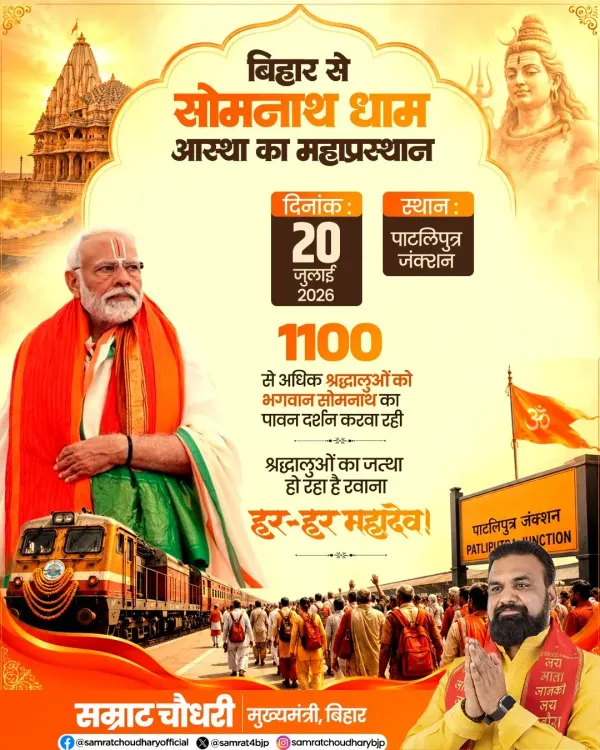
Over 1,100 pilgrims are set to depart from Patliputra Junction, Patna for the Somnath temple in Gujarat on 20 July 2026 .
The Bihar government has arranged travel, food, medical care, and security for all pilgrims at state expense.
2026 marks the 1,000th year of the attack on the Somnath temple attributed to Mahmud of Ghazni in 1026 AD .
2026 also marks the 75th year of the temple's post-independence pran-pratishtha , performed by President Dr.
Rajendra Prasad in May 1951 .
CM Samrat Choudhary described the yatra as a celebration of cultural renaissance and national self-respect under #SomnathSwabhimaanParv .
The initiative mirrors a broader pattern of BJP -led state governments organising pilgrimages to link heritage sites with identity-building and youth outreach.
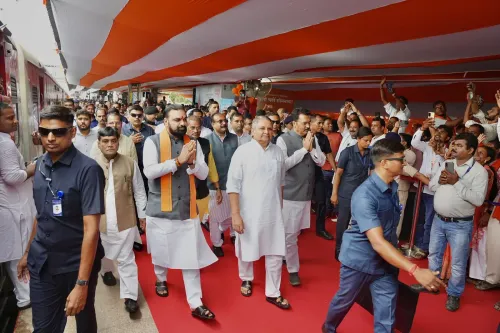
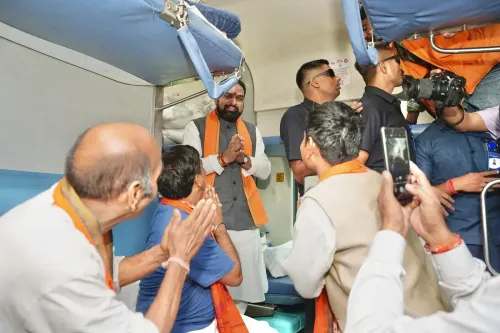
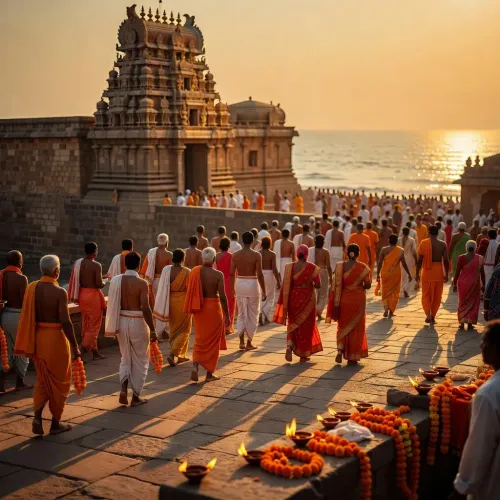
Bihar Chief Minister Samrat Choudhary on Sunday, 19 July 2026 announced that over 1,100 pilgrims would depart from Patliputra Junction in Patna the following day for a state-organised pilgrimage to the Somnath temple in Gujarat, framing the journey as a celebration of cultural revival and national pride tied to two landmark anniversaries in 2026.
Context
Posting on X under the hashtag #SomnathSwabhimaanParv, CM Choudhary described the pilgrimage in terms that go well beyond a routine religious trip. In his post, translated from Hindi, he wrote: 'Yah yatra usi gauravshali virasat, sanskritik punarjagaran aur rashtriya swabhiman ka utsav hai' — 'This journey is a celebration of that glorious heritage, cultural renaissance, and national self-respect.' The Bihar government, he stated, has made full arrangements for the pilgrims' travel, food, medical care, security, and all other essential facilities.
The Chief Minister explicitly connected the pilgrimage to two milestones falling in 2026: the 1,000th year since the historic attack on the Somnath temple, and the 75th year of the temple's post-independence consecration ceremony (pran-pratishtha).
Policy Backdrop
The Somnath temple, one of the twelve Jyotirlingas dedicated to Lord Shiva, was repeatedly attacked over centuries, most notably by Mahmud of Ghazni in 1026 AD — the event whose 1,000th anniversary falls this year. After independence, it was Sardar Vallabhbhai Patel, India's first Deputy Prime Minister, who championed the temple's reconstruction as a symbol of national renewal. The rebuilt temple's pran-pratishtha — the consecration of the deity — was performed in May 1951 by India's first President, Dr. Rajendra Prasad, completing a project that Patel had initiated before his death.
CM Choudhary invoked both figures directly, calling Patel the 'Loh Purush' (Iron Man) and citing Dr. Rajendra Prasad's role in the consecration as part of the heritage this yatra seeks to honour. The Bihar connection is particularly resonant: Dr. Rajendra Prasad was himself a son of Bihar.
Stakeholders and Impact
The immediate beneficiaries are the 1,100-plus pilgrims departing from Patliputra Junction, who will travel at the state's expense with comprehensive logistical support. CM Choudhary stated the government's broader objective clearly: to connect society with its culture, familiarise the new generation with its history, and 'awaken a sense of pride towards the Sanatan tradition.'
The initiative fits a wider pattern seen across BJP-governed states, where state-sponsored pilgrimages to sites such as Ayodhya, Kashi, and now Somnath are used to blend religious access with identity-building and youth outreach. For Bihar, a state with a large Hindu population and a historically significant connection to both Patel and Dr. Prasad, the symbolism carries particular electoral and cultural weight.
What's Next
The 2026 calendar is expected to see multiple events across states marking both the 1,000-year attack anniversary and the 75-year consecration milestone at Somnath, with possible inter-state pilgrim coordination. CM Choudhary concluded his post with a prayer — 'May Lord Somnath bless all pilgrims and keep his blessings on Bihar, the nation, and all of humanity' — and the invocations 'Har-Har Mahadev! Jai Somnath!' The Bihar government's willingness to underwrite the full cost of this pilgrimage signals that state-organised religious tourism is likely to remain a prominent policy instrument in the months ahead.
Point of View
100-pilgrim train to Somnath on the eve of two major anniversaries is a calculated act of cultural statecraft, not merely a welfare measure. By invoking Sardar Patel and Dr. Rajendra Prasad — one a BJP icon, the other a Bihari son of the soil — CM Choudhary is simultaneously claiming the post-independence legacy of temple reconstruction for the current political dispensation. The #SomnathSwabhimaanParv framing positions the yatra within a broader BJP narrative that treats 2026 as a year of civilisational reckoning, echoing similar milestone-driven campaigns at Ayodhya and Kashi. Whether this translates into durable voter sentiment in Bihar will depend on how the government sustains the outreach beyond the pilgrimage itself.
NationPress
18 Oct 2026
Frequently Asked Questions
What is the Bihar Somnath pilgrimage announced by CM Samrat Choudhary?
Bihar Chief Minister Samrat Choudhary announced a state-organised pilgrimage in which over 1,100 devotees will travel from Patliputra Junction in Patna to the Somnath temple in Gujarat, with the Bihar government covering arrangements for travel, food, medical care, and security.
Why is 2026 significant for the Somnath temple?
2026 marks two major milestones: the 1,000th anniversary of the attack on the Somnath temple attributed to Mahmud of Ghazni in 1026 AD, and the 75th anniversary of the temple's post-independence consecration (pran-pratishtha) performed by President Dr. Rajendra Prasad in May 1951.
Who performed the pran-pratishtha of the Somnath temple after independence?
India's first President, Dr. Rajendra Prasad, performed the pran-pratishtha (consecration) of the rebuilt Somnath temple in May 1951. The reconstruction was championed by Sardar Vallabhbhai Patel, India's first Deputy Prime Minister.
What is #SomnathSwabhimaanParv?
#SomnathSwabhimaanParv is the hashtag used by Bihar CM Samrat Choudhary to describe the state-organised Somnath pilgrimage, framing it as a celebration of cultural renaissance and national self-respect tied to the 2026 anniversaries of the temple.
Does the Bihar government pay for the Somnath pilgrimage?
Yes, according to CM Choudhary's announcement, the Bihar government has made comprehensive arrangements covering travel, food, medical care, security, and all other essential facilities for the over 1,100 pilgrims departing from Patliputra Junction.