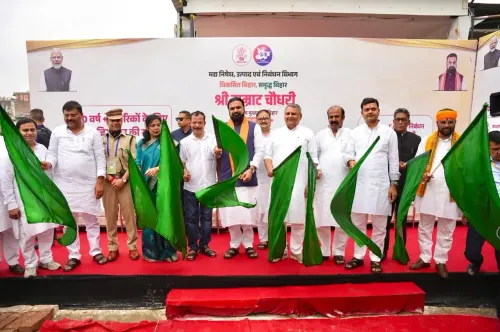
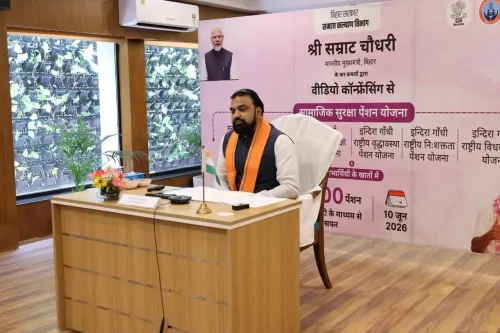
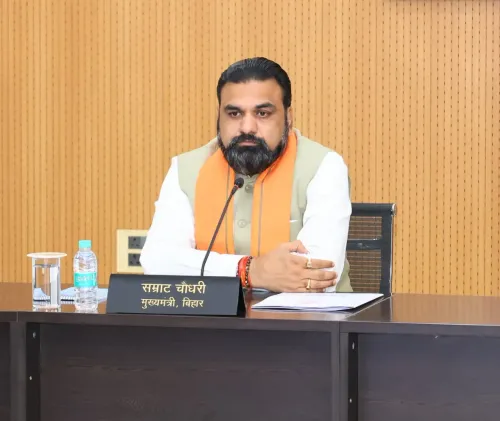
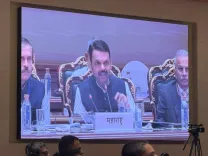
Bihar CM Samrat Choudhary announces home registration for 80+ seniors

Synopsis
Bihar Chief Minister Samrat Choudhary has announced doorstep land registration for citizens aged 80 and above, alongside GIS-based land verification and a fully paperless registration system, aiming to make property transactions faster and more transparent across the state.
Key Takeaways
Bihar CM Samrat Choudhary announced home registration services for citizens aged 80 years and above on 10 July 2026 .
The reformed system will be fully paperless , eliminating physical document workflows at sub-registrar offices.
GIS-based technology will be used for accurate land verification prior to registration.
Updated land information will be made available to citizens before the registration process begins.
The reforms align with the national Land Records Modernization Programme and broader e-governance frameworks.
Phased district-level rollout and GIS integration across Bihar are the key implementation milestones ahead.
Bihar Chief Minister Samrat Choudhary on Friday, 10 July 2026, announced a sweeping overhaul of the state's land registration system, promising doorstep registration services for citizens aged 80 years and above, fully paperless workflows, and GIS-based land verification to make the process faster and more transparent.
Context
Posting on X, CM Choudhary stated — '80 वर्ष एवं उससे अधिक आयु के वरिष्ठ नागरिकों को घर बैठे होम रजिस्ट्रेशन की सुविधा मिलेगी' ('Senior citizens aged 80 and above will be provided home registration facilities from the comfort of their homes'). He added that updated land information prior to registration, a completely paperless system, and GIS-based accurate land verification would all be ensured. The announcement positions Bihar as one of the states actively extending technology-driven governance to its most vulnerable citizens.
Policy Backdrop
The reforms build on the National Land Records Modernization Programme, launched by the Government of India in 2008, which aimed to computerise land records, reduce disputes, and promote transparency across states. Bihar has progressively aligned its revenue and registration infrastructure with national e-governance frameworks over subsequent years. The shift to GIS-based verification and paperless registration reflects a broader pattern visible across Indian states seeking to minimise fraud and eliminate intermediaries from property transactions.
Doorstep delivery for senior citizens is a targeted extension of this administrative evolution. Citizens aged 80 and above often face significant physical and logistical barriers when visiting sub-registrar offices, making home registration a meaningful accessibility measure. The integration of GIS mapping adds a layer of spatial accuracy to title verification that traditional paper-based processes could not provide.
Stakeholders and Impact
Senior citizens and landowners across Bihar stand to benefit most directly. For elderly property owners, the home registration facility removes the need to travel to government offices, reducing dependence on intermediaries and the associated risk of exploitation. The paperless system is expected to cut processing time and reduce document-related errors that have historically delayed registrations.
Broader stakeholders include Bihar's revenue administration, which will need to deploy trained officials for home visits and ensure GIS data is current and district-level coverage is uniform. The phased rollout across Bihar's districts will be critical to the reform's reach and credibility.
What's Next
CM Choudhary framed technology-based good governance — 'तकनीक आधारित सुशासन' — as the state's 'highest priority' in delivering better services to citizens. The key implementation milestones to watch include the phased rollout of home-registration facilities for senior citizens and the integration of GIS verification across Bihar's districts. How swiftly the state's registration machinery can absorb these digital workflows will determine whether the reform translates into ground-level change for property owners.
Point of View
The BJP-led state government is signalling alignment with the Centre's Digital India agenda ahead of what remains a competitive political environment in Bihar. The focus on citizens aged 80 and above also sets a precedent that could be expanded to other vulnerable groups, making this a template rather than a one-off measure. The real test will be execution: whether Bihar's district-level registration machinery can absorb these reforms uniformly or whether implementation remains uneven across the state's diverse geography.
NationPress
9 Oct 2026
Frequently Asked Questions
What is Bihar's home registration facility for senior citizens?
Bihar is introducing a doorstep land registration service for citizens aged 80 years and above, allowing them to complete property registration from home without visiting a government office.
How will GIS technology be used in Bihar's land registration?
GIS-based technology will be used to accurately verify land boundaries and details before the registration process is completed, reducing disputes and errors.
Will Bihar's new land registration system be paperless?
Yes, the reformed system will be fully paperless, replacing physical document workflows with digital processes to speed up registration and improve transparency.
Who announced Bihar's new land registration reforms?
Bihar Chief Minister Samrat Choudhary announced the reforms on 10 July 2026 via a post on X, describing them as part of the state's technology-based good governance priority.
What is the National Land Records Modernization Programme?
The National Land Records Modernization Programme was launched by the Government of India in 2008 to computerise land records across states, reduce property disputes, and improve transparency in land administration.