Did the BJP-led Alliance Achieve a Majority in the BMC Elections?
Click to start listening
Synopsis
In a significant political shift, the BJP-led alliance has crossed the majority mark in the BMC elections, challenging the Thackeray cousins’ dominance. With a keen focus on Mumbai's civic body, the election results could reshape Maharashtra's political landscape. This article delves into the implications of these trends and their potential impact on local governance.
Key Takeaways
- BJP-led alliance surpasses majority in BMC elections.
- Thackeray cousins face setback in retaining control.
- Significant political and financial implications for Maharashtra.
- Polling covered 2,869 seats across 893 wards.
- Results may reshape urban governance dynamics.
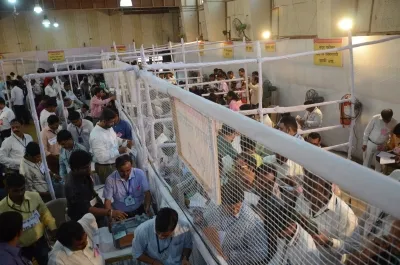
New Delhi, Jan 16 (NationPress) The alliance led by the BJP has successfully surpassed the majority threshold in the crucial Brihanmumbai Municipal Corporation (BMC) elections, as per the latest counting trends. This outcome poses a significant challenge to the Thackeray cousins' attempts to maintain their grip on India's wealthiest civic institution.
As ballots were tallied for 29 municipal corporations throughout Maharashtra, the Bharatiya Janata Party emerged as the dominant force in the civic elections in Mumbai, with its coalition securing a substantial advantage.
In the BMC, the BJP-led coalition was leading in 119 wards, with the BJP heading in 88 wards and Chief Minister Eknath Shinde's faction of Shiv Sena in 31.
Conversely, the Thackeray family's combined strength fell short of initial projections.
Uddhav Thackeray's Shiv Sena (UBT) was leading in 64 wards, while Raj Thackeray's Maharashtra Navnirman Sena (MNS) was ahead in six, bringing the cousins' total to 70 wards.
Despite their efforts to unify politically, both seemed to struggle in matching the momentum of the BJP alliance.
The BMC elections have drawn significant attention due to the civic body's extensive political and financial implications.
With an annual budget surpassing Rs 74,400 crore, control of the BMC has historically been a coveted prize in Maharashtra politics. These elections were conducted after a notable delay of almost nine years, increasing their significance.
Beyond Mumbai, results across the state also showed a strong inclination towards the BJP-led alliance. In 29 municipal corporations, the BJP was leading in 909 wards, while its ally, Shiv Sena under Shinde, was ahead in 237 wards, solidifying the ruling alliance's supremacy in urban governance.
Pune emerged as another crucial battleground, where rival factions of the Nationalist Congress Party (NCP) — led by Deputy Chief Minister Ajit Pawar and his uncle, Rajya Sabha MP Sharad Pawar — collaborated for the municipal elections. The outcome in Pune is viewed as a litmus test for the alliance's electoral strength at the grassroots.
Polling took place for 2,869 seats across 893 wards in these 29 civic bodies last Thursday. Approximately 3.48 crore voters were eligible to cast their votes, determining the fate of 15,931 candidates, with nearly 1,700 candidates contesting in Mumbai alone.
The final outcomes are expected to significantly alter the urban political dynamics of Maharashtra.
Point of View
The recent BMC election results indicate a significant shift in urban governance in Maharashtra. The BJP-led alliance's triumph not only reflects the changing political sentiments but also raises questions about the Thackeray cousins' future influence. As the nation observes these developments, it is crucial to consider the broader implications for local democracy and governance.
NationPress
16/01/2026
Frequently Asked Questions
What is the significance of the BMC elections?
The BMC elections are crucial due to the civic body's substantial political and financial influence, managing an annual budget exceeding Rs 74,400 crore.
Who are the key political figures in this election?
The key figures include Uddhav Thackeray of Shiv Sena (UBT), Raj Thackeray of Maharashtra Navnirman Sena (MNS), and Eknath Shinde of Shiv Sena.
What impact do these results have on Maharashtra politics?
The results signify a potential shift in power dynamics, reinforcing the BJP's dominance in urban governance and challenging traditional strongholds.
How many wards were contested in the BMC elections?
A total of 2,869 seats across 893 wards were contested in the BMC elections.
What was the voter turnout for this election?
Approximately 3.48 crore voters were eligible to participate in the elections.