BrahMos Missile Agreements Elevate India's Strategic Role in Indo-Pacific Security
Synopsis
India is solidifying its position in Southeast Asia with the BrahMos missile, a supersonic weapon that enhances regional defense against growing Chinese assertiveness. This strategic move is causing a significant shift in the Indo-Pacific security landscape.
Key Takeaways
BrahMos missile enhances regional defense capabilities.
Countries in Southeast Asia are seeking stronger deterrence against China.
India's strategic partnerships are crucial for military capacity building.
The missile offers high speed and a range exceeding 400 kilometers.
Growing interest among nations like Vietnam and Indonesia reflects shifting security dynamics.
New Delhi, April 11 (NationPress) As India aims to establish Southeast Asia as a pivotal market for the BrahMos missile, this supersonic cruise weapon—jointly engineered by India and Russia—has sparked considerable interest in the region, particularly in light of increasing Chinese assertiveness in the South China Sea.
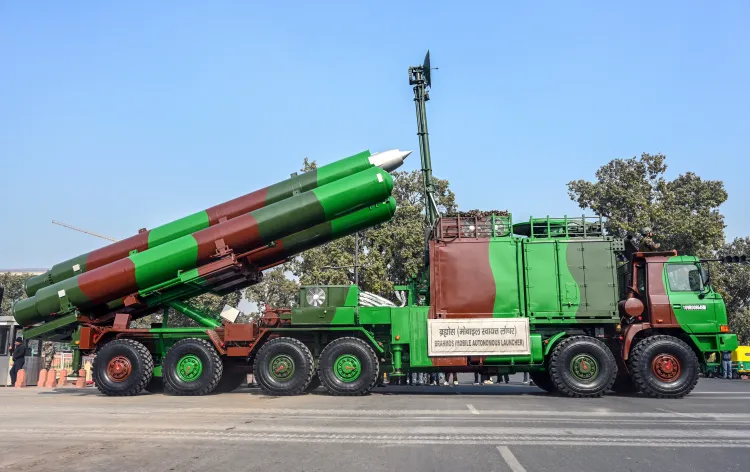
The missile's remarkable speed, precise strike capabilities, and versatility across various platforms—from land and sea to air and submarines—render it a powerful asset for strengthening regional defense.
As reported by India Narrative, with velocities ranging from Mach 2.8 to Mach 3—surpassing many traditional cruise missiles deployed globally by naval forces—the BrahMos offers a striking range exceeding 400 kilometers and can be launched from multiple platforms.
“The missile is gaining popularity as the urgency among nations bordering the South China Sea to enhance their deterrence grows. Its deployment is strategically aimed at countering any aggressive maritime stance from China regarding its territorial claims in the South China Sea, which conflict with those of other neighboring nations. A key approach to enhancing this capacity is through improved Anti-Access/Area Denial (A2/AD) capabilities,” the report elaborated.
“A notable trend is emerging among countries such as Vietnam, the Philippines, and Indonesia in this context. While China’s People’s Liberation Army Navy (PLAN) has established formidable A2/AD capabilities, anti-ship missiles like the BrahMos empower smaller nations to implement similar strategies,” it continued.
Furthermore, the ongoing conflict in West Asia has led US allies and partners in East Asia to increasingly question Washington’s security assurances, especially given the observable shift of American missile and naval resources from the Pacific to West Asia.
This situation has raised concerns that such redeployments could compromise defense readiness in the Indo-Pacific against Chinese assertiveness.
The report emphasized that worries are rising regarding the gradual sidelining of Southeast Asia in the current US administration’s priorities, as indicated by the US National Security Strategy 2025, which scarcely references the region.
“In this environment, Southeast Asian nations are engaging with a wider range of external partners to boost their military capabilities. Indonesia’s recent decision to acquire the BrahMos missile from India is noteworthy. India, in collaboration with Japan and South Korea, is providing capacity-building, training, and technological cooperation to Southeast Asian countries like Indonesia to enhance their responses to China’s increasing assertiveness. Previously, India supplied BrahMos missiles to the Philippines in 2024 and is approaching a $700 million deal with Vietnam,” it reported.
Highlighting India's expanding role in Indo-Pacific security, the report stated, “The BrahMos agreement with Indonesia—following a similar pact with the Philippines—underscores India’s growing strategic significance in the broader Indo-Pacific geopolitical landscape.”
Point of View
Particularly in the face of rising tensions in the South China Sea. It showcases the significance of the BrahMos missile in empowering Southeast Asian nations to strengthen their defense capabilities.
NationPress
22 Oct 2026
Frequently Asked Questions
What is the BrahMos missile?
The BrahMos missile is a supersonic cruise missile developed jointly by India and Russia, known for its speed, precision, and multi-platform deployment capabilities.
Why is Southeast Asia important for BrahMos?
Southeast Asia is becoming a key market for BrahMos due to rising security concerns regarding Chinese assertiveness in the South China Sea, prompting nations to enhance their defense capabilities.
How does BrahMos improve regional defense?
With its high speed and range, BrahMos enables countries to adopt advanced Anti-Access/Area Denial strategies, enhancing their deterrence against potential threats.
Which countries have shown interest in BrahMos?
Countries like Indonesia, Vietnam, and the Philippines are engaging with India to acquire BrahMos missiles to strengthen their military capacities.
What impact do these agreements have on Indo-Pacific security?
The agreements signify India's expanding strategic role and contribute to a collective effort among Southeast Asian nations to counterbalance China's military influence in the region.