Shivraj Chouhan: Cabinet clears 4-laning of NH-63, NH-563 in Telangana
Synopsis
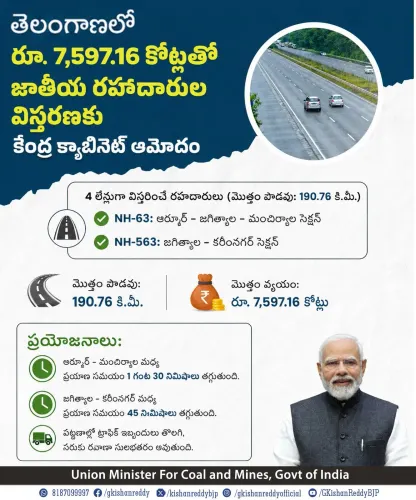
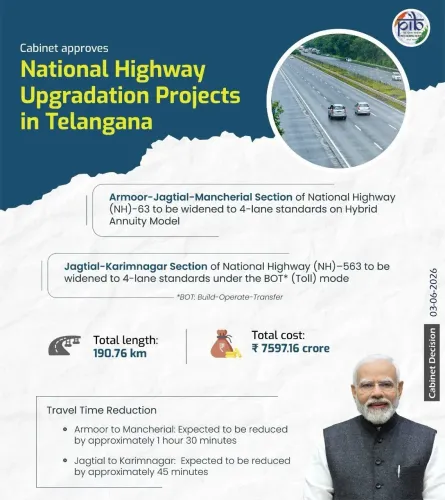
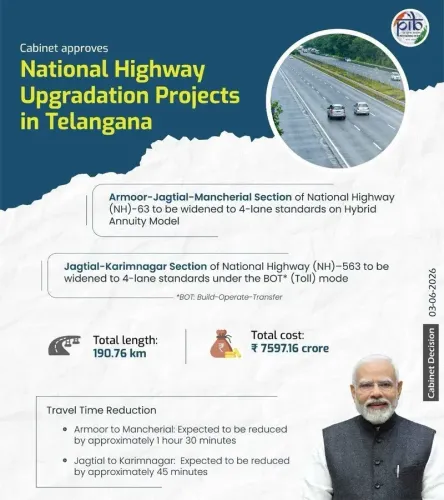
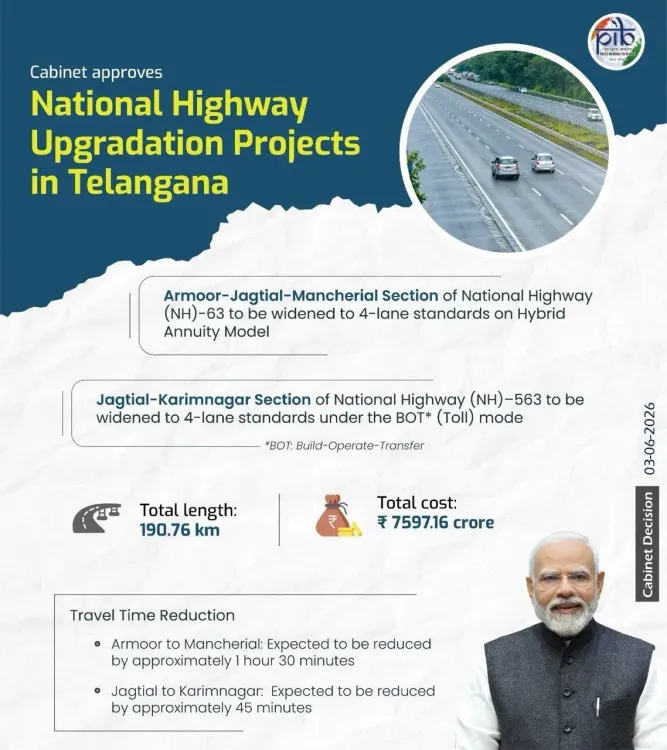
Union Agriculture Minister Shivraj Singh Chouhan announced that the Union Cabinet has approved four-laning of NH-63 (Armoor–Jagtial–Mancherial) and NH-563 (Jagtial–Karimnagar) in Telangana. The 190.76 km corridor, costing ₹7,597.16 crore, aims to strengthen regional connectivity, improve road safety and accelerate socio-economic development across the northern Telangana belt.
Key Takeaways
Union Cabinet has approved four-laning of NH-63 (Armoor–Jagtial–Mancherial) and NH-563 (Jagtial–Karimnagar) in Telangana.
Project covers a combined length of 190.76 km at a total cost of ₹7,597.16 crore .
Announcement made by Union Agriculture Minister Shivraj Singh Chouhan on X, citing PM Narendra Modi 's leadership.
The corridor links Armoor , Jagtial , Karimnagar and Mancherial in northern Telangana.
Implementation will fall under NHAI as part of the wider national highway expansion push.
Union Agriculture Minister Shivraj Singh Chouhan on Wednesday announced that the Union Cabinet, chaired by Prime Minister Narendra Modi, has approved the four-laning of National Highway-63 (Armoor–Jagtial–Mancherial section) and National Highway-563 (Jagtial–Karimnagar section) in Telangana. The minister said the 190.76 km stretch will be developed at a total cost of ₹7,597.16 crore, with the aim of strengthening regional connectivity and ensuring safer, smoother traffic flow.
Sharing the update on X, Chouhan wrote that 'under the leadership of respected Prime Minister Shri Narendra Modi ji, the Union Cabinet today approved the widening to four lanes of NH-63 (Armoor–Jagtial–Mancherial section) and NH-563 (Jagtial–Karimnagar section) in Telangana.' He added that the project will 'accelerate the overall socio-economic development of Telangana' along with reinforcing the transport network in the region.
Context
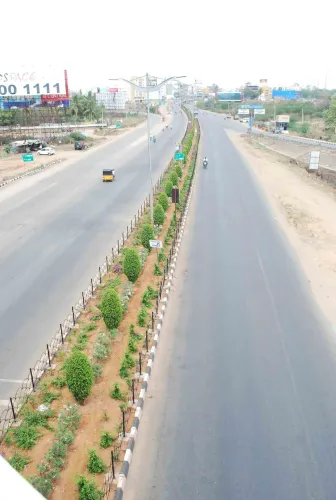
The approved corridor links three key districts of northern Telangana — Nizamabad (via Armoor), Jagtial, Karimnagar and Mancherial — running through an agriculturally productive belt that also feeds into industrial clusters and coal-mining areas further north. Upgrading the two highways from their current configuration to four lanes is expected to cut travel time between district headquarters and improve freight movement to neighbouring states.
Chouhan, a senior Bharatiya Janata Party leader and four-term former Chief Minister of Madhya Pradesh, has been amplifying central cabinet decisions across sectors in addition to his core portfolios of Agriculture & Farmers Welfare and Rural Development. The use of the hashtag #CabinetDecisions places the announcement within the government's standard communications template for post-cabinet briefings.
Policy backdrop
The four-laning falls within the broader national highway expansion push that gained pace after the launch of the Bharatmala Pariyojana in 2017, the umbrella programme to widen, realign and develop economic corridors across the country. Successive Union Cabinet meetings have cleared state-specific highway packages, with the Ministry of Road Transport and Highways treating four-laning of two-lane stretches as a priority intervention to ease congestion and reduce accident rates.
Southern states, including Telangana, Andhra Pradesh, Karnataka and Tamil Nadu, have received a steady pipeline of such approvals in recent years. The NH-63 and NH-563 sections cleared on Wednesday add to that pipeline and are likely to be tendered and executed by the National Highways Authority of India (NHAI).
Stakeholders and impact
For residents along the alignment, the upgrade promises shorter commutes between Armoor, Jagtial, Karimnagar and Mancherial, towns that anchor trade in paddy, turmeric, maize and cotton. Farmers and traders moving produce to mandis and processing units stand to benefit from reduced transit times and lower vehicle operating costs.
Logistics operators serving the coal belt around Mancherial and the cement and granite units in the wider region are another set of beneficiaries. Improved geometrics and divided carriageways are also expected to address the safety concerns typical of mixed-traffic two-lane highways.
State-level stakeholders, including the Telangana government and local administrations, will be involved in land acquisition, utility shifting and clearances — typically the most time-sensitive elements in such projects.
What's next
The focus now shifts to the NHAI's detailed project reports, bid documents and award of civil contracts for the 190.76 km corridor. Construction timelines, the choice of delivery mode — engineering, procurement and construction (EPC) or hybrid annuity — and the schedule for land acquisition notifications will determine how quickly the ₹7,597.16 crore outlay translates into ground activity.
If executed on schedule, the twin-highway upgrade could become a template for further four-laning of inter-district corridors in Telangana, reinforcing the central government's stated emphasis on transport infrastructure as a driver of regional economic growth.
Point of View
Chouhan signals the party's coordinated communications approach, where senior ministers project cabinet wins beyond their departmental remit. The choice of corridor — linking agrarian districts to industrial and mining hubs — also lets the Centre claim a dual dividend of farm logistics and freight efficiency. Execution speed by NHAI, however, will decide whether the ₹7,597.16 crore outlay yields political mileage on the ground.
NationPress
26 Sept 2026
Frequently Asked Questions
Which highways in Telangana has the Union Cabinet approved for four-laning?
The Union Cabinet has approved four-laning of NH-63 (Armoor–Jagtial–Mancherial section) and NH-563 (Jagtial–Karimnagar section) in Telangana, as announced by Union Agriculture Minister Shivraj Singh Chouhan.
What is the total length and cost of the NH-63 and NH-563 widening project?
The combined project length is 190.76 km and the total approved cost is ₹7,597.16 crore, covering both the NH-63 and NH-563 stretches.
Which districts will benefit from the NH-63 and NH-563 four-laning?
Districts and towns along the alignment — including Armoor (Nizamabad), Jagtial, Karimnagar and Mancherial in northern Telangana — will benefit through improved connectivity and faster travel.
Who announced the cabinet decision on Telangana highway widening?
Union Agriculture Minister Shivraj Singh Chouhan announced the cabinet decision on X, crediting Prime Minister Narendra Modi's leadership for the approval.
How will the project impact Telangana's economy?
The project is expected to strengthen regional connectivity, support safer and smoother traffic, ease freight movement for farm and industrial goods, and accelerate socio-economic development across northern Telangana.