Gadkari: Cabinet clears Rs 7,597 crore Telangana NH widening
Synopsis
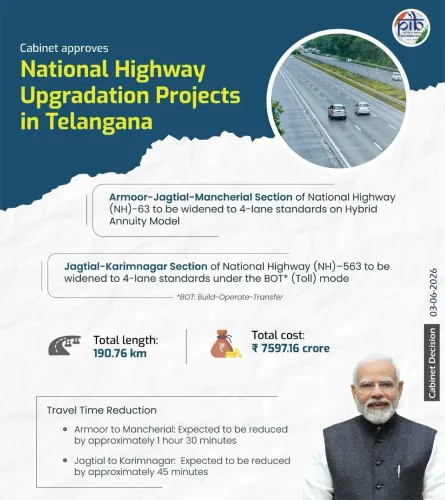
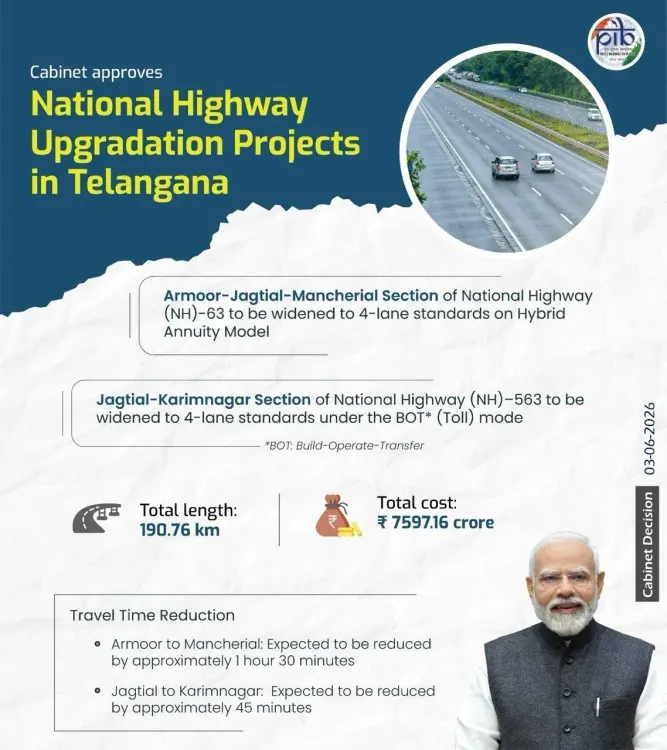
Union Road Transport and Highways Minister Nitin Gadkari said the Union Cabinet has cleared Rs 7,597.16 crore four-laning of 190.76 km across NH-63 and NH-563 in Telangana, covering the Armoor–Jagtial–Mancherial and Jagtial–Karimnagar sections under HAM and BOT (Toll) models, with travel-time cuts of up to 90 minutes expected on key stretches.
Key Takeaways
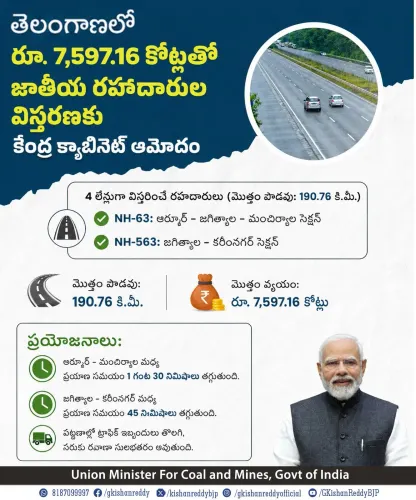
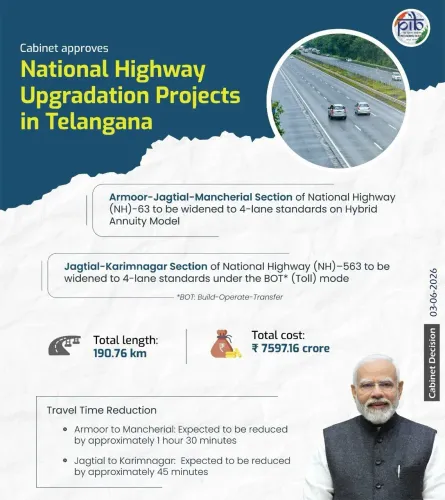
Union Cabinet approved widening of NH-63 and NH-563 sections in Telangana at an estimated Rs 7,597.16 crore.
Total project length is 190.76 km, split into three packages.
NH-63 Armoor–Jagtial–Mancherial section will be built under the Hybrid Annuity Model.
NH-563 Jagtial–Karimnagar section will be developed under BOT (Toll) with open tolling.
Corridors will be four-laned to a 100 km/hour design speed with bypasses around built-up areas.
Travel time to drop by about 1 hour 30 minutes between Armoor and Mancherial, and 45 minutes between Jagtial and Karimnagar.
Union Road Transport and Highways Minister Nitin Gadkari on Wednesday announced that the Union Cabinet, chaired by Prime Minister Narendra Modi, has approved the four-laning of two major national highway stretches in Telangana at an estimated capital cost of Rs 7,597.16 crore. The package covers a combined length of 190.76 km across the Armoor–Jagtial–Mancherial section of NH-63 and the Jagtial–Karimnagar section of NH-563, to be executed under hybrid public-private financing.
Context
In his post on X, Gadkari said the Armoor–Jagtial–Mancherial stretch of NH-63 will be developed under the Hybrid Annuity Model (HAM), while the Jagtial–Karimnagar stretch of NH-563 will be taken up on a Build-Operate-Transfer (Toll) basis. The works will be split into three packages.
The minister noted that the corridors will be 'upgraded to 4-lane standards', with bypasses around built-up areas and 'open tolling systems' designed for a top speed of 100 km/hour. The four districts covered are Nizamabad, Jagtial, Mancherial and Karimnagar.
Policy backdrop
The approvals extend the Centre's decade-long pivot toward blended public-private financing to accelerate four-laning of single- and two-lane national highway stretches. The Hybrid Annuity Model, introduced in 2016, splits project risk between the government and the concessionaire, with the Centre funding a share upfront and paying annuities over the concession period.
The BOT (Toll) route, by contrast, places construction and traffic-revenue risk largely on the private developer, who recovers investment through user fees. Combining both models in adjacent Telangana packages reflects the Ministry's effort to match financing structures to expected traffic intensity on each corridor.
The projects also slot into the broader Bharatmala Pariyojana framework approved in 2015, which targeted the development of roughly 34,800 km of national highways nationwide, including key inter-district corridors in southern states.
Stakeholders and impact
According to Gadkari, travel time between Armoor and Mancherial is projected to fall by about 1 hour and 30 minutes, while the Jagtial–Karimnagar leg should be shorter by roughly 45 minutes. The minister said the upgraded corridors will offer 'safe, fast, and seamless connectivity for both passenger and freight traffic'.
He added that the project is expected to deliver 'substantial reductions in fuel consumption, carbon emissions, and vehicle operating costs (VOC)'. For commuters and small businesses across northern Telangana, the bypasses around congested town centres are likely to be among the most visible day-to-day gains.
Freight operators moving agricultural produce, granite and manufactured goods between the Nizamabad belt and the coal-rich Mancherial region stand to benefit from the higher design speed and open tolling, which reduces idling at plaza queues. District-level traders, fuel retailers and roadside service providers along the realigned alignments are typical secondary stakeholders in such upgrades.
What's next
Attention will now turn to the package-wise tendering by the highways authority and to land acquisition notifications for the proposed bypasses, which historically determine whether HAM and BOT projects stay on schedule. Financial close timelines for the three packages, along with the concession periods and annuity structures, will indicate how aggressively the Centre expects private bidders to price the corridors.
For the Telangana government, the approvals add to a pipeline of central road investments that intersect with state-level industrial and mobility plans in the northern districts. If executed on time, the 190.76 km upgrade could become a template for similar mixed-model rollouts in other inter-district corridors across the south.
Point of View
Matching financing risk to expected traffic on each stretch rather than defaulting to a single template. It also reinforces the Centre's preference for private capital to do the heavy lifting on inter-district four-laning, while reserving HAM for sections where commercial viability is less certain. For Telangana, the approvals deepen a steady pipeline of central road outlays in the northern districts, an area where logistics costs have long been flagged as a constraint on industrial dispersal. The real test, as with most highway packages, will be land acquisition speed and bidder appetite at financial close.
NationPress
19 Sept 2026
Frequently Asked Questions
What did the Union Cabinet approve for Telangana highways?
The Union Cabinet approved the four-laning of the Armoor–Jagtial–Mancherial section of NH-63 and the Jagtial–Karimnagar section of NH-563, covering 190.76 km at an estimated capital cost of Rs 7,597.16 crore.
Which financing models will be used for the projects?
The NH-63 Armoor–Jagtial–Mancherial stretch will be executed under the Hybrid Annuity Model (HAM), while the NH-563 Jagtial–Karimnagar stretch will be developed under the Build-Operate-Transfer (Toll) model.
How much travel time will the new highways save?
Travel time is projected to reduce by about 1 hour and 30 minutes between Armoor and Mancherial, and by around 45 minutes between Jagtial and Karimnagar.
Which Telangana districts will benefit from the project?
The upgraded corridors will pass through Nizamabad, Jagtial, Mancherial and Karimnagar districts in Telangana.
What is the design speed of the upgraded highways?
The corridors are being designed for a top speed of 100 km/hour, with bypasses around built-up areas and open tolling systems.