Khattar: Cabinet clears Bihar, Telangana highway four-laning projects
Synopsis
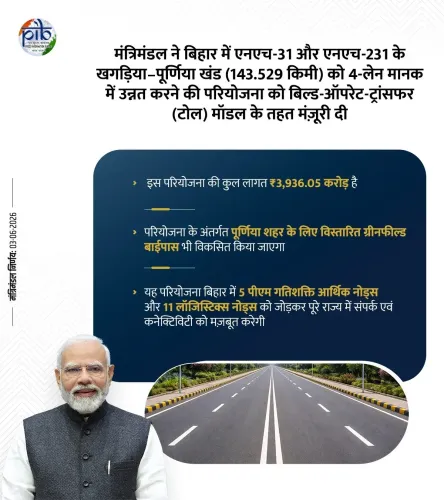
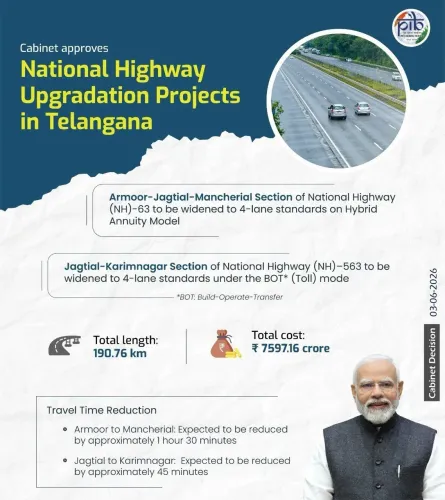
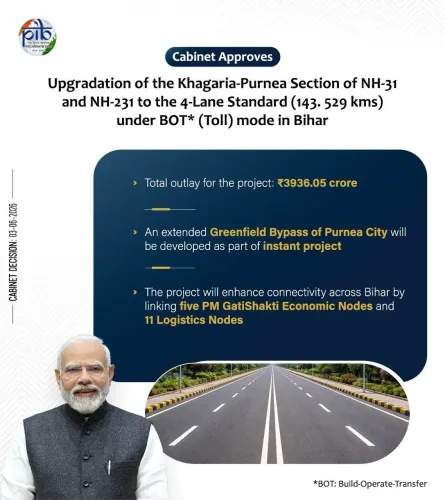
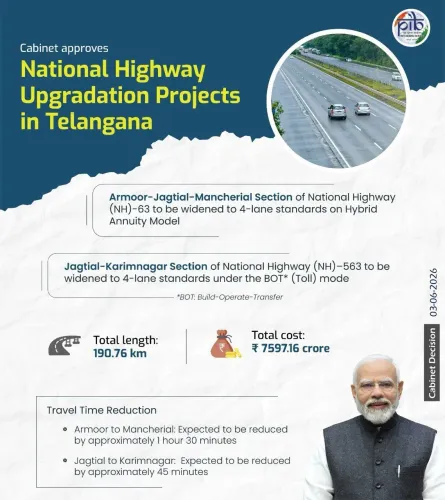
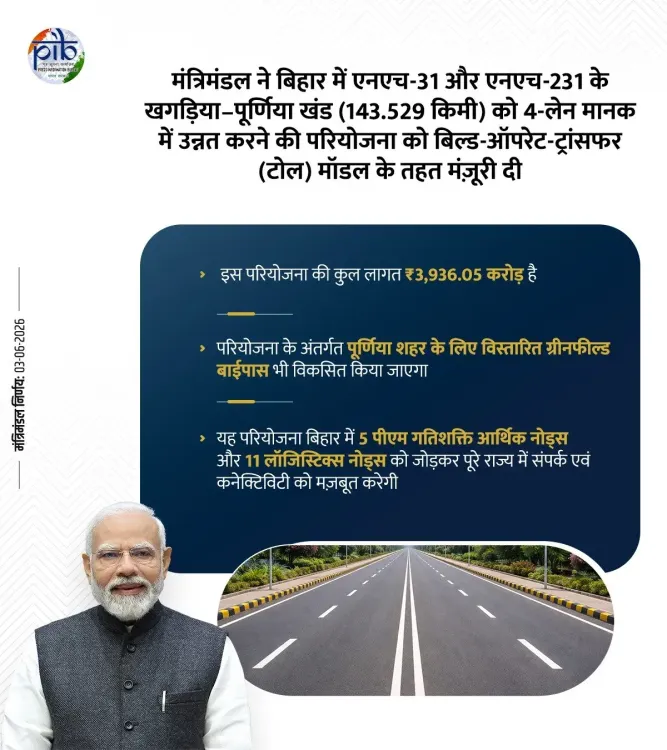
The Union Cabinet has approved four-laning of the 143.529 km Khagaria-Purnia section of NH-31 and NH-231 in Bihar at ₹3,936.05 crore on BOT (toll) mode, along with widening of NH-63 and NH-563 stretches in Telangana under Hybrid Annuity and BOT models across three work packages, Union Power Minister Manohar Lal Khattar said.
Key Takeaways
Cabinet clears four-laning of 143.529 km Khagaria-Purnia section of NH-31 and NH-231 in Bihar on BOT (toll) mode.
Project cost pegged at ₹3,936.05 crore.
NH-63 Armoor-Jagtial-Mancherial stretch approved for widening under Hybrid Annuity Model.
NH-563 Jagtial-Karimnagar stretch cleared on BOT (toll) basis.
Telangana works to be executed across three packages.
Approvals fall within the Bharatmala Pariyojana highway-upgrade pipeline.
Union Power Minister Manohar Lal Khattar on June 3, 2026 announced Cabinet clearance for major four-laning works on national highways in Bihar and Telangana, covering the Khagaria-Purnia corridor and segments linking Armoor, Jagtial, Mancherial and Karimnagar. The approvals span a mix of Build-Operate-Transfer (toll) and Hybrid Annuity Model packages, signalling continued momentum on the Centre's highway-upgrade pipeline.
Context
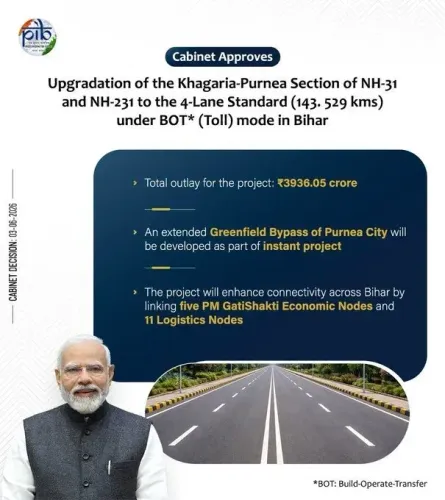
In the post tagged #CabinetDecisions, Khattar wrote that the 143.529 km Khagaria-Purnia section of NH-31 and NH-231 in Bihar has been approved for upgradation to four-lane standard on BOT (toll) mode at a cost of ₹3,936.05 crore.
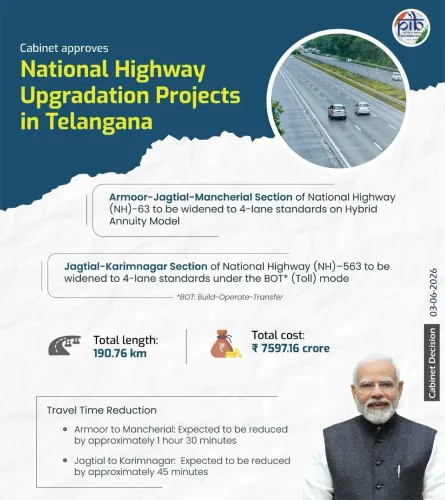
He added that the existing Armoor-Jagtial-Mancherial stretch of NH-63 will be widened to four lanes under the Hybrid Annuity Model, while the Jagtial-Karimnagar stretch of NH-563 will be developed under BOT (toll). The two Telangana corridors will be executed across three work packages.
Translated, the minister's note reads: 'Approval for upgrading the Khagaria-Purnia section (143.529 km) of NH-31 and NH-231 in Bihar to four-lane standard on BOT (toll) mode at a cost of ₹3,936.05 crore. Approval for widening the existing Armoor-Jagtial-Mancherial section of NH-63 under the Hybrid Annuity Model and the Jagtial-Karimnagar section of NH-563 under Build-Operate-Transfer (toll) to four-lane standard across three work packages.'
Policy backdrop
The approvals sit within the Bharatmala Pariyojana, the umbrella highway-development programme whose Phase-I was approved by the Cabinet in 2017 with an outlay of ₹6.92 lakh crore for around 34,800 km of highways. Bharatmala has been the principal vehicle for four-laning legacy two-lane national highways across eastern and southern states.
The Centre's choice of funding models is also notable. The Hybrid Annuity Model, adopted in 2016, was designed to revive stalled projects by splitting cost between the government and private developers, reducing concessionaire risk. The BOT (toll) model, by contrast, transfers traffic and revenue risk to private builders who recoup investment through user fees.
The National Highways Authority of India (NHAI) is expected to implement the packages, in line with its mandate over the national highway network.
Stakeholders and impact
The Khagaria-Purnia corridor runs through Bihar's flood-prone northern belt and is a critical east-west link feeding into traffic from Jharkhand, West Bengal and the Northeast. A four-lane upgrade is expected to ease freight movement and shorten travel times for commuters between Kosi and Seemanchal regions.
In Telangana, the Armoor-Jagtial-Mancherial and Jagtial-Karimnagar stretches connect the state's northern districts to the Hyderabad-Nagpur axis. Widening is likely to benefit agri-logistics from the region's rice and turmeric belts, along with daily commuters.
Beneficiaries include highway users in both states, NHAI's pool of empanelled contractors, and logistics operators who have long flagged single-carriageway bottlenecks on these stretches.
What's next
Attention will turn to the issuance of tenders, financial closure, appointed dates and construction start timelines for each of the packages. Land acquisition status in Bihar's flood-affected districts and forest clearances along Telangana segments are likely to determine the pace of rollout.
Parliamentary questions on physical and financial progress, alongside NHAI's quarterly disclosures, will offer the next checkpoints. With the Centre continuing to mix BOT and Hybrid Annuity formats, the approvals reinforce a policy arc that leans on private capital to deliver four-lane connectivity in states still catching up on highway density.
Point of View
While the Telangana stretches deepen the BJP's infrastructure pitch in a state where it has been expanding its footprint. The choice of BOT (toll) for high-traffic corridors and Hybrid Annuity for the trickier package suggests the government is calibrating risk-sharing project by project. Execution timelines, not announcements, will now be the real test.
NationPress
21 Oct 2026
Frequently Asked Questions
What is the cost of the Khagaria-Purnia highway project?
The Khagaria-Purnia four-laning project has been approved at a cost of ₹3,936.05 crore. It covers 143.529 km of NH-31 and NH-231 in Bihar on BOT (toll) mode.
Which national highways are being upgraded in Telangana?
NH-63 and NH-563 are being upgraded in Telangana. The Armoor-Jagtial-Mancherial stretch of NH-63 will be widened under the Hybrid Annuity Model, while the Jagtial-Karimnagar stretch of NH-563 will be developed on BOT (toll) basis.
What is the Hybrid Annuity Model in highway projects?
The Hybrid Annuity Model is a public-private partnership framework adopted in 2016. It splits project cost between the government and a private developer, with the developer paid annuities over the concession period, reducing private-sector risk.
How long is the Khagaria-Purnia highway stretch?
The Khagaria-Purnia section covers 143.529 km. It runs along NH-31 and NH-231 in Bihar and will be upgraded to four-lane standard.
Who announced the Cabinet approvals for the highway projects?
Union Power Minister Manohar Lal Khattar shared the Cabinet decisions in a post on X. He outlined approvals for highway four-laning works in Bihar and Telangana under different funding models.