Nadda: CCEA clears Rs 7,597 cr Telangana highway widening
Synopsis
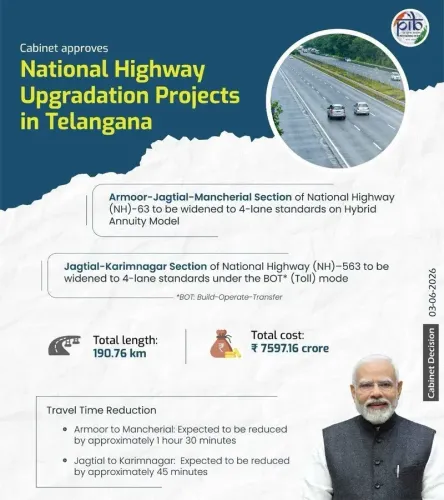
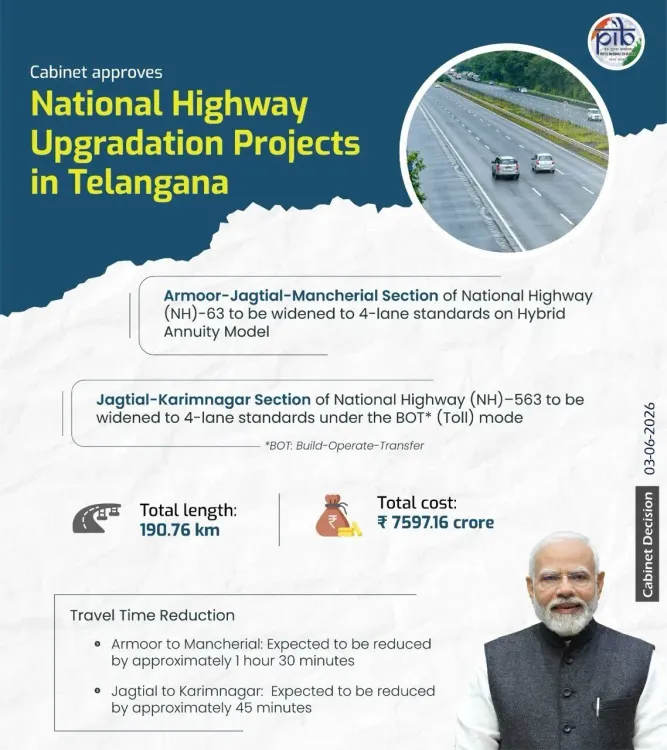
Union Health Minister J. P. Nadda has announced CCEA approval for widening the Armoor–Jagtial–Mancherial stretch of NH-63 and the Jagtial–Karimnagar stretch of NH-563 in Telangana to four lanes. The 190.76 km project, costing Rs 7,597.16 crore, will be built under the Hybrid Annuity Model and BOT mode, with bypasses easing town congestion.
Key Takeaways
CCEA, chaired by PM Narendra Modi, approved four-laning of NH-63 and NH-563 sections in Telangana.
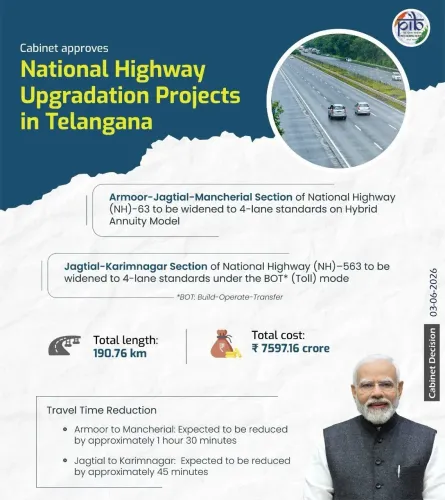
Total project length is approximately 190.76 km with an outlay of Rs 7,597.16 crore.
Execution will use a mix of the Hybrid Annuity Model and Build-Operate-Transfer mode.
Bypasses around urban areas are planned to ease congestion in towns like Jagtial and Karimnagar.
Project targets lower fuel use, reduced emissions and faster freight and passenger movement.
Announcement was made by Union Health Minister J.
Nadda on X on 3 June 2026.
Union Health Minister J. P. Nadda on Wednesday, 3 June 2026, announced that the Cabinet Committee on Economic Affairs (CCEA), chaired by Prime Minister Narendra Modi, has approved the four-laning of the Armoor–Jagtial–Mancherial section of NH-63 and the Jagtial–Karimnagar section of NH-563 in Telangana. The combined corridor spans roughly 190.76 km and carries an outlay of Rs 7,597.16 crore, to be executed under the Hybrid Annuity Model (HAM) and the Build-Operate-Transfer (BOT) mode.
Context
In his post on X, Nadda said the project 'aims to ease traffic congestion in key urban areas through the development of bypasses and modern, high-speed highway infrastructure'. He added that the corridor would deliver 'safe, fast, and seamless connectivity for both passenger and freight traffic while reducing fuel consumption, carbon emissions, and vehicle operating costs'.
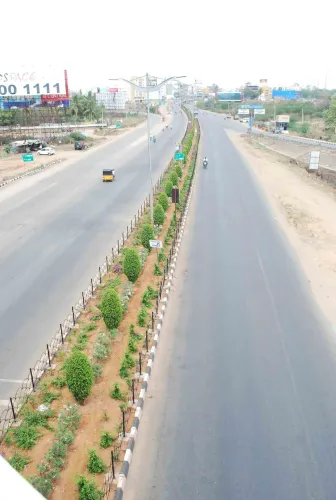
The approval covers two contiguous stretches in northern Telangana that today carry a mix of inter-district passenger traffic and freight movement linked to agricultural produce, granite and cement clusters. Widening to four lanes is expected to compress travel times between Armoor, Jagtial, Karimnagar and Mancherial, while bypasses will divert through-traffic away from congested town centres.
Policy backdrop
The decision sits within the Union government's long-running push to upgrade single and intermediate-lane national highways to four-lane corridors. Bharatmala Pariyojana Phase-I, cleared by the Cabinet in 2017, set targets for upgrading over 34,000 km of highways, with a particular focus on economic corridors, feeder routes and bypasses around urban clusters.
The choice of HAM and BOT reflects a deliberate financing mix. HAM, formally adopted in 2016, was designed to revive stalled public-private partnerships in the road sector by having the government bear a share of construction cost through annuity payments, while the private concessionaire takes on execution and partial traffic risk. BOT, the older toll-based model, transfers more revenue risk to the developer in return for longer concession rights.
Successive CCEA clearances over the past few years have applied this blended approach across states, an attempt to speed up project award while limiting the kind of disputes that dogged earlier pure-BOT toll concessions.
Stakeholders and impact
The most direct beneficiaries are commuters and freight operators on the northern Telangana grid, where two-lane bottlenecks have historically slowed movement between the state's interior districts and the borders with Maharashtra and Andhra Pradesh. Faster, higher-capacity links are expected to lower vehicle operating costs and improve turnaround times for trucking.
Regional businesses — including agri-processing units, mining and quarrying operators, and small manufacturing clusters around Karimnagar and Jagtial — stand to gain from cheaper logistics. Bypasses around towns should also reduce roadside accidents and ease air quality pressure inside urban cores, even as construction phases bring short-term disruption.
State authorities will be central to the rollout: land acquisition, utility shifting and any forest or environmental clearances for the new bypass alignments typically determine whether HAM and BOT projects stay on schedule.
What's next
Attention now shifts to tendering and award timelines by the implementing agency, the structuring of HAM versus BOT packages across the 190.76 km stretch, and the pace of land acquisition in the affected districts. Financial closure by selected concessionaires, and the speed with which appointed dates are issued, will signal whether the project can avoid the delays that have historically plagued multi-package highway works.
For the Union government, the Telangana clearance adds another data point to its claim of sustained capital spending on transport infrastructure — a plank it has consistently pitched as a driver of medium-term growth and regional balance.
Point of View
Bundle bypasses with widening, and use national highway upgrades to anchor regional logistics. That Nadda — the BJP national president, not the roads minister — is amplifying the decision underscores how cabinet infrastructure wins are routinely projected by the party's senior leadership, particularly in states where the BJP is contesting political space. The real test will be the speed of land acquisition and tender award, the chronic choke points in HAM rollouts. If executed on schedule, the corridor will tighten northern Telangana's links with Maharashtra and the Hyderabad freight grid.
NationPress
18 Oct 2026
Frequently Asked Questions
What has the CCEA approved for Telangana highways?
The CCEA has approved widening the Armoor–Jagtial–Mancherial section of NH-63 and the Jagtial–Karimnagar section of NH-563 in Telangana to four-lane standards. The project covers about 190.76 km.
What is the total cost of the Telangana NH-63 and NH-563 widening project?
The total investment approved is Rs 7,597.16 crore. The funds will cover construction, bypasses and associated highway infrastructure.
Under which model will the Telangana highway project be built?
The project will be implemented under a mix of the Hybrid Annuity Model (HAM) and the Build-Operate-Transfer (BOT) mode. HAM blends government annuity payments with private construction, while BOT relies more on toll-based recovery.
Which towns will benefit from the NH-63 and NH-563 widening?
Armoor, Jagtial, Karimnagar and Mancherial are the main towns along the alignment. Bypasses around congested urban stretches are part of the plan to reduce through-traffic in these centres.
How will the project help commuters and freight operators?
Four-laning is expected to deliver faster, safer connectivity for both passenger and freight traffic. It is also projected to lower fuel consumption, carbon emissions and vehicle operating costs.