Pradhan: Cabinet clears Rs 7,597 cr Telangana highway 4-laning
Synopsis
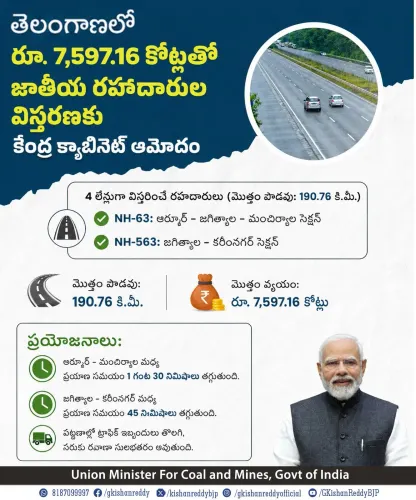
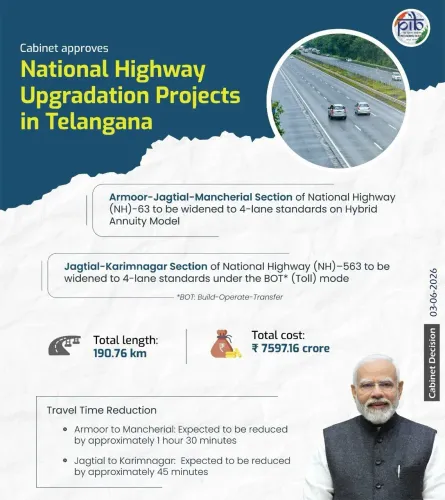
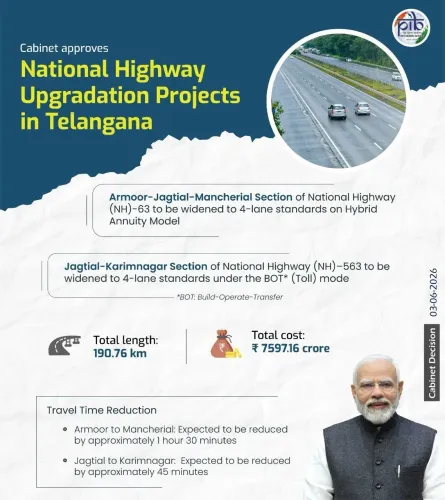
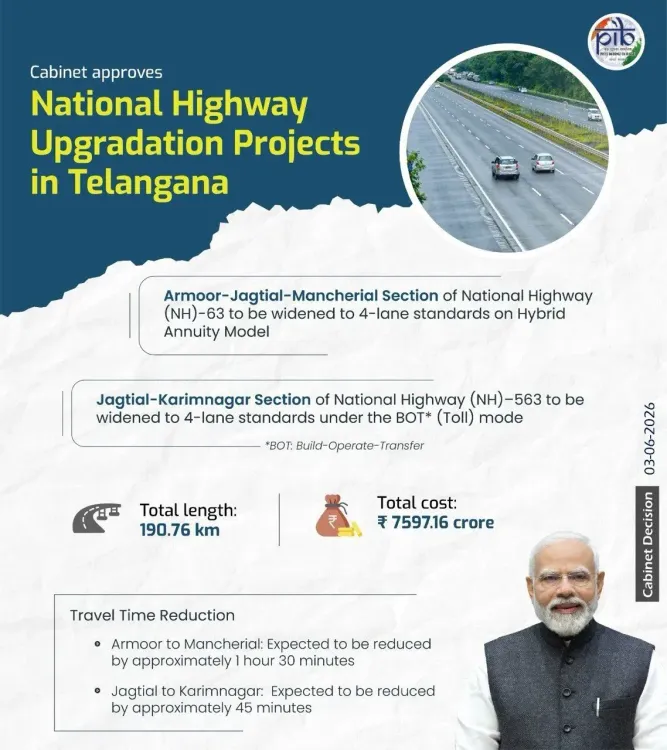
Union Education Minister Dharmendra Pradhan announced that the Cabinet Committee on Economic Affairs has approved four-laning of NH-63 and NH-563 across 190.76 km in Telangana at Rs 7,597.16 crore. Aligned with PM GatiShakti, the project aims to decongest key corridors, cut logistics costs and improve freight and passenger movement in northern Telangana.
Key Takeaways
CCEA, chaired by PM Narendra Modi, approved widening of NH-63 and NH-563 in Telangana to four lanes.
Total length covered is 190.76 km with an investment of Rs 7,597.16 crore.
NH-63 runs Armoor-Jagtial-Mancherial; NH-563 runs Jagtial-Karimnagar.
Project is aligned with the PM GatiShakti National Master Plan launched in 2021.
Expected to cut travel time, fuel use and logistics costs while improving safety.
Announcement made by Union Education Minister Dharmendra Pradhan on 3 June 2026.
Union Education Minister Dharmendra Pradhan on Wednesday, 3 June 2026, announced that the Cabinet Committee on Economic Affairs (CCEA), chaired by Prime Minister Narendra Modi, has cleared the four-laning of NH-63 between Armoor, Jagtial and Mancherial and NH-563 between Jagtial and Karimnagar in Telangana. The combined stretch spans 190.76 km at an outlay of Rs 7,597.16 crore.
In his post on X, Pradhan said the project is 'aligned with PM GatiShakti' and will 'decongest key corridors in Telangana, strengthen logistics efficiency and improve regional connectivity across economic, social and logistics nodes'. He added that it will 'significantly reduce travel time, fuel consumption and operating costs while ensuring safer and faster movement of passengers and freight'.
Context
The two corridors cut through northern Telangana, linking the agrarian and mining belts of Armoor, Jagtial, Karimnagar and Mancherial. These towns sit on freight routes that feed into the wider Hyderabad-Nagpur economic axis and onward to ports on the eastern seaboard.
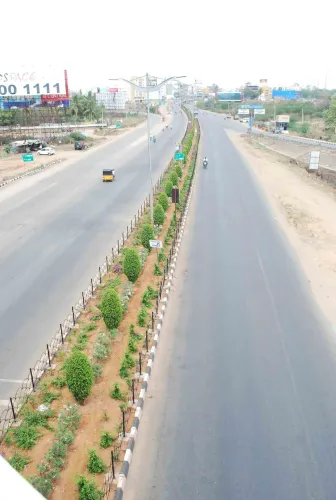
Widening from two lanes to four is expected to ease bottlenecks for trucks carrying coal, granite, paddy and turmeric, all of which move in heavy volumes through this belt. The Cabinet note positions the expenditure as a capital outlay with downstream benefits for logistics-dependent industries.
Policy backdrop
The clearance fits within the PM GatiShakti National Master Plan, launched in October 2021 to synchronise infrastructure planning across central ministries and state governments. GatiShakti uses geospatial mapping to align road, rail, port and utility projects, with the stated aim of cutting India's logistics costs.
The project also extends the highway build-out under Bharatmala Pariyojana, approved in 2017 to develop 83,677 km of highways nationwide. Telangana has been a consistent beneficiary of corridor upgrades under this programme, alongside parallel allocations flagged in the National Infrastructure Pipeline unveiled in 2019.
Stakeholders and impact
Direct beneficiaries include residents of Karimnagar, Jagtial, Armoor and Mancherial districts, who currently navigate congested two-lane stretches that mix local traffic with long-haul freight. Faster, divided carriageways are expected to reduce accident rates on these corridors.
Freight operators stand to gain from shorter turnaround times between Telangana's interior production zones and consumption hubs in Hyderabad, Vijayawada and Nagpur. State traders and agri-aggregators have long flagged road quality as a constraint on perishables and bulk commodities moving out of the region.
The investment will also generate construction-phase employment and is likely to feed land value appreciation along the upgraded alignment, a pattern observed on earlier four-laning projects in southern India.
What's next
Attention now turns to the Ministry of Road Transport and Highways and the National Highways Authority of India, which will issue detailed project reports, finalise alignment, and float construction tenders. Land acquisition timelines and rehabilitation packages for affected landowners will be closely tracked at the district level.
Coordination with the Telangana state government on utility shifting, forest clearances and access roads will determine how quickly groundwork begins. Any supplementary allocations or implementation milestones are expected to surface in subsequent CCEA notes and Union Budget documents.
If executed on schedule, the twin upgrades will tighten the road grid in northern Telangana and reinforce the central government's broader pitch that arterial highway capacity is a precondition for the next leg of manufacturing and agri-export growth in the southern states.
Point of View
With Telangana receiving steady attention under the Bharatmala and GatiShakti frameworks. Routing the announcement through a senior Union minister outside the Road Transport portfolio reflects the BJP's practice of distributing high-visibility infrastructure messaging across its frontline cabinet. The real test, as with earlier approvals, will be land acquisition pace and contractor execution rather than the headline outlay. For Telangana, the upgrade dovetails with a broader push to anchor logistics around Hyderabad's industrial periphery.
NationPress
18 Oct 2026
Frequently Asked Questions
What did the CCEA approve for Telangana highways?
The CCEA approved four-laning of NH-63 (Armoor-Jagtial-Mancherial) and NH-563 (Jagtial-Karimnagar) in Telangana, covering 190.76 km. The sanctioned investment is Rs 7,597.16 crore.
How long is the NH-63 and NH-563 widening project?
The combined length of the two corridors being widened to four lanes is 190.76 km. NH-63 connects Armoor, Jagtial and Mancherial, while NH-563 links Jagtial with Karimnagar.
What is the cost of the Telangana 4-lane highway project?
The approved investment is Rs 7,597.16 crore. The outlay covers upgrading both NH-63 and NH-563 to four-lane standards.
How is the project linked to PM GatiShakti?
The project is aligned with the PM GatiShakti National Master Plan, launched in October 2021 for integrated multimodal infrastructure planning. It aims to decongest corridors and strengthen logistics efficiency in Telangana.
Who announced the Cabinet approval for the Telangana highways?
Union Education Minister Dharmendra Pradhan announced the CCEA decision on X on 3 June 2026. He highlighted gains in travel time, fuel use, safety and freight movement.